Breads of Africa: a thousand ways to break bread together
Injera, kisra, lahoh, chapati, msemen, kesra and Comorian breads: a delicious journey through soft flatbreads, layered dough, fragrant loaves and shared meals.
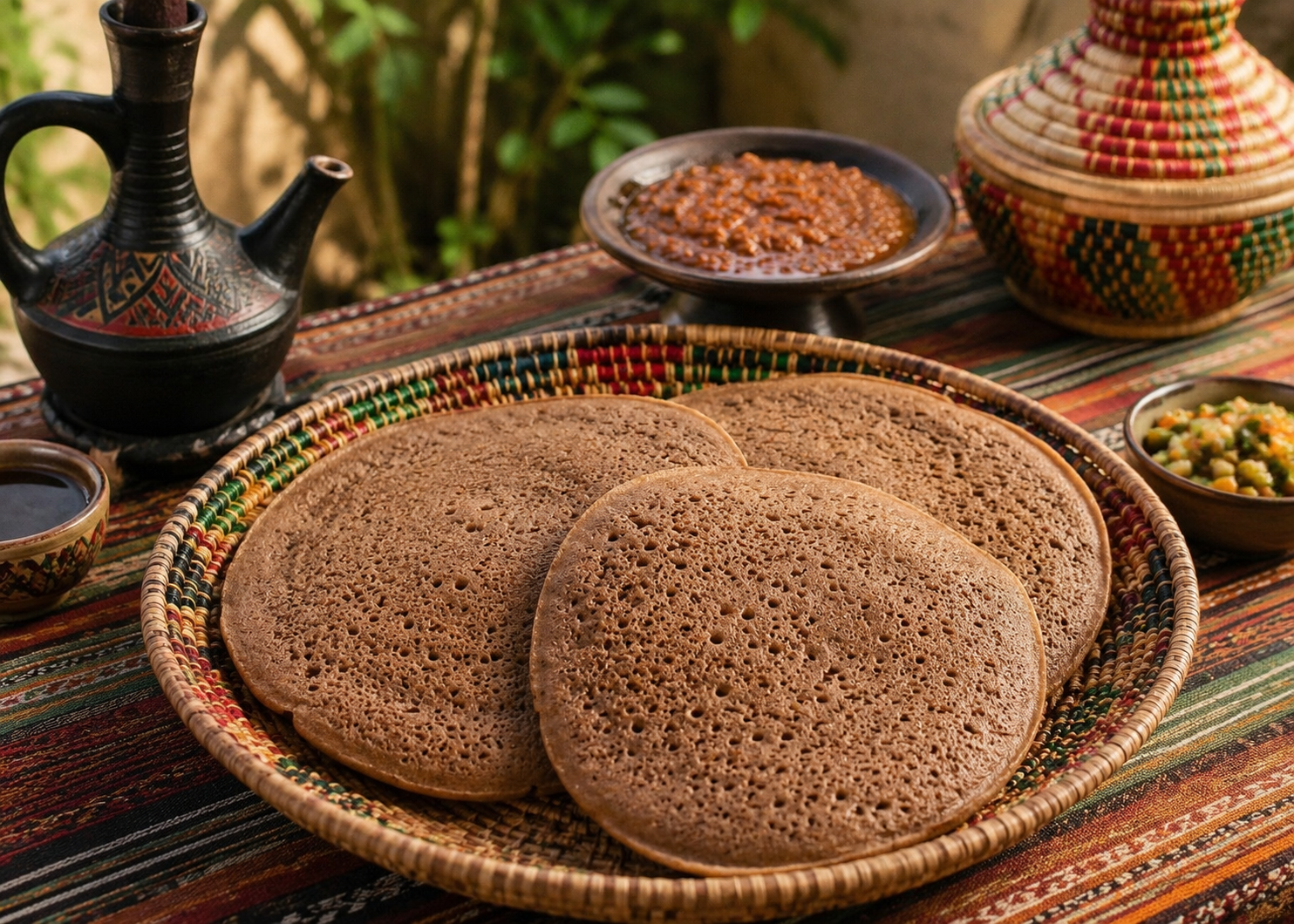
Warm bread arrives in the middle of the table. One hand tears off a piece; another brings the sauce closer. Sometimes there is no knife or individual plate: bread accompanies the meal and helps it pass between people.
Elsewhere, a flatbread folds around beans, layered dough opens into thin sheets, or a round loaf leaves the oven smelling of seeds. African breads have no single flour, shape or way of being eaten. This journey follows RecettesAfricaines.com recipes while allowing each table its own gestures and flavours.
Bread is more than its crust
Bread may first suggest a loaf to slice, yet soft injera, a sheet of kisra and chapati belong in the conversation. Their place in the meal matters as much as their outline.
Bread, flatbread and pancake do not divide neatly into the same categories everywhere. Rather than imposing a final label, we explore dough, cooking and serving.
Begin with the nicest question: what will go with it? Greens, stew, beans or honey already change the way we look at bread.
Flours: the grain sets the tone
Wheat appears often, but teff, sorghum, maize and rice offer other textures. Durum semolina absorbs water differently from fine flour, and wholemeal dough need not behave like white-flour dough.
Names do not reveal everything. “Maize bread” may contain wheat, and injera may combine flours. Check full ingredients and labels for particular dietary needs.
Start with the flour specified, adding water gradually where the method allows. Soft dough is not necessarily failed dough, but it needs the appropriate handling.
Injera: the flatbread that welcomes the meal
Ethiopian injera and Eritrean injera invite attention to tiny openings, flexibility and tang. Teff is central in these recipes, with some blends explicitly offered.
Injera with doro wat shows bread as a partner. A torn piece gathers sauce while the sheet beneath gradually receives the dish’s flavours.
The pleasure is therefore more than bread tasted alone: support becomes a flavoured mouthful. Explore toppings without erasing the bread’s own character.
Kisra: thin sheets meet the sauce
Sudanese kisra foregrounds sorghum. South Sudanese kisra rhaheefa introduces a very thin version in large sheets.
Sudanese meals with mullah, okra sauce and tagalia offer different pairings. South Sudanese kisra with molokhia meets jute mallow leaves; Chadian kisra with okra extends the journey.
Thinness changes the bite: fold, gather and let sauce enter. A supple sheet does not need chapati’s thickness to find its place.
Illustration from the corresponding recipe, already available on RecettesAfricaines.com.
Lahoh and canjeero: breakfast opens a journey
Djiboutian lahoh, Somali canjeero and Djiboutian canjeero or anjero use fluid batters, with flours and methods specified in each recipe.
Lahoh with honey and ghee takes a sweet direction. Lahoh with Djiboutian stew offers another meal of meat, vegetables and sauce.
They may resemble injera without being identical. Our article Injera, lahoh and kisra: how do they differ? explores their characters further.
Fermentation and resting: waiting has different purposes
Resting can relax dough, develop yeast or support a more complex fermentation. These functions are not synonyms. Resting chapati dough does not turn it into injera.
Follow a method appropriate to the ingredients, starter and intended conditions. Tang and bubbles alone do not establish safety. For long fermentations, use a controlled process or dough from a reliable producer.
Time is learned through the intended texture as well as the clock, supported by a precise recipe and people familiar with the product.
Chapati: softness begins before the pan
Kenyan chapati and Ugandan chapati offer starting points. Kneading, resting and shaping prepare the flexibility; cooking finishes it.
Compare Rwanda, Burundi and South Sudan. Ingredients and enrichments differ: no universal rule says every chapati contains egg, milk or a fixed amount of fat.
Chapati madondo with beans offers a simple meal idea. Bread folds, sauce remains suitably thick, and vegetables complete the table.
Illustration from the corresponding recipe, already available on RecettesAfricaines.com.
Sabaayad and msemen: the pleasure of layers
Somali sabaayad and Moroccan msemen draw attention to shaping: stretch, distribute fat and fold or roll as directed. The result begins before the pan.
Our Algerian msemen combines fine semolina and wheat flour. Libyan msemen offers another version. Related gestures do not require identical proportions.
Tear the bread and discover its layers. Honey, butter or savoury accompaniments can suit the chosen preparation without burying the dough.
Illustration from the corresponding recipe, already available on RecettesAfricaines.com.
Kesra, khobz and tabouna: heat shapes the bread
Algerian kesra foregrounds semolina; khobz eddar offers enriched dough with seeds in our version. Libyan khobz follows another construction.
Tunisian tabouna bread also recalls the link between bread and its oven. A domestic adaptation can approach it while acknowledging different equipment rather than promising identical cooking.
The site’s Tunisian chapati is a filled meal with egg, tuna, cheese and harissa. Its name does not promise the same meal as an East African chapati.
Egypt and Sudan: flatbreads, pockets and sauces
Egyptian aish baladi uses wheat flours including wholemeal in our recipe. Puffing and a possible pocket are part of the intended result, with oven and pan methods potentially differing.
Sudanese gurasa with dama’a, with meat and with chicken pair thicker bread with sauce. South Sudanese gurasa with ful brings beans into the conversation.
Look at the full mouthful: thickness and sauce consistency answer each other. More substantial crumb carries a meal differently from a thin kisra sheet.
Illustration from the corresponding recipe, already available on RecettesAfricaines.com.
Kitcha, dabo and himbasha: another rhythm in the Horn
Our Ethiopian kitcha is unleavened flatbread. Eritrean kitcha with honey and kitcha with tesmi offer sweet service or clarified butter and spices.
Ethiopian dabo and himbasha or ambasha turn to risen, enriched dough. Seeds, cardamom and other aromas follow the chosen version.
Slow down to cut, tear and look at the bread’s pattern, letting its crumb reveal its aroma. Not every discovery needs a large sauce.
Comoros: coconut enters the bread
Our mkatra foutra includes coconut milk, grated flesh and cardamom in an enriched version. Comorian coconut bread offers another composition, while mhare wa djungu introduces pumpkin.
“Bread” can lead towards a sweeter, cake-like preparation depending on ingredients. There is no need to force every dough into one category.
Serve a portion with tea or coffee. Our coconut article continues towards sauces and other sweets.
Illustration from the corresponding recipe, already available on RecettesAfricaines.com.
Pot, grill and oven: other ways to form a crust
South African roosterkoek and potbrood offer grilled and pot-baked bread respectively in our recipes. Related base ingredients meet different heat.
Mauritanian traditional bread introduces another meal. Sand bread: an oven adaptation clearly labels its domestic method, rather than improvising cooking in material unsuitable for food.
Further south, Lesotho fresh-maize milk bread changes the crumb. Liberian rice bread, with rice, banana and plantain in our version, takes a fruity direction.
Filled bread: street food enters the kitchen
Senegalese pain ndambé carries cowpeas in sauce. Senegalese omelette bread, Ivorian egg bread and Guinean pain-brochette offer other pairings.
Bread should be flexible enough to bite yet strong enough for its filling. Too much sauce can soak the crumb before the first mouthful.
Offer some fillings separately when entertaining. Guests choose their combinations and the bread retains its texture.
When bread returns to the pot
Eritrean injera fit-fit, Ethiopian firfir, Eritrean fata and fata ful give torn bread a central role. It becomes part of the sauce rather than simply carrying it.
Balance matters: pieces still able to absorb liquid behave differently from saturated dough. Adjust gradually for the recipe’s intended texture.
Properly stored stale bread can start a new dish. Mouldy bread is not an ingredient to rescue in sauce.
A first bread and a meal without rushing
Choose one starting point, perhaps chapati, kesra or a risen loaf. Prepare accompaniments before the last cooking so the cook can sit down too.
Notice flour, resting and thickness. A golden surface can conceal an undercooked centre; the method and dough matter more than colour alone.
Do not taste raw dough: flour is a raw food, with optional eggs adding another reason to wait. [1] Store breads according to their nature; refrigerate perishable fillings and cooked dishes within two hours, keeping the coldest fridge area at 0–4°C. [2]
Then put bread in the middle of the table. Whether it gathers, wraps, accompanies or is simply torn, it has already done part of the work: inviting everyone to eat together.
Sources and further reading
This journey describes versions on RecettesAfricaines.com, not every local or family practice. Linked recipes contain ingredients and methods; illustrations come from the site.
Read also injera, lahoh and kisra, millet, sorghum and fonio, maize, beans and cowpeas and African fritters.