Millet, sorghum and fonio: small grains, generous tables
From thiéré to steamed fonio, thiakry to kalo, tô to kisra and sadza: explore African kitchens where grains, meals and flours become shared meals, skills and memories.
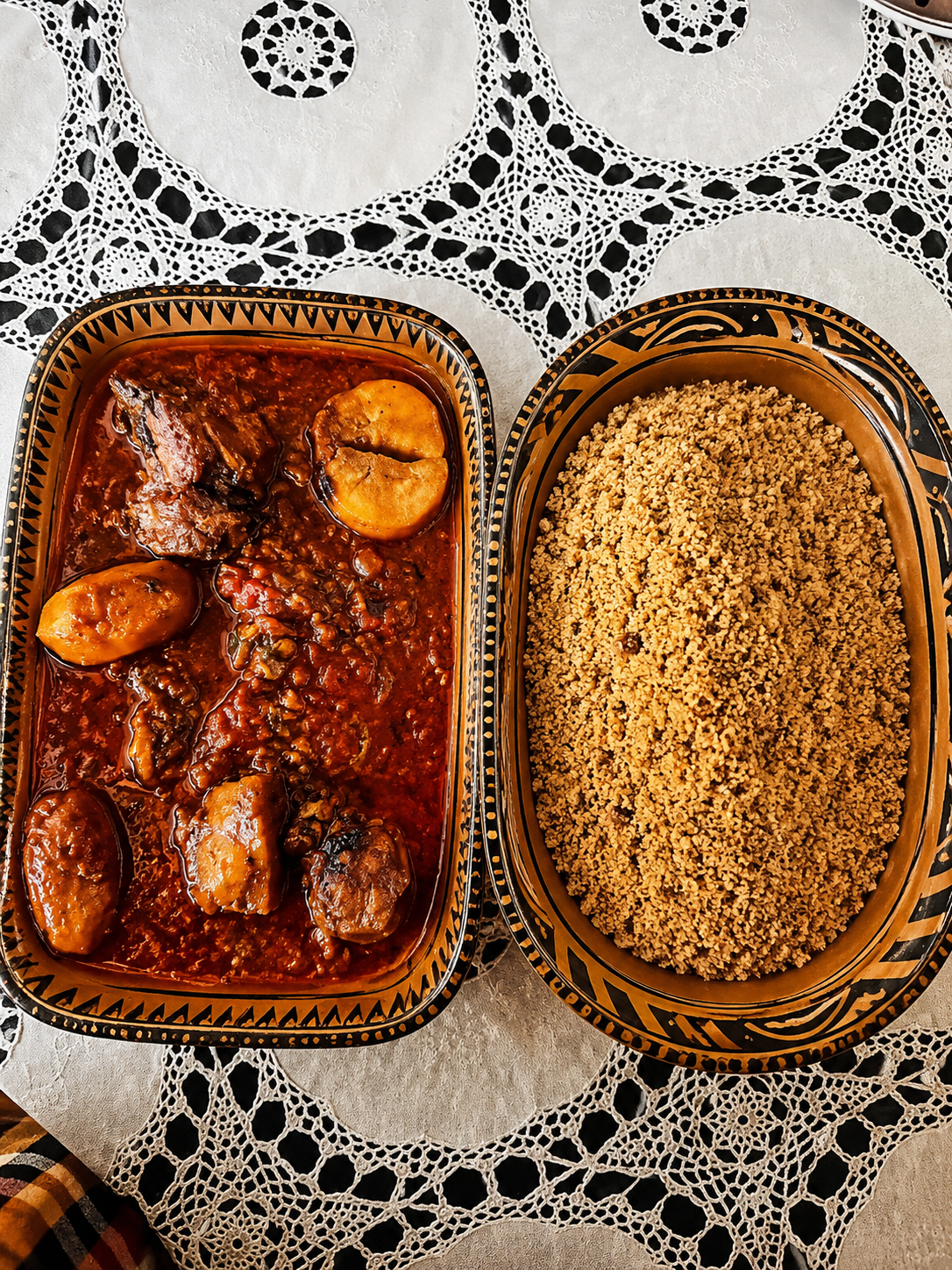
A hand lifts the grains, separates and moistens them, then returns them to the steam. In another kitchen, a spatula works a thick dough in a pot. Elsewhere, a thin flatbread leaves the hotplate to await its sauce. For dessert, millet grains meet cultured milk. Cereals shape skills and meals as well as supplying ingredients.
After groundnuts, cassava, plantain and beans, we follow millet, sorghum and fonio through the website’s major recipe families. Links describe particular versions rather than every household practice, with attention to the actual product and intended texture.
Millet is not a single cereal
Pearl millet is different from finger millet, or Eleusine coracana. Research distinguishes these crops clearly. [2][3] An imprecise translation simply as “millet” can hide an important difference in the kitchen.
Sorghum is another cereal. Its flour varies in fineness and colour; appearance alone cannot predict every variety’s flavour or cooking behaviour.
White fonio, Digitaria exilis, is a West African cereal whose diversity has also been studied. [1] It is neither finely divided wheat semolina nor quinoa. Naming the ingredient accurately is the recipe’s first step.
Grain, broken grain, meal, couscous and flour
Whole grain, broken grain and flour need different cooking times. Rolled grains for couscous or dessert are also different from flour stirred straight into water.
“Precooked”, “dehulled”, “washed”, “fermented” and “ready to rehydrate” change the method. The producer’s previous work matters as much as the cereal’s name. Follow the form specified and the package directions.
Water quantities do not transfer automatically between products. Decide whether you want separated grains, soft porridge, firm dough or thin flatbread before starting.
Thiéré: millet couscous at the meal’s centre
Our Senegalese thiéré bassi serves millet couscous with meat and vegetable sauce. Work on grains and sauce together without letting either disappear into the other.
Vegetable thiéré, chicken thiéré and smoked-fish thiéré show different balances. Smoked fish may already supply salt, chicken needs proper cooking, and vegetables should not collapse while the grains finish.
Our thiéré mboum includes moringa leaves and groundnuts in the sauce. The dish’s name describes a way of building a meal as well as its cereal.
Chere, cheré and Sahelian couscous
Gambian chere mbuum and chere baasi gerteh combine millet couscous with leaves, okra or groundnuts depending on the version. Related tables need not use identical seasonings.
Guinea-Bissau’s cheré and Mauritanian millet couscous extend the journey. Always identify the grain or rolled product: couscous does not invariably mean wheat.
Grain size, steam, fluffing and moisture change the result. Rehydrating an instant product does not exactly reproduce repeated steaming of another type.
Dambou: leaves meet the cereal
Our Nigerien moringa dambou uses precooked millet or sorghum couscous. Sorghum dambou instead starts with dehulled, cracked sorghum, neither whole grain nor flour.
These recipes show why particle size matters. Adding leaves does not require soaking the cereal into a paste, and visible steam does not remove the need to check the grains’ cooking.
Served with suitable cowpeas or other accompaniments, the dish connects with our bean article. Cereal and pulse can retain distinct textures.
Fonio: separate the tiny grains
Our Guinean steamed fonio couscous uses precooked or already washed fonio as specified. Ready-to-use fonio and grain requiring cleaning and sorting do not start from the same point.
Moisten gradually, use equipment suited to the fine grain, and fluff gently. Too much water can turn a light accompaniment into a compact mass. Small grain size is not a reason to improvise ratios.
Malian fonio au gras and Burkinabè fonio au gras integrate it differently with vegetables and meat or fish. Available liquid and the moment the cereal joins the sauce become important.
Illustration from the corresponding recipe already on RecettesAfricaines.com.
Fonio with sauces: a small grain with a role
Our Guinean fonio with okra-groundnut sauce and fonio with mushroom sauce create distinct experiences. Okra’s binding texture, groundnut paste and mushrooms each change how sauce meets grain.
Burkinabè babenda with fonio places leaves within the dish’s structure. Keep the word “version”: not every preparation called babenda necessarily uses fonio.
Senegalese fonio salad starts with cooked, cooled grain rather than raw cereal dressed with lemon. Dressing adds flavour; it replaces neither cooking nor refrigeration.
Lakh, rouye and porridge: the spoon’s pleasures
Our Senegalese lakh pairs millet with a dairy preparation. Rouye uses fine flour for a more homogeneous porridge. Whole grains, small formed pieces and dispersed flour give different sensations.
Guinean fonio porridge with milk and millet porridge with groundnuts open other paths. Milk and groundnuts are not interchangeable finishes: flavour, texture and allergens change.
Mix and dilute as directed, then stir the bottom to prevent lumps and scorching. Porridge often thickens as it stands; adjust at serving without pouring random quantities of cold liquid into the pot.
Thiakry, dégué and chakery: grains for dessert
Malian dégué, Burkinabè dégué and Gambian chakery or thiakry bring millet grains and cultured milk into conversation. Grain size, dairy consistency and flavourings distinguish the recipes.
Our Togolese dégué uses precooked grains sold for rehydration and pasteurised dairy. A rolled, prepared product is not raw flour.
Cool the cereal appropriately before the specified assembly and keep the dessert chilled. Vanilla, nutmeg, raisins or other fruit may enrich a version without burying the millet’s taste or automatically multiplying the sugar.
Illustration from the corresponding recipe already on RecettesAfricaines.com.
Fura da nono: shaping before serving
Our Nigerien fura da nono brings spiced millet balls together with a dairy preparation. Flour, shaping and cooking are part of the result; it is not simply porridge poured into milk.
The cereal becomes a constructed shape, then worked at serving. Ginger and spices can accompany its flavour rather than make it merely a vehicle for sugar.
Use a safe dairy supply and a controlled method. Acidity alone cannot judge fermentation, and a family recipe still requires hygiene and proper storage.
Tô, tuwo dawa and aseeda: firm dough
Burkinabè sorghum tô, Nigerian tuwo dawa and South Sudanese sorghum aseeda build a mouthful around dough and sauce.
Flour, incorporation and spatula work matter. Adding everything at once against the method can leave dry pockets. Conversely, smooth dough alone does not prove complete cooking.
Leaf, okra, groundnut and meat sauces may call for different consistencies. Follow the recipe’s intended firmness rather than a universal model of African dough.
Kalo and ubugali: look behind the name
Our Ugandan kalo allows finger millet, sorghum or a mixture. Kalo with groundnut sauce shows the dough’s role beside a creamy sauce.
Our Burundian ubugali bw’uburo uses millet flour with an optional cassava addition. Mixtures can change suppleness and taste and should be named.
Ugali, ubugali and sadza therefore do not, by themselves, guarantee millet or sorghum. Many versions use other cereals. This article selects recipes by their actual ingredients.
Sadza: compare three flours
Zimbabwe’s sadza rezviyo, sadza remhunga and sadza remapfunde feature finger millet, pearl millet and sorghum respectively in our versions, including their stated mixtures or substitutions.
Finger millet and pearl millet are not identical names. Comparing aroma, colour, absorption and dough texture helps explain the finished meals.
For a tasting, make small amounts with a simple accompaniment. Differences are easier to notice without several strong sauces masking them.
Illustration from the corresponding recipe already on RecettesAfricaines.com.
Bogobe and ting: another expression of sorghum
Our Botswanan bogobe jwa mabele works with sorghum flour. Bogobe jwa ting uses commercially prepared food-grade fermented flour, ready to cook according to its label.
Fermentation is different from adding lemon juice for acidity. The transformed product and method matter in their own right. An identified fermented flour provides concrete instructions to follow.
Do not salvage mouldy flour by calling it fermented, or invent one room-temperature resting period for every batter. Desired flavour does not replace product quality.
Illustration from the corresponding recipe already on RecettesAfricaines.com.
Kisra and flatbreads: spread rather than mould
Sudanese kisra with mullah and South Sudanese kisra rhaheefa shift the work towards spreading a thin layer. Fluidity, the hotplate and the spreading action become decisive.
Our Lesotho sorghum liphaphatha also contain wheat flour: sorghum is not this version’s only flour. The detail matters for texture and for people who must avoid gluten.
Batter fermentation, sourdough and adding baker’s yeast are not identical actions. Follow the chosen method and name adaptations instead of promising the same result.
Illustration from the corresponding recipe already on RecettesAfricaines.com.
Shared skills: hydrate, cook, rest and adjust
For separated grains, measure water and fluff at the appropriate time. For porridge, disperse flour and stir the bottom. For firm dough, incorporate flour as directed and cook properly. For flatbread, watch fluidity and thickness.
Pot, steam, heat and rest all affect the result. Ratios for precooked couscous cannot simply be transferred to raw meal or whole grain.
A dry preparation may need a little hot liquid; a loose one may need further cooking if its ingredients allow it. Adjust gradually. Sugar, oil and spices cannot remove a burnt base.
Choose, store and compose thoughtfully
Enjoy millet, sorghum and fonio for their culinary qualities without turning them into remedies or universal superfoods. Vegetables, pulses, sauces, sugar and added fat all contribute to the meal.
For a strictly gluten-free diet, check the complete product, mixtures and preparation contacts. A dish called “with sorghum” may contain wheat, as our liphaphatha do. Coeliac disease requires rigorous gluten exclusion. [5]
Protect dry products from moisture and follow labels. Cool cooked food promptly in suitable portions and refrigerate within two hours, with the coldest zone at 0–4°C. [4] This includes cooked-grain salads and dairy desserts. Cultured milk does not guarantee safe room-temperature storage.
Three textures to continue the journey
Choose fonio with vegetables or mushrooms, a little sorghum dough with sauce, then a suitable portion of dégué. Another time, explore thiéré, dambou and kisra across several meals.
Notice separated grains, a dough’s resistance, the thinness of bread and the meeting with milk. Daily ingredients become very different experiences through different skills.
Continue with Africa’s rice dishes and beans and cowpeas. Shared kitchens connect tables while keeping each one’s skills and names.
Sources and further reading
Recipe links describe versions on RecettesAfricaines.com; illustrations come from those recipes. The botanical references distinguish cereals rather than demonstrate therapeutic benefits of the dishes.
- Abrouk et al. — Genome sequence and genetic diversity of white fonio, 2021
- Whole genome sequence data on diverse pearl millet accessions across Africa, 2026
- Chromosome-level genome assembly of finger millet (Eleusine coracana), 2025
- Ministère de l’Agriculture — Hygiène en cuisine
- NHS — Coeliac disease: treatment and gluten-free diet