Beans and cowpeas: the little seeds that bring Africa together
From ndambé to waakye, akara to koki, madesu to coconut beans: explore African kitchens where pulses become stews, soups, fritters, steamed cakes and meals to share.
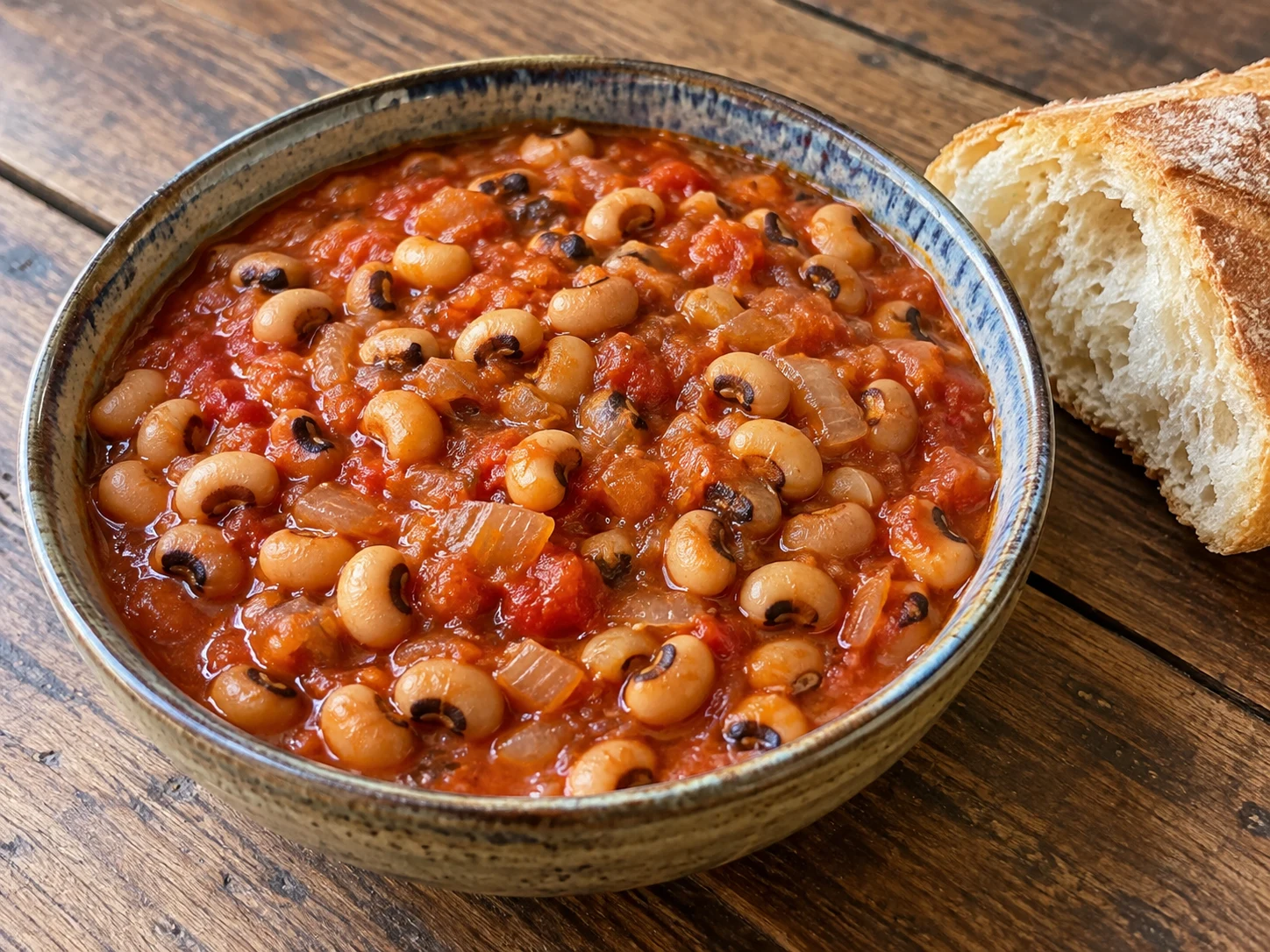
A bread roll opens, ndambé sauce meets the crumb, and the meal begins. Elsewhere, cowpea batter rises in hot oil; in another kitchen, it sets gently over steam. Further on, beans meet maize, rice or coconut milk. Small seeds open remarkably wide culinary paths.
After groundnuts, cassava and plantain, this article follows beans and cowpeas through the website’s major recipe families. The links describe specific versions rather than every practice in a country, tracing the work between a dry seed and a shared meal.
Beans, cowpeas and black-eyed peas
Cowpea is Vigna unguiculata, an African-origin legume with varieties of different colours and characteristics. [1][3] Black-eyed peas are one familiar form, but not every cowpea has that black mark on a pale seed.
Many red, white and black beans belong to Phaseolus vulgaris, an American-origin species deeply established in African cuisines. [2] Colour alone does not always identify the species: check labels and intended uses.
Bambara groundnut, Vigna subterranea, is a different legume again. [8] Lentils, chickpeas and mung beans have their own identities. Here we focus mainly on cowpeas and grain beans, with a look at edible cowpea leaves.
Dry, cooked, dehulled or milled
Dry beans and drained canned beans are not interchangeable at the same weight. Cooking adds water: 300 g dry and 300 g cooked represent different starting amounts. Follow the state specified in the recipe as well as its number.
Dehulled cowpeas have lost their seed coats and suit particular pastes. Coarse meal, flour and moist paste absorb liquid differently. OECD describes the diversity of cowpea preparations, including fried and steamed products. [4]
Before starting, ask which seed, in which form, for which texture. These questions prevent many substitution mistakes.
Ndambé: sauce inside the bread
Senegalese ndambé centres cowpeas in an onion and tomato sauce. Cook the seeds properly, then adjust the reduction to make a spoonable dish or a suitable bread filling.
Our pain ndambé starts with cooked cowpeas, letting the cook concentrate on seasoning and consistency. A loose sauce soaks the crumb; an excessively dry filling loses its softness.
The bread is part of the meal rather than a neutral container. Seed, sauce and crumb work together, with chilli adjusted at the table if desired.
Benga, dambou and cowpea meal: Sahelian paths
Our Burkinabè benga with soumbala combines cowpeas with a fermented condiment. Soumbala contributes its own character; this is different from fermenting the cowpeas during the dish’s preparation.
Nigerien dambou with cowpeas brings millet or sorghum couscous together with cowpeas and leaves in our version. Cereal and pulse retain distinct roles.
Doungouri wassalé changes the starting ingredient: our recipe uses coarse meal from dehulled cowpeas. It is not simply whole beans renamed couscous. Choosing the right milling is as important as seasoning.
Waakye, atassi and ayimolou: rice meets beans
Our Ghanaian waakye pairs rice and cowpeas. Beninese atassi and Togolese ayimolou offer other rice-and-bean combinations using the ingredients specified in each recipe.
Related dishes need not have identical compositions. Seed type, aromatics, garnishes and how the cooking is combined change the meal. Cooked beans require different planning from dry ones.
If cooking components together, account for their different times. Rice should not collapse while beans remain hard; appropriate advance cooking of the pulse may be necessary. Bean safety comes before colour or aroma.
Akara and ata: air in the batter
Nigerian akara, Beninese ata and Nigerien akara introduce cowpea fritters. After the specified seed preparation, grinding and working the batter become decisive.
Fineness, water and aeration influence the fritter’s shape and interior. Too much liquid makes it disperse; an overly dense batter can give a compact centre.
Make regular small portions and fry to cook the middle, not simply brown the surface. An attractive crust does not prove complete cooking. Do not replace cowpeas with raw kidney beans in this batter: their preparation requirements are not interchangeable.
Illustration from the corresponding recipe already on RecettesAfricaines.com.
Moi-moi, ekuru, koki and toubani: the steam route
Nigerian moi-moi or moin-moin and ekuru explore steamed cowpea pastes. Seasoning, additional ingredients and intended texture distinguish the versions.
Our Cameroonian koki puts cowpeas and palm oil in the foreground. Beninese toubani and Nigerien toubani extend this family without implying a single recipe or history.
Wrapping or moulds, fill depth, batter fineness and available steam all matter. Use suitable food-safe leaves or containers and a tested cowpea method. Do not improvise a substitution with another raw pulse. Steam must cook the centre, rather than merely firm the surface.
Illustration from the corresponding recipe already on RecettesAfricaines.com.
Gbegiri and ewa: soup or melting tenderness
Nigerian gbegiri works peeled beans into soup. Unlike a fritter, it seeks flowing liquid, smoothness and a place beside the meal’s other components.
Ewa riro and ewa agoyin offer other textures: beans or cowpeas cooked until soft, with seasonings that give the versions distinct personalities.
Purée, soup and tender whole seeds are different goals, rather than stages of success in one dish. Choose the texture before deciding how much to mash and how much liquid to retain.
Madesu: beans at the heart of the pot
Congo-Brazzaville’s madesu and DR Congo’s madesu show variation within a culinary family. Our first recipe uses white beans; the second includes a red-bean version.
DR Congo’s loso na madesu builds the meal around rice and starts with canned, cooked beans, changing the organisation compared with dry seeds.
Tomato, onion, the chosen oil and optional meat or fish have distinct roles. Whole beans can sit in a sauce thickened with a few crushed seeds without the entire pot becoming purée.
Illustration from the corresponding recipe already on RecettesAfricaines.com.
Beans with leaves
Congo-Brazzaville’s pondu ya madesu brings cassava leaves and beans together. Our Burundian isombe n’ibiharage also uses groundnut paste in another leaf-and-bean preparation.
Each component needs its own treatment. Cooking beans does not replace the appropriate processing of cassava leaves, and groundnuts make neither ingredient safe by themselves. Use correctly processed food-grade leaves with reliable directions.
Our cassava article explains the distinction. The combination is rewarding when the work required for each ingredient is respected.
Burundi, Rwanda and Uganda: everyday beans
Burundian ibiharage and Rwandan ibishyimbo give simmered beans a central place. Aromatics and accompaniments invite varied everyday meals.
Ugandan matooke with beans offers another balance between cooking bananas and pulses. Softness, structure and sauce quantity depend on the complete plate.
This continues our plantain and cooking-banana article: an accompaniment changes how the sauce and beans are eaten.
Maize and beans: githeri, mutakura, samp and cachupa
Kenyan githeri, Zimbabwean mutakura and Zambian samp with beans explore different forms of the maize-and-bean combination.
Dry whole maize, cracked maize and cooked maize behave differently. Plan their cooking to avoid crushing one component while waiting for the other.
Our Cape Verdean cachupa pobre uses cooked maize and beans with several vegetables, allowing attention to focus on building the stew. Shared ingredients do not erase these dishes’ particular names and uses.
Coconut milk: another creaminess
Tanzanian maharagwe ya nazi, Mozambican feijão com coco and Comorian coconut maharage bring beans, coconut milk and aromatics together in our versions.
Coconut contributes a different flavour and body from groundnut paste. It is not a neutral substitute. Adjust liquid to the beans’ existing cooking and the intended thickness.
The aim is not to cover the seed with anonymous cream: its flavour and texture still matter. Rice or another accompaniment then organises the mouthful.
Illustration from the corresponding recipe already on RecettesAfricaines.com.
Loubia, feijoada and filled bread
Moroccan loubia and Algerian loubia highlight white beans in our versions, with their own seasoning, liquid and serving choices.
Cape Verdean feijoada and Mozambican feijoada build other pots with meat in our recipes. Angolan feijão de óleo de palma highlights the chosen oil and accompanying ingredients.
South African bean bunny chow places a bean curry inside hollowed bread. As with pain ndambé, sauce quantity affects structure. A comparable serving idea does not make the dishes identical.
Illustration from the corresponding recipe already on RecettesAfricaines.com.
Salad: cooked seeds served fresh
Senegalese cowpea salad starts with fully cooked, cooled and drained cowpeas, alongside tomato, cucumber, onion and lemon. Fresh dressing does not mean a raw pulse.
Mix gently to preserve the seeds and adjust dressing to their moisture. A suitable canned product can simplify preparation; drain and rinse as appropriate.
Use clean hands, utensils and vegetables and keep the salad chilled. Lemon seasons it; it replaces neither cooking nor refrigeration.
Cowpeas offer leaves as well as seeds
Kenyan kunde uses young cowpea leaves sold for food. Our Zimbabwean dried cowpea leaves with dovi combines dried leaves and groundnuts. The World Vegetable Center documents cowpea leaves as food. [10]
This is a different plant part and method, rather than merely a different bean colour. Identify food-grade leaves, follow preparation directions and adapt rehydration to the product.
It does not mean that every legume leaf can be gathered and cooked in the same way.
Basic skills: sort, hydrate, cook and adjust
Sort the seeds, remove foreign matter and rinse. Follow soaking and cooking directions appropriate to the product. Variety, size, age and equipment can change the time needed.
Separate cooking the seed from finishing the sauce when the dish calls for it. Fully cooked beans can then meet tomato, aromatics and fat without a sauce simmering indefinitely around hard seeds.
Add small amounts of hot liquid when needed. If crushing some beans to thicken, do it intentionally: a creamy sauce does not require breaking down the entire pot.
Safety: soaking alone is not enough
Raw or undercooked pulses may contain active lectins. Dry kidney beans require particular attention. EFSA’s 2026 advice emphasises proper soaking, changing water, genuine boiling and cooking until tender. [5]
For the relevant dry seeds, its guidance specifies soaking for 6–12 hours, then boiling at 100°C for at least 30 minutes, with time adapted to the variety and continued until tender. [5] Do not taste undercooked beans to check their flavour.
Health Canada advises against cooking dry kidney beans directly in a low-temperature slow cooker. Canned cooked beans have undergone different processing and are not handled like dry ones. [6] Follow product and appliance instructions. These precautions do not authorise substituting any raw bean for cowpea in fritters or steamed pastes.
A nourishing plate, careful storage
Pulses contribute protein and fibre, as FAO explains. [9] Dry weight is not directly comparable with cooked weight, and the dish’s composition also depends on oil, salt, garnishes and portion size.
Combine cereals or other starches, vegetables and pulses to suit the meal. Stock cubes, dried fish and cured meats can add substantial salt; taste the cooked dish before adding more.
Cool promptly in suitable portions and refrigerate within two hours, with the coldest zone at 0–4°C. [7] A large pot should not sit cooling overnight on a switched-off stove. Follow product storage directions and avoid unnecessary handling.
Small seeds, many ways to share
Choose three textures for a tasting: cowpea salad, koki or a few akara, then a small serving of beans with rice or maize. Spread the experience across several meals if preferred.
Notice skins, paste fineness, a steamed interior, a fritter’s crust and how a seed holds sauce. Beans become much more than an accompaniment.
Shared kitchens follow that thread: grinding, cooking, seasoning and feeding people together while keeping each dish’s name and place.
Sources and further reading
Links describe versions on RecettesAfricaines.com rather than every household or regional practice. Illustrations come from the corresponding recipes. The following references support plant identification, culinary processing and preparation advice.
- Royal Botanic Gardens, Kew — Vigna unguiculata
- Royal Botanic Gardens, Kew — Phaseolus vulgaris
- IITA — Cowpea
- OCDE — Cowpea: culinary uses and processing
- EFSA — Haricots secs et lectines : préparation adéquate
- Santé Canada — Les lectines dans les légumineuses sèches
- Ministère de l’Agriculture — Hygiène en cuisine
- Royal Botanic Gardens, Kew — Vigna subterranea
- FAO — Nature’s nutritious seeds: pulses
- World Vegetable Center — Growing cowpea and its edible leaves