Cassava: a thousand ways to gather around the table
From attiéké to chikwangue, gari to placali, pondu to ravitoto: explore African kitchens where cassava roots and leaves become distinctive textures, skilled preparations and meals to share.
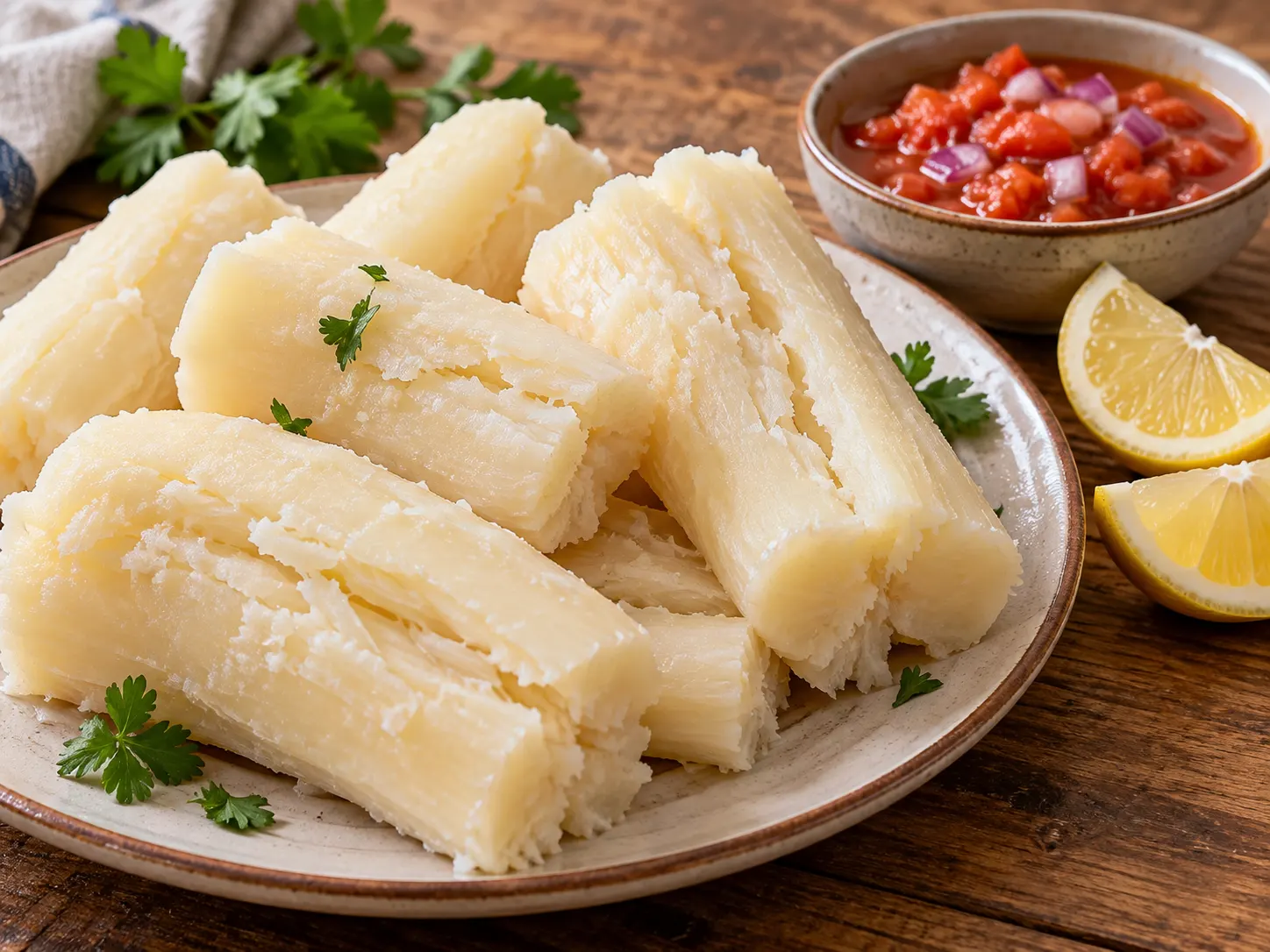
On an Ivorian table, cassava becomes light grains beside grilled fish. In Cameroon, it arrives as sticks wrapped in leaves. In the Congos, pounded leaves become pondu; in Madagascar, they meet pork in ravitoto. In Benin, a bowl of gari can take a sweeter turn.
Cassava connects these tables without making them taste alike. Roots, leaves, flour, granules, fermented dough and starch each need their own handling. This journey follows major culinary families through specific recipes on our website. Those versions invite discovery; they do not define every household’s tradition.
A travelling plant, deeply rooted knowledge
Cassava, Manihot esculenta, is a shrub grown for its storage roots and, after appropriate processing, its leaves. Its origin is South American. [1] Atlantic connections brought it to Africa in the early modern period, followed by extensive agricultural and culinary adaptation. [2]
A plant’s arrival cannot date every dish made with it. Generations of cooks and processors have selected, grated, pressed, fermented, dried, pounded and cooked it. Their work belongs at the heart of the story.
Cassava is often called a side dish, yet the grain of attiéké or elasticity of a dough determines how sauce is lifted and a mouthful is built. The starch helps shape the whole meal.
One plant, several ingredients
A fresh root is not flour. Edible cassava flour comes from dried material that is milled; fermentation and other processing affect its properties. [9] Extracted, purified starch is another product and cannot automatically replace flour in a dough.
Gari is a granular processed product, generally fermented, pressed and toasted. Attiéké is fermented cassava formed into grains and steamed. FAO describes these distinct processing chains. [4] Moist akpu dough and dry gari therefore need different treatment.
Food-grade tapioca pearls offer another form, including desserts on this site. Commercial names vary: read the ingredients and directions rather than assuming that “cassava”, “tapioca” and “flour” guarantee the same behaviour.
The precaution behind every preparation
Cassava roots and leaves contain cyanogenic compounds that can release cyanide. Levels vary, and leaves can contain substantial amounts. Ordinary cooking alone is not a universal guarantee of adequate reduction. [5][6]
Never eat cassava raw or taste a root to judge its safety. “Sweet”, “frozen”, “pounded” and “fermented” do not, by themselves, mean ready to eat. Buy from a reliable supply chain and establish what processing has already taken place.
This article describes dishes, not a home detoxification protocol. For complex preparations, choose properly processed food-grade dough, flour or leaves and follow the producer’s instructions. A general recipe cannot replace those directions. Do not use a product whose suitability is uncertain.
Attiéké: small grains, living heritage
Our attiéké is an inviting starting point. Its grains should separate pleasantly and remain moist enough for the meal without turning into a compact mass. Rehydrating a dry product and reheating fresh attiéké are different tasks.
UNESCO inscribed the skills related to attiéké production in Côte d’Ivoire in 2024. The recognition concerns knowledge and its transmission, including women producers’ work, rather than the finished plate alone. [3]
Compare attiéké with grilled fish, with fried fish, with grilled chicken and with tuna. Juices, sauces and fresh vegetables change the balance while the grains retain their own role.
Illustration from the corresponding recipe already on RecettesAfricaines.com.
Akyeke and gari: related does not mean identical
Akyeke from western Ghana extends the exploration of fermented granular preparations. Name it on its own terms; one recipe cannot represent every practice in a country.
Gari is generally drier and shaped by its processing. It can become a topping, a dough or a hydrated dish. Check that your product is suitable for the intended use, especially if it will be eaten without further cooking.
Our Ghanaian gari foto and Togolese gari foto bring together gari, tomato, onion and egg. Togolese gari pinon offers another arrangement. Add liquid gradually: too much can erase the grain and produce an unintended paste.
Gari as piron, eba or a sweet bowl
Beninese piron de gari and Liberian eba show how a granular ingredient becomes dough for sauces. Water temperature, grain size and hydration affect firmness. Separated attiéké-like grains are no longer the aim.
Ghanaian gobe and Beninese beans with gari bring it alongside legumes, contrasting soft beans with the grain’s texture.
Beninese soaked gari takes a sweeter direction, with milk and groundnuts in our version. Use potable water and gari ready for this use. A cold bowl is never a way to make unidentified raw flour safe.
Foutou, placali and akpu: working the dough
Ivorian cassava foutou highlights prepared, pounded root. Our placali uses a fermented cassava base whose acidity and texture interact with the sauce. It is not simply foutou under another name.
Placali with kopè sauce and placali with palm-nut sauce show that relationship. A very firm or very loose dough picks up sauce differently.
In Nigeria, akpu uses fermented, sieved cassava dough, while lafun in our recipe uses dried fermented cassava flour. Their hydration and cooking stages differ; a single set of instructions cannot serve both.
Illustration from the corresponding recipe already on RecettesAfricaines.com.
Fufu and foufou: ask what it is made from
Fufu and foufou do not identify one fixed ingredient everywhere. Depending on place and practice, preparations can involve cassava, yam, plantain, maize or mixtures. Read the ingredient list before treating any fufu as a cassava dish.
Our Liberian fufu and geebee or GB introduce contrasting textures; Ghanaian kokonte works with dried cassava flour. Cameroon’s water fufu and eru pairs cassava dough with a dish containing eru leaves, which come from a different plant.
Not every pale dough is cassava, and not every green sauce served beside cassava is made from its leaves.
Bobolo, miondo and chikwangue: food in a wrapper
Cameroonian bobolo and miondo use processed cassava dough wrapped for cooking. The shaping, packet size and cooking method influence the result; the leaf is part of the process.
Chikwangue from Congo-Brazzaville and chikwangue from DR Congo accompany sauces. Our Angolan chikwanga starts with prepared, detoxified food-grade dough supplied with cooking directions.
Equatorial Guinean cassava sticks with fish builds another meal around this family. At home, a reliable prepared dough is preferable to improvising fermentation with unfamiliar roots. The final wrapping does not replace the processing that comes before it.
Illustration from the corresponding recipe already on RecettesAfricaines.com.
Roots in pieces: boiled, dressed and crisped
Liberian boiled cassava, Rwandan imyumbati and Central African cassava with sesame keep the root in pieces, ready to meet fish, sauce or another accompaniment.
Liberian fried cassava seeks a golden surface and tender centre. Frying is not a guaranteed detoxification step: start with a suitable, correctly prepared ingredient. Colour alone says nothing about safety.
Serve sauces separately and season thoughtfully. Cassava has enough character to remain visible beside oil, chilli and garnishes.
Pondu and saka-saka: leaves at the centre
DR Congo’s pondu or saka-saka opens the pounded-leaf family. Our Congo-Brazzaville versions with smoked fish, groundnuts and beans, pondu ya madesu, build different dishes around the same part of the plant.
Leaf preparation, liquid and the way the pot is managed affect texture. Smoked fish, groundnut paste and palm oil have distinct roles: aroma, binding and fat are not interchangeable.
Pounded food-grade leaves are not necessarily precooked. Check the label and complete the required preparation; do not treat them as spinach that needs only a quick wilt.
Illustration from the corresponding recipe already on RecettesAfricaines.com.
Isombe: Rwanda and Burundi
Rwandan isombe and Burundian isombe n’ubunyobwa bring leaves and groundnuts together in our versions. Other households make other choices; a single recipe does not fix the whole tradition.
Vegetarian Rwandan isombe and isombe n’ibiharage with beans show leaves carrying a meal without meat. Choose the legumes, sauce and starch as a coherent combination.
An accompaniment called ubugali or ubugari is not automatically cassava: flours vary. Identify the leaves, the dough and any binder separately.
Guinea, Sierra Leone and Liberia
Guinean cassava leaves, Sierra Leonean cassava leaves and Liberian cassava leaf stew take us west. Meat, smoked fish, groundnuts and dried shrimp appear in different combinations in our recipes.
The words cassava leaf name an ingredient, not a single composition. Finely pounded leaves, sauce density and the choice of protein give each pot its character.
Rice distributes the sauce differently from a firm dough. Compare the complete meals as well as the stews themselves.
Matapa and ravitoto: Indian Ocean perspectives
Our Mozambican matapa brings leaves together with groundnuts, coconut and seafood. The shrimp version and vegetarian version show different balances while retaining the leaves’ place.
In Madagascar, henakisoa sy ravitoto pairs pounded leaves with pork, an association also described by Madagascar’s embassy. [7] The site’s fish ravitoto offers another household version.
Groundnuts, coconut and pork are not requirements for every cassava cuisine. Their particular uses make the journey interesting. A shared pounding technique does not erase differences in flavour or history.
Illustration from the corresponding recipe already on RecettesAfricaines.com.
Kondowole, ugali wa muhogo and nshima
Malawian kondowole with fish, Tanzanian ugali wa muhogo and Zambian cassava nshima extend the family of cooked doughs made with suitable food-grade flour.
Water temperature, the specified incorporation method and vigorous work with a spatula help establish the texture. Do not transfer ratios blindly between flours: fineness, moisture and processing alter absorption.
These doughs are neither interchangeable placali nor mashed potatoes. Aim for a consistency that suits the fish, beans or vegetables served alongside.
Fritters, balls and tapioca desserts
Our Burundian cassava fritters and Sierra Leonean cassava balls use prepared, cooked cassava. Shaping, binding and browning create a new texture; none replaces safe preparation of the starting ingredient.
Beninese tapioca with milk and Togolese tapioca zogbon use food-grade pearls. Their cooking produces a different result from thickening a liquid with flour. Follow the pearl type and package directions.
Check the full ingredients for anyone with dietary restrictions: a cassava fritter may contain wheat, and tapioca dessert may contain milk. The main ingredient’s name does not list every allergen.
Buying, keeping and balancing the meal
Choose a clearly identified product suited to the task. Keep dry flour and gari away from moisture, and follow storage instructions for fresh dough, leaves and frozen products. Unusual smells or mould are not signs of successful fermentation to salvage.
Manufacturing fermentation does not make a moist product indefinitely stable. Cool cooked food promptly in suitable portions and refrigerate within two hours; maintain the coldest refrigerator zone at 0–4°C. [8] Observe the storage life indicated for each product.
Roots mainly supply starch; leaves have a different nutritional profile. [6] Think also about vegetables, legumes, fish, eggs or meat according to your habits. Cassava alone does not automatically make a complete meal.
Three ways into a shared table
For a manageable tasting, choose attiéké with fish or beans, a leaf dish with rice, and a small tapioca dessert. Another day, explore firm dough and sauce, or cassava sticks bought from a reliable producer.
Notice the grains, acidity, elasticity, leaf aromas and how sauce clings. Cassava becomes a lesson in texture and skill as well as a meal.
Sharing a cuisine means passing on accurate ingredient names, the work that makes them edible and the ways people enjoy them together.
Sources and further reading
Recipe links describe the versions on RecettesAfricaines.com rather than every family tradition. Illustrations come from those recipes. Continue with From mafé to ndolé: sharing Africa’s groundnut pastes to explore the connections between seed sauces and leaf dishes.
For a closer look at processing, read From cassava to attiéké, gari and fufu: what does processing change?.
- Kew — Manihot esculenta
- FAO — Save and Grow: Cassava
- UNESCO — Les savoir-faire liés à la production de l’attiéké en Côte d’Ivoire
- FAO — Processing of Roots and Tubers
- Food Standards Australia New Zealand — Cassava
- EFSA — Cyanogenic glycosides in foods, 2019
- Ambassade de Madagascar — Repas et boissons
- Ministère de l’Agriculture — Hygiène en cuisine
- FAO AGROVOC — Farine de manioc