Pondu / Saka-saka
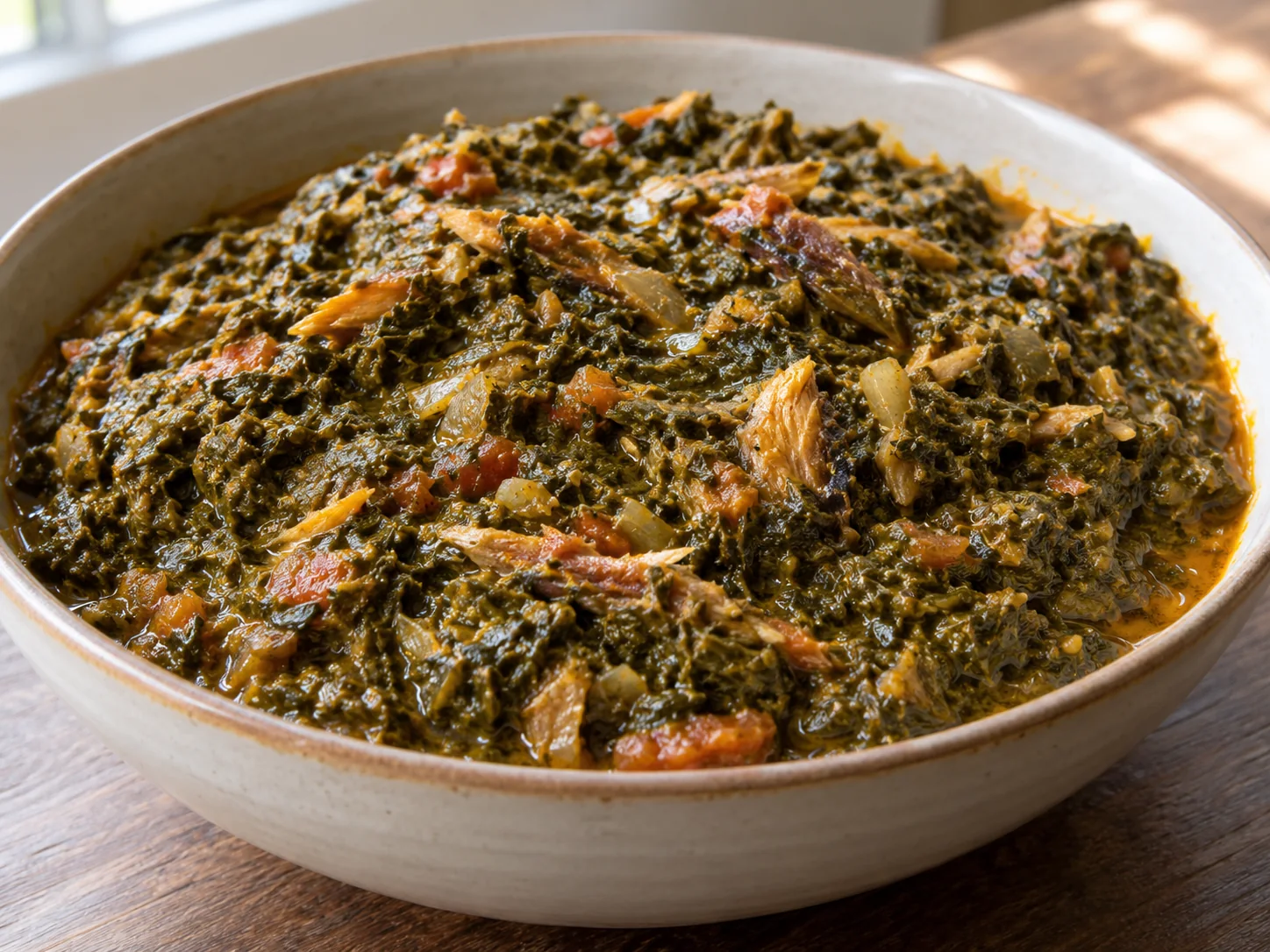
Fully cooked cassava leaves simmered with smoked fish, peanut paste, tomato and palm oil. This home adaptation starts with a ready-to-eat food product.
Ingredients
- 1 kg finely chopped food-grade cassava leaves sold fully cooked and ready to eat; drained weight, thawed in the refrigerator if necessary
- 300 g ready-to-eat food-grade smoked fish flesh, tough skin and bones removed; check storage and manufacturer’s instructions
- 180 g pure unsweetened peanut paste with no added salt
- 200 g chopped onion
- 250 g crushed tomato
- 3 garlic cloves, about 12 g, chopped
- 45 ml food-grade red palm oil, or 3 tablespoons
- 400 ml hot drinking water initially; reserve a separate 200 ml for adjustments
- 1 small whole chilli, optional
- 0–2 g salt after tasting the thoroughly heated dish, depending on fish and leaves
Preparation
Weigh the prepared, drained leaves and keep refrigerated until needed. Wash and cut vegetables. Heat the initial water and keep the reserve separate to avoid adding too much at once.
Warm palm oil over medium heat without smoking. Soften onion for about 7 minutes, stirring. Add garlic for 1 minute, then tomato. Cook down for 8 minutes until less watery.
Add the fully cooked leaves and 250 ml measured hot water. Break up clumps and stir to the base. Bring to a simmer, lower heat and cook partly covered for 10 minutes, stirring several times.
Thin peanut paste with the remaining 150 ml hot water. Start with a little to make a smooth cream, then add the rest. Stir into the leaves; a thick lump would be harder to distribute.
Add flaked fish and optional whole chilli. Simmer gently for 15 minutes without vigorous boiling. Scrape the bottom regularly as peanuts thicken and may catch. Add one or two tablespoons reserve water if drying before thoroughly hot.
Check the whole mixture is steaming hot through the centre; a measured reheating target is 74°C. Follow any more specific package reheating instructions. This reheats already safe ingredients; it does not process raw cassava leaves.
Taste only when thoroughly heated. Add salt in small pinches, up to 2 g if necessary. Remove whole chilli to limit its flavour spreading. Adjust to a thick but moist sauce, then rest covered off the heat for 5 minutes.
Serve six portions with a separately prepared accompaniment. Offer chilli separately and warn that small bones might remain. Do not leave the pan cooling on the table throughout a long meal.
Introduction
This pondu combines finely chopped cassava leaves, smoked fish and peanut paste in a thick sauce. The leaves must be sold as fully cooked and ready to eat: the timing here assembles and reheats the dish rather than making raw leaves safe. Aim for a soft, moist mixture that can be spooned easily, without a large pool of separate water.
“Frozen” or “chopped” does not mean “fully cooked.” Read the product name and instructions before buying. Leaves requiring processing, raw leaves or a product with unclear status are unsuitable for this method. Do not simply apply our simmering time to them. This recipe provides no improvised cassava-detoxification procedure.
Congolese cook Gisèle documents a family pondu with peanuts and sardines. Her account supports that combination and family diversity; ours uses smoked fish, fully prepared leaves and less oil. These are declared home-cooking adaptations, not an exact reproduction of her process. No beans are included, distinguishing this from the catalogue’s pondu ya madesu.
Cultural context
Pondu, saka-saka and sombe refer to cassava-leaf uses in Congo-basin cuisines, with linguistic and preparation differences. One tomato-peanut-fish combination should not be treated as every DR Congolese household’s formula. Gisèle’s account records a cook’s family memories, not an exhaustive provincial inventory.
This version retains leaves, peanuts and fish but moves leaf processing upstream through a fully cooked commercial product. It does not erase the work of processing: an identified commercial supply chain performs it. Keep this choice explicit in the description and ingredients so reheating is not confused with traditional fresh-leaf preparation.
Tips
“Frozen” alone does not establish prior full cooking.
Thin peanut paste before adding to distribute its texture.
Smoked fish may supply enough salt: taste after reheating before adjusting.
Stir down to the bottom to prevent catching.
Remove bones during flaking and check again at serving.
Keep adjustment water separate to retain a thick sauce.
Planning
Check both prepared products: the leaves must be edible without further processing and the fish must also be sold ready to eat. Smoked fish requiring special cooking cannot be substituted without revising the method. Reject damaged packaging, known cold-chain failures or expired food.
Prepare a heavy four-litre pan, paddle, small ladle and bowl for thinning the peanut paste. Flake fish by hand on a clean plate to find bones, then wash hands. Check portions again when serving: flaking does not guarantee every small bone has been removed. Allergens: fish and peanuts.
Serving
Serve hot and soft enough to moisten the accompaniment. Stir gently before portioning so fish is evenly shared. Use a clean serving spoon. Check a child’s portion again for bones and provide a small serving without chilli.
Storage
Divide leftovers into shallow containers and refrigerate within two hours. Keep at 4°C or below and preferably use within 48 hours. Reheat only the needed quantity to 74°C at the centre, adding water if thickened. Do not mix old leftovers into a fresh batch or judge uncertain storage by smell alone.
Variations
Omitting fish changes nutritional composition; label it a variation. To replace paste with ground peanuts, choose a suitable food-grade product and check fineness and cooking time. Never replace cassava leaves with casually identified or foraged plants. Spinach or other leaves produce a different adaptation rather than an exact pondu.
Accompaniments
Serve with fufu, plain rice, chikwangue reheated according to its label or cooked plantain. Fish is already in the sauce, so a second meat is not necessary. Diners choose starch portions; these are excluded from pondu ingredients.
Nutrition notes
Fish supplies protein; peanuts supply fats and plant protein. Leaf micronutrients depend on the product and processing. Salt differs greatly between smoked fish and prepared leaves. Without labels and actual yield, previous numeric figures cannot be confirmed. No therapeutic claim is made; calculations should use purchased products and exclude separately calculated sides.
Conclusion
Start with fully cooked leaves and ready-to-eat fish, then gently bind with peanut paste. Steady heat, careful bone removal and gradual water additions produce a pondu consistent with the stated method. Serve hot without presenting this simmering as raw-leaf processing.
Enjoy your meal
Enjoy your meal!