From mafé to ndolé: sharing Africa’s groundnut pastes
Mafé, tigadèguèna, domoda, ndolé, fumbwa, nkono owono, binyebwa, matapa and dovi: a journey through African kitchens where groundnuts become sauces, soups, leafy dishes and pastes steamed in leaf parcels.
A spoon sinks into the jar, lifts a dense paste and deposits it in a bowl. A few ladles of stock and patient stirring loosen the groundnut into cream before it joins the pot. In Senegal, this gesture may announce mafé. In Cameroon, preparing skinned groundnuts accompanies ndolé. In the Congos, paste flavours fumbwa or certain versions of pondu. In Gabon, it can set inside a leaf parcel.
The ingredient seems familiar, yet its uses are remarkably varied. This feature follows the main recipe families from West and Central Africa to the Great Lakes and Southern Africa, reaching Sudanese preparations too. The connecting thread is processed groundnut, not one universal recipe. Links lead to specific versions on the site: each household and region retains its choices of leaves, texture, fish, meat and accompaniment.
A seed from elsewhere, profoundly African cooking traditions
Groundnut, Arachis hypogaea, is a legume whose seeds develop inside underground pods. Its origin is South American. [1] That botanical origin does not diminish the depth of African knowledge built around growing, processing and cooking it.
A plant’s history and a dish’s history do not overlap exactly. Agricultural diffusion cannot by itself date mafé, ndolé or a family sauce. Rather than inventing one ancestor, look at the skills: shelling, skinning, roasting or cooking, pounding, thinning, simmering and sharing.
Groundnuts provide flavour, body and a way to connect broth with the other ingredients. The same ingredient becomes a coating sauce, flowing soup, binder for leaves or a mixture firm enough to slice after cooking.
Paste, butter and flour: choosing the right product
Unsweetened 100% groundnut paste is a convenient base for many sauces. “Butter” does not necessarily mean dairy butter is present: read the ingredient list. Sweetened or heavily salted products change the dish; crunchy paste leaves more pieces.
Roasting changes aroma and colour. Deeply roasted nuts taste different from raw skinned nuts prepared according to a recipe. For ndolé especially, replacing the specified ingredient with industrial roasted peanut butter without considering the difference can significantly change the intended result.
Flour or powder is not always equivalent to paste: it may vary in fineness and fat content. Quantities therefore cannot automatically be converted gram for gram. Groundnut oil is a fat; alone it does not provide the body of a groundnut-paste sauce.
Mafé and tigadèguèna: the pot that brings people together
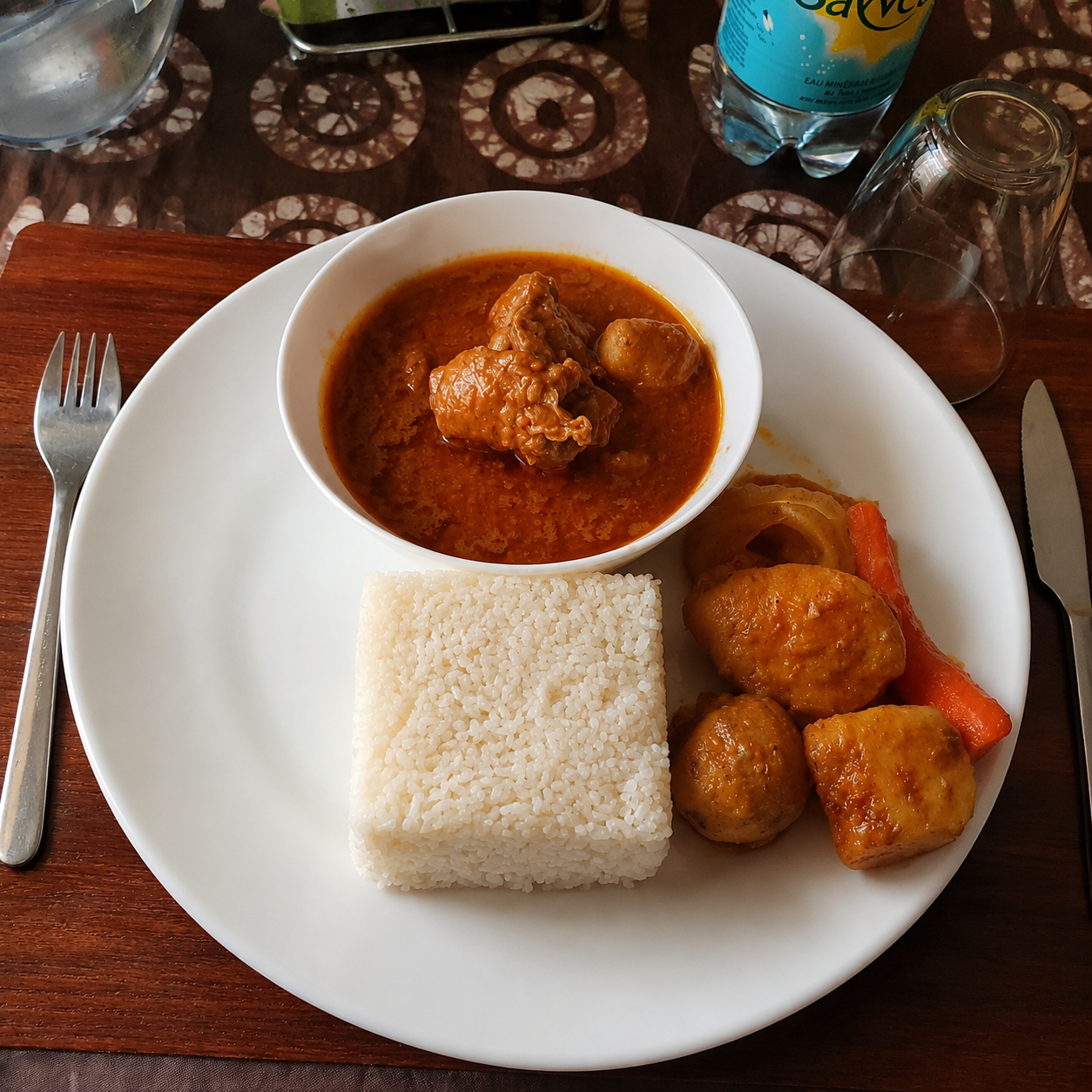
Senegalese mafé is a natural starting point. Our version combines meat, tomato, vegetables and groundnut. Sauce coats the pieces and accompanies rice; tender meat and properly cooked vegetables matter as much as colour.
Malian beef tigadèguèna belongs in this conversation without being reduced to a renamed dish. Chicken tigadèguèna and smoked-fish tigadèguèna show how the protein changes stock, salt and cooking time.
Continue in Senegal with chicken mafé and smoked-fish mafé. These versions need adjustments rather than a simple exchange of pieces in an unchanged recipe. Smoked fish salts and flavours differently from fresh meat, while delicate flesh requires more careful timing.
Domoda and West African sauces: related but distinct
Gambian domoda belongs to this family of generous sauces. The Gambian government lists it among the country’s groundnut specialities. [2] Our recipe uses beef and vegetables that contribute body and sweetness.
Continue with Togolese azindessi, Beninese chicken groundnut sauce, Ivorian groundnut sauce and Burkinabè tô with groundnut sauce. The starch changes how the meal is eaten: a sauce for rice need not have the same consistency as one scooped with a piece of stiff porridge.
Tomato, chilli, onion, smoked fish and vegetables do not play identical roles everywhere. Comparison helps reveal local choices without ranking countries or imposing one formula on West Africa.
In Ghana and Liberia, groundnuts become soup
Ghanaian nkate nkwan invites a looser texture. Groundnut joins a broth that should move around the accompaniment. Ghana’s National Commission on Culture lists groundnut soup among the country’s foods. [3]
Our fufu with groundnut soup shows the role of the starch; Liberian groundnut soup opens another table. The English name describes a shared ingredient, not an identical composition across countries.
Do not automatically reduce a soup to the thickness of mafé. The right result depends on the chosen recipe. A more fluid texture can be a fully finished dish.
Cameroon: ndolé and a different way of working groundnuts
Ndolé puts the leaf first. Our recipe uses raw skinned groundnuts for a creamy base alongside leaves prepared to control bitterness. Cameroon’s Tourism Ministry identifies this combination of ndolé leaves and groundnut paste. [4]
The prawn version and beef version illustrate two balances. Preparing the leaves, grinding finely, managing cooking and finishing all belong to the dish. It is more than putting leaves into mafé sauce.
Spinach can be a practical substitution, but does not reproduce ndolé’s exact flavour. Naming the adaptation allows the recipe to travel without erasing its defining ingredient.
Existing illustration from the Ndolé recipe — Cameroon, RecettesAfricaines.com.
Okok, fumbwa, nkumu and koko: the leaves make the difference
In Cameroonian okok, DR Congo fumbwa, Gabonese nkumu with groundnuts and Central African Republic koko with fish, groundnut accompanies leaves whose preparation and texture require attention. Cameroon’s ministry also mentions groundnuts in okok. [4]
Fine cutting, fresh or dried leaves, possible rehydration and tenderising time change the cooking process. In our fumbwa, smoked fish and palm oil help shape the balance; groundnut binds without making the leaves disappear.
These names should not become automatic synonyms for all green sauces. Nor does every leafy dish contain groundnuts. Reading the actual recipe is more reliable than inferring ingredients from a similar photograph.
Existing illustration from the Fumbwa recipe — DR Congo.
Pondu, saka-saka and isombe: groundnut versions
Congo-Brazzaville pondu with groundnuts, DR Congo saka-saka with groundnuts, Rwandan groundnut isombe and Burundian isombe n’ubunyobwa introduce another family of cooked leaves. Here, groundnut enriches versions based on cassava leaves.
“Version” matters: preparations called pondu, saka-saka or isombe do not invariably use the same binder. Groundnut may provide creaminess without defining the entire tradition.
Cassava leaves require appropriate processing because they contain cyanogenic compounds. [9] Use correctly prepared food-grade leaves and a proven method; do not treat them like briefly wilted spinach. Adding groundnut cannot replace any safety step.
Gabon and the Central African Republic: poultry and meat sauces
Gabonese nfouk-owone brings a hen together with groundnut sauce. Our Central African Republic beef in groundnut sauce shows another meat choice. Beyond the shared ingredient, the bird’s age, cut of meat, stock and aromatics structure the result.
A firm hen needs longer than a chicken breast. A delicately reduced sauce must not dictate insufficient meat cooking: organise the stages, adjust liquid and continue until appropriately cooked.
Congo Tourisme also describes groundnut chicken using nuts roasted, pounded and diluted with water. [5] This clarifies a shared technique without turning every poultry sauce into a copy of mafé.
When paste becomes a dish: groundnut parcels
Gabon’s nkono owono offers a different perspective. Paste is no longer simply poured sauce: enclosed in leaves with seasonings, it becomes a preparation where firmness matters too. Our recipe combines groundnuts, fish and dried crayfish.
Equatorial Guinea’s akuamí or nkot owono presents another leaf parcel. Its interest lies in texture, retained moisture and the ingredients’ aromas. The leaf is a cooking wrapper, not decoration added afterwards.
An overly wet mixture leaks; a dry one compacts. Follow the recipe’s proportions and method, use clean food-safe leaves and check cooking through the centre. These parcels deserve their own identities alongside the great pot sauces.
Existing illustration from the Nkono Owono recipe — Gabon.
Moambé and mbika: neighbours not to confuse
Moambé refers to a palm-nut preparation, not the general name for groundnut paste. Congo Tourisme distinguishes this base from groundnut chicken. [5] Recipes may combine products, but coexistence does not make them identical.
Our DR Congo mbika uses squash or melon seeds rather than groundnuts. Words such as “paste”, “seed sauce” and sometimes “pistache” in culinary usage therefore do not establish the ingredient.
Comparing techniques is useful; silently replacing palm nuts or squash seeds with groundnuts changes the dish. Accurate naming is a form of culinary respect.
Uganda: binyebwa, matooke and luwombo
Our Ugandan groundnut sauce and matooke with groundnut sauce show sauce accompanying cooking bananas. Binyebwa with mushrooms offers another construction without making meat the centre of the meal.
Groundnut luwombo uses banana leaves as a cooking enclosure. The wrapping gesture echoes Central African parcels while retaining distinct ingredients and presentation. Technical similarity alone does not prove historical descent.
The accompaniment and cooking method matter as much as groundnut itself: the ingredient occupies a different place in a separate sauce and in a closed parcel.
Mozambique: matapa, groundnuts and coconut
Our Mozambican matapa combines prepared cassava leaves, groundnuts, coconut milk and seafood. Vegetarian matapa illustrates another version. Coconut and groundnut bring distinct characteristics; their meeting is more than “two creamy ingredients”.
Fish caril de amendoim shifts the centre towards fish and sauce. Adjust liquid and cooking to preserve pieces that hold together.
Follow the chosen recipe for leaves and proteins alike: creaminess must not hide unsuitable preparation. Comparison with Central African leafy dishes is productive when the differences remain visible.
Existing illustration from the Matapa recipe — Mozambique.
Malawi, Zambia and Zimbabwe: leaves, grains and dovi
Malawian vegetable groundnut relish and Zambian chibwabwa with groundnuts place leaves at the centre of the mouthful. In Zimbabwe, muriwo une dovi and muboora with dovi extend the family with other leafy vegetables.
Chicken dovi shows groundnut in a meat dish; mupunga unedovi brings it to rice. These examples avoid reducing dovi to one stew.
Paste or ground nuts may enrich sauce, coat a starch or accompany leaves. Serving them with stiff cereal porridge creates another eating experience compared with separate rice grains.
Chad and Sudan: vegetable binders, soup and fresh sauce
Our Chadian groundnut daraba combines okra, vegetables and groundnut. Okra’s texture and groundnut’s body add together, so the binder needs balancing to avoid overwhelming everything else.
In Sudan, shorba bel dakwa is soup, while salatat dakwa works the paste with vegetables and acidity. Sudanese Kitchen documents this second family. [6] Groundnut therefore belongs beyond long simmering.
The useful distinction concerns the ingredient: a paste intended for uncooked use is different from raw nuts requiring cooking. For a fresh sauce, use ready-to-eat paste and the specified ingredients.
Shared techniques: thin, cook gently and adjust
Mix the paste in a bowl with a little liquid, then gradually add more while stirring. It may initially stiffen before becoming smooth. Continue patiently rather than pouring all the water at once, then incorporate it as the recipe directs.
A heavy-based pot and moderate heat reduce sticking. Stir the bottom, beware of splashes and keep hot water for adjustments. Cooking time depends on the product and dish; a little oil separating is not, by itself, proof that everything is cooked.
Soup needs flow, mafé needs a coating sauce and parcels need a mixture that holds. Name the desired texture first. No single paste-to-water ratio suits every family.
Adjusting and accompanying without losing the dish
Loosen thick sauce with a little hot liquid. Thin sauce may reduce gently if the other ingredients allow it. A large spoonful of paste added at the end risks lumps and imbalance: thin it first and give it time to integrate.
If the bottom burns, carefully transfer the intact part without scraping. Sugar does not repair burnt or rancid groundnuts. If a meal feels too rich, adjust portion size, vegetables and a simple accompaniment rather than adding more oil, paste and toppings.
Rice, tô, fufu, chikwangue, plantain, matooke, nsima and sadza each organise a different mouthful. Plant-based versions need their own balance too: choose mushrooms, beans and vegetables for texture and role, not merely as the absence of meat.
Choosing, storing and sharing with confidence
Groundnut paste provides fat and protein and is energy-dense. A meal’s profile depends on quantities, salt, added fats, vegetables and starch. Plant-based sauce is not automatically light, but groundnut sauce need not be excessively oily either.
Groundnut is an important allergen. [8] Clearly identify it, check other ingredients and avoid cross-contact. Long cooking cannot make a dish safe for someone with peanut allergy; replacement seeds also require checking individual tolerance.
Buy from a reliable supplier. Aflatoxins may survive processing; home cooking cannot guarantee decontamination. [7] Do not salvage mouldy paste by removing the surface. Absence of visible mould cannot replace supply-chain controls.
Follow the jar’s storage instructions and use a clean, dry spoon. Cool cooked dishes promptly and refrigerate within two hours; keep the coldest zone at 4°C or below. [10] Storage time depends on the recipe: a jar of paste is not the same product as sauce containing water, meat or fish.
A tasting table, several stories
For friends, choose three contrasting preparations rather than three similar sauces: mafé, a leafy dish and a groundnut parcel, for example. Offer suitable portions, identify allergens and explain which form of groundnut was used.
Observe colour, fineness, leafy bitterness, smoked-fish depth, flowing soup and firm steamed paste. This makes the connections clear without reducing everything to one uniform “peanut sauce”.
That is the spirit of shared food traditions: recognise cooks’ skills, name the traditions and inspire another attempt. One seed can connect tables while leaving each its own voice.
Sources and further exploration
Recipe links describe versions offered on RecettesAfricaines.com without fixing every household practice. Images already belong to the site and illustrate the corresponding dishes. Continue with Ndolé: Cameroon’s culinary pride and Bissap, karkadé, zobo.
- Royal Botanic Gardens, Kew — Peanut
- Gouvernement de Gambie — spécialités culinaires
- National Commission on Culture, Ghana — The Ghanaian Kitchen
- Ministère du Tourisme du Cameroun — Cuisine
- Congo Tourisme — Cuisine congolaise
- Sudanese Kitchen — Salatat Dakwa
- OMS — Mycotoxines
- NHS — Allergies alimentaires
- Food Standards Australia New Zealand — Manioc
- Ministère français de l’Agriculture — Hygiène en cuisine