Wassa-wassa
Wassa wassa is a preparation of small grains made from flour or meal milled from dried yam chips, especially associated with Benin.
Identity and recipe examples
Wassa-wassa is a preparation of small grains made from flour or meal milled from dried yam chips, especially associated with Benin. The chips are pieces of yam flesh cut and dried; they should not be confused with husks or simple peelings. This ingredient identity distinguishes wassa-wassa from wheat couscous and millet thiéré. A similar appearance on the plate does not mean the same raw material or water absorption.
The site's Wassa-wassa uses 700 g of dried yam chip flour or meal. Water is introduced gradually to form small grains rather than a smooth dough. Resting and steaming stages are separated by fluffing or breaking up clumps. Adding too much water at once can produce a mass instead of individual grains; leaving them too dry gives uneven hydration. Follow the detailed method and the grain texture rather than relying on a shortened cooking time in a summary box.
Wassa-wassa with meat retains the yam base and adds a separately prepared beef and tomato sauce. It distinguishes making the grains from composing the accompaniment. Water quantities cannot be transferred blindly between products: milling, drying and the particular flour change how it behaves. Liquid reserved for the sauce is not automatically part of the water used to hydrate the grains.
Ask specifically for dried yam chip flour or meal suitable for wassa-wassa when shopping. Wagasi, which may accompany some Beninese meals, is a cheese, not a hot seasoning, and it is not part of the definition of the grains. This food can be described accurately without claiming it treats diabetes or assigning every serving one fixed nutritional value. Portion size, preparation and the sauce served with it also shape the meal actually eaten.
A wide bowl gives room to moisten and separate the grains without crushing everything into one mass. Add water in small stages, mix, then observe before adding more. A finer meal or a drier product may respond differently to the same measured quantity. The objective is the formation of small distinct grains, not simply making all visible powder disappear into a smooth dough. Keeping track of the product and water actually used gives a more helpful record than copying an unexplained ratio.
During steaming, maintain enough water in the lower pot and open the lid cautiously. Intermediate fluffing separates clumps while preserving the grain structure. It is not the same operation as mashing a boiled tuber. If making a larger amount for guests, allow space for steam to circulate according to the method rather than tightly compressing the entire mixture into a dense block.
Serving sauce separately can help diners adjust moisture and lets a first time cook recognise the yam base before tomato and meat cover its flavour. The sauce remains part of the complete meal even when it is presented in a separate bowl. A definition of the grain preparation should therefore be distinguished from the ingredient list of a finished meat dish.
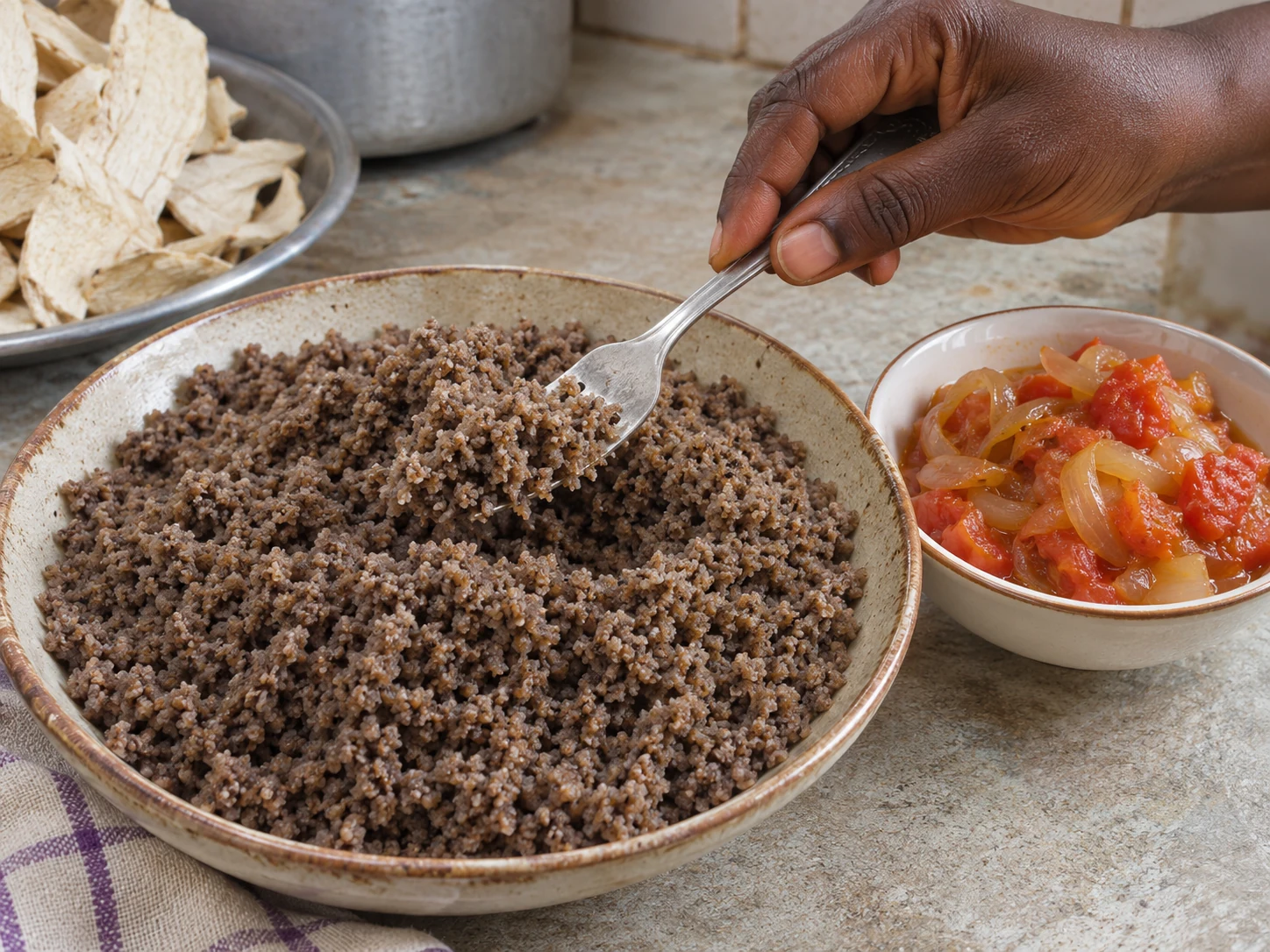
The illustration shows small brown grains with tomato and onion alongside. It communicates a possible presentation, without proving the composition of an unidentified flour. Ingredient identity is established by the product information and the recipe. That combination of name, raw material and cooking steps is what makes wassa-wassa a useful entry in an African culinary dictionary rather than a generic description of couscous.
🌾 🥣 BLACK COUSCOUS AND ITS MANY NAMES
Wassa-wassa, also spelled wassawassa or ouassa-ouassa, is one of the most authentic and unique jewels of West African gastronomy. This traditional dish, which takes the form of a couscous with a very characteristic dark color, is made from dried and ground yam chips. Primarily rooted in northern Benin, Togo, and Ghana, as well as in some regions of Nigeria, wassa-wassa embodies the art of transforming and enhancing yam, a nourishing tuber elevated to the status of a sacred plant in many African cultures. To define it precisely, it is a tuber couscous, where the usual wheat semolina gives way to a fine grind of dehydrated yam, patiently steamed until tender, light, and deliciously fragrant grains are obtained.
Where to find it
Look for the exact food-grade form required by the recipe at markets and specialist shops. Check the product name, ingredients, condition and storage instructions.
Explore further: Cooking tips · Food hygiene and safety advice.
🚜 🪵 THE EXPERTISE OF PREPARING AND ROLLING THE GRAINS
The traditional preparation of wassa-wassa is a demanding process that requires great precision, infinite patience, and remarkable tactile sensitivity, an art almost exclusively held by women. It all begins with grinding the dried yam chips into powder. This powder, with a fine but slightly granular texture, is then sieved to remove impurities and overly coarse pieces. The most delicate step is then wetting and rolling. The cook very delicately sprinkles the yam flour with lightly salted water, then, with rapid and regular circular movements of the palm of her hand, she agglomerates the powder into tiny balls, thus forming the couscous grains. If the gesture is too abrupt or the water too abundant, the flour turns into a paste, thus ruining the preparation.
Once the semolina is perfectly rolled, it is transferred to a traditional clay or metal couscoussier for steaming. This cooking is done in several stages. During the first steaming, which lasts about thirty minutes, the yam grains begin to cook and clump together slightly. The cook then removes the couscous, pours it into a large wooden dish, carefully separates the grains with a ladle or fingers moistened with cold water, and then puts it back to cook for a second steaming. This double cooking ensures perfectly tender grains that do not stick together and literally melt in the mouth.
🍲 🇧🇯 ITS PLACE AND ACCOMPANIMENTS IN WEST AFRICAN CUISINE
It is very often served with a thick and concentrated tomato sauce, richly garnished with fried onions, fresh chilies, crumbled smoked fish, powdered dried shrimp, or pieces of fried mutton. To add freshness, it is customary to accompany it with steamed moringa leaves, slices of ripe avocado, or boiled black-eyed peas. This contrast between the earthy sweetness of dried yam, the spiciness of the sauce, and the creaminess of the oil makes each bite of wassa-wassa a true explosion of typically African flavors.
Sources and checked recipes
https://pubs.sciepub.com/ajfst/6/1/1/index.html