Wasawasa
Wassa-wassa with onions: a homemade version with weighed ingredients and detailed preparation.
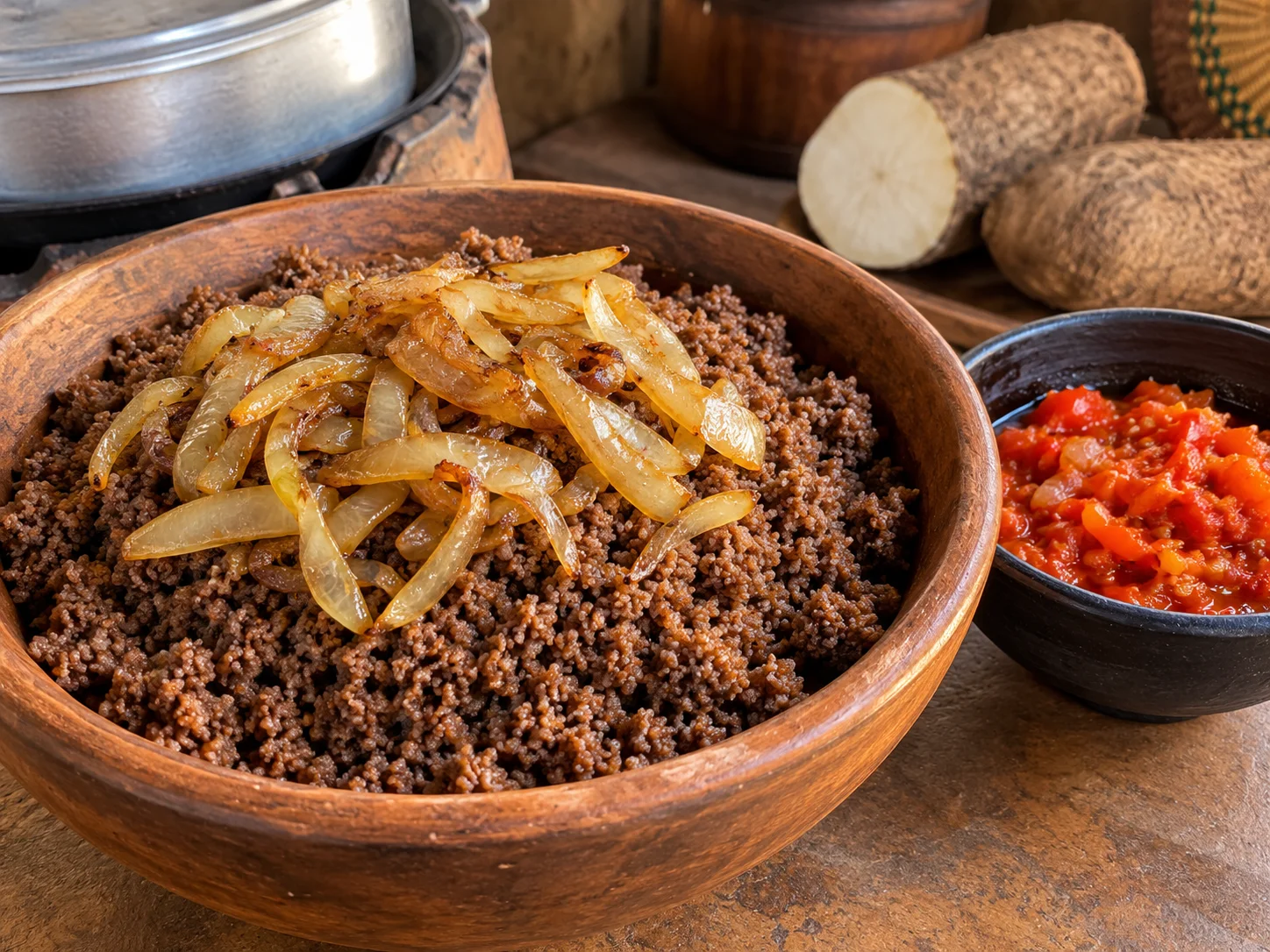
Ingredients
- 300 g of food granules of yam chips for wassa-wassa
- 350 g of onion
- 30 g of olive oil
- 500 ml of drinking water for moistening
- 4 g of salt
- 1 g of fresh chili
Preparation
Buy food granules for wassa-wassa, ready to cook, and follow their moistening instructions. The 500 ml of water is a reserve: not all the water is necessarily absorbed. Do not make flour from unidentified chips.
Steam the granules according to their packaging, usually in successive passes. Separate the grains between passes with suitable utensils, without touching the burning hot grains.
Melt the sliced onions in the oil for 15 minutes over moderate heat. Add the chili and salt.
Mix the cooked semolina and onions, then serve. The cooked yield depends on the product chosen.
Introduction
Wasawasa is documented in northern Ghana as steamed dried-yam-flour granules, including Kinorah Awini’s Crop Trust interpretation. Related dishes exist in neighbouring countries. Use ready-to-cook food-grade wasawasa granules, not home-ground unknown peels. Soft onions top this airy grain preparation.
Tips
For optimal preparation, make sure to accurately weigh all edible ingredients before starting. This step not only ensures fidelity to the recipe but also the balance of flavors and textures. The use of a kitchen scale is highly recommended for yam granules, onions, oil, salt, and chili. An exact measurement helps avoid approximations that could alter the final taste of the wassa-wassa and ensures even cooking of the onions.
When moistening the yam granules, it is crucial to scrupulously follow the manufacturer's instructions. The indicated amount of water (500 ml) is a reserve; it is rare for all of it to be absorbed. The goal is to obtain granules that are just hydrated, neither too dry nor soggy, for successful steaming. Excessive moistening would make the semolina sticky, while insufficient moistening would leave it hard. Gradually adjust the water to find the ideal texture before cooking.
Steaming the yam granules is a delicate step that requires patience. Perform successive passes as recommended by the manufacturer, making sure to separate the semolina between each pass. Use a fork or spatula to separate the grains without crushing them, and above all, never touch the burning hot grains with bare hands. This aeration allows for uniform cooking and prevents the formation of clumps, ensuring a light and airy texture for the wassa-wassa.
The secret to tender and flavorful onions lies in slow cooking over moderate heat. Sauté them in olive oil for at least 15 minutes, stirring regularly. The goal is not to brown them quickly, but to let them soften and caramelize gently, which develops their natural sweetness. Too fast cooking would make them crunchy or bitter. It is this patience that will give the dish its full depth.
The addition of fresh chili and salt should be done with discernment. The chili adds a touch of heat, but its quantity (1 g) is indicative and can be adjusted according to your tolerance for spiciness. Salt is essential to enhance the flavors. Taste the onions at the end of cooking to adjust the seasoning before mixing them with the semolina. Balance is key to not masking the delicate taste of the yam.
When slicing the onions, aim for thin and uniform slices. This ensures even cooking and a tender texture. Pieces that are too thick would take longer to cook and might remain crunchy, while pieces that are too thin might burn. Good slicing technique greatly contributes to the final quality of the onion garnish.
The choice of olive oil is important for the flavor. A good quality olive oil will bring fruity notes that will pair well with the sweetness of the onions. If you don't have olive oil, another neutral vegetable oil can be used, but it won't offer the same aromatic complexity. Avoid oils that are too strong and could overpower the taste of the onions.
After steaming, the yam semolina should be airy and light. If it seems too compact, continue to gently separate it with a fork. The goal is to obtain well-separated grains that will easily mix with the onions. Well-separated semolina absorbs the flavors of the garnish better and offers a better texture in the mouth.
When finally mixing the cooked semolina and onions, proceed gently. Use a large spoon or spatula to incorporate the onions into the semolina without crushing the grains. The idea is to evenly distribute the fragrant garnish throughout the semolina. This final gesture ensures that every bite of wassa-wassa will be infused with the flavors of the onions and chili.
The cooked yield of wassa-wassa will depend on the type of yam granules chosen. Some products may swell more than others. Don't worry if the final quantity seems slightly different from your expectations. The important thing is to focus on texture and taste. Serve the wassa-wassa hot to fully appreciate its aromas and consistency.
Variations
The possibilities for variations for wassa-wassa with onions are numerous, allowing the dish to be adapted to personal tastes or available ingredients. A common substitution could be the addition of extra vegetables. Colorful bell peppers (red, green, yellow) cut into thin strips and sautéed with the onions would bring a touch of freshness and crunch, as well as visual richness. Grated carrots or small zucchini cubes could also be incorporated to increase fiber and vitamin intake. For a more protein-rich version, the addition of peeled shrimp or small pieces of cooked and shredded chicken would be an excellent option. These elements should be added towards the end of the onion cooking to avoid overcooking. Another interesting variation concerns spices. Although fresh chili is used here, one could experiment with grated fresh ginger for a different pungent and aromatic note, or spices like cumin or ground coriander for a more earthy flavor. It is crucial to note that any substitution or addition requires a re-evaluation of potential allergens, quantities, and, if necessary, nutritional calculation. For example, adding shrimp would introduce a major allergen. Similarly, using another variety of yam or cassava granules (fufu) would modify the texture and nutritional profile. These adjustments must be made with caution to maintain the balance of the dish and food safety.
Accompaniments
Wassa-wassa with onions, with its neutral yam base and fragrant garnish, lends itself to a multitude of accompaniments, thus offering great flexibility to compose a balanced and tasty meal. For a complete dish, it is often served with a light sauce. A fresh tomato sauce, prepared with ripe tomatoes, garlic, onions, and a little chili, would bring a welcome acidity that contrasts pleasantly with the sweetness of the onions. A rich and creamy peanut-based sauce is also an excellent choice, offering depth of flavor and a different texture. For those who appreciate protein, wassa-wassa pairs very well with fried or grilled fish, such as tilapia or mackerel, whose firm flesh and pronounced taste perfectly complement the yam semolina. Marinated and grilled meat skewers (beef, chicken) are also a delicious option. For a lighter meal, a crisp green salad with a simple vinaigrette can accompany the wassa-wassa, bringing freshness and vitamins. Always remember to check product labels and allergens for each added ingredient, especially for prepared sauces or processed products. Allergens: No major allergens identified in the basic ingredients; check labels and cross-contamination for accompaniments and additional products.
Nutrition notes
Theoretical estimate per serving, excluding variations and additional accompaniments. Quantities are those of the edible ingredients indicated; liquids in ml are assimilated to the same mass in g. Any measured fat is assumed to be consumed. Losses in juices and yield variations are not measured. These values do not constitute an analysis of the served dish. Vitamins and minerals: ND, not determined. A missing data is not zero. Undetermined values: The composition and yield of the yam chip granules used are not verified. Source: Anses, Ciqual 2025. Values below the limit use half the limit; traces are neglected and recorded in the calculation. Without a measured final weight, do not convert these results into values per hundred grams of cooked dish.