Couscous à l’oroupounnà
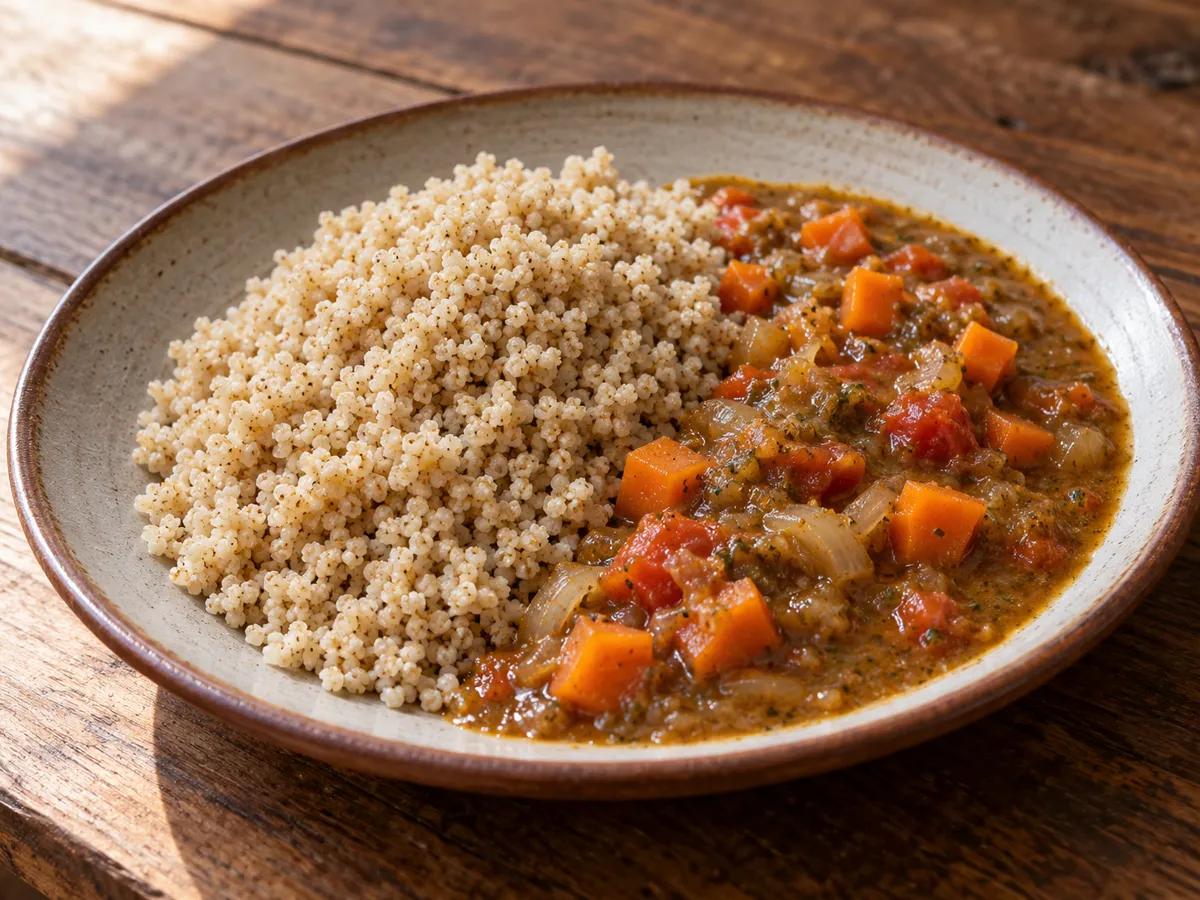
🥣 Steamed millet couscous with baobab-leaf sauce, vegetables and Dogon seasoning (somé).
Ingredients
- 🥣 300 g plain precooked millet couscous, in grains, not millet flour
- 🥣 200 ml lukewarm water for the first moistening
- 🥣 80 ml hot water for the second moistening
- 🥣 1000 ml water to produce steam, topped up if necessary
- 🥣 15 g ground dried baobab leaves sold for food use
- 🥣 600 ml water for the sauce
- 🥣 150 g peeled and sliced onion
- 🥣 250 g fresh tomatoes cut into small pieces
- 🥣 200 g peeled carrots cut into small dice
- 🥣 10 g peeled and chopped garlic
- 🥣 20 g neutral oil, including 5 g for the millet and 15 g for the sauce
- 🥣 3 g salt for the sauce
- 🥣 10 g commercially produced food-grade Dogon seasoning (somé), with identified provenance and ingredients, labeled for use in a cooked sauce
Preparation
🧑🍳 During the 25 min preparation period, weigh the ingredients and cut the vegetables. Gradually sprinkle the millet with the 200 ml lukewarm water, mix with a fork and rest for 10 min. The grains should be moist without sitting in a puddle. Add the 5 g oil and gently break apart any clumps.
🧑🍳 Begin the 40 min cooking period by heating the 1000 ml water in a saucepan suited to the steamer basket. Allow about 5 min to establish steady steam. The bottom of the basket must remain above the water; cover without blocking steam outlets.
🧑🍳 At the same time, heat the 15 g oil in another saucepan. Soften the onion for 6 min, add the garlic for 1 min, then the tomatoes for 3 min. Stir: the onion should become supple and the tomato begin breaking down, without pronounced browning.
🧑🍳 Add the carrots, the 3 g salt and 500 ml of the 600 ml sauce water. Partially cover and simmer for 20 min. Mix the baobab leaves with the remaining 100 ml water in a bowl to obtain an even suspension without pockets of powder.
🧑🍳 Once the steam is steady, spread the millet in the basket without packing it down. Steam for 15 min. Transfer to a heatproof dish, opening the lid away from your face. The grain should begin softening but may still have a firm center.
🧑🍳 Sprinkle the millet with the 80 ml hot water in several passes, then separate the grains with a fork. Let it absorb for 5 min, return to the basket and steam for another 10 min. Check the saucepan's water level before this second stage.
🧑🍳 For the final 10 min of the sauce's simmering time, stir in the baobab suspension. Add the 10 g somé after checking the ingredients, provenance and manufacturer's usage instructions. The sauce should lightly coat a spoon without becoming a solid mass; the diced carrots should yield to the tip of a knife. Then keep warm until serving.
🧑🍳 After the second steaming, taste a grain: its center should be tender, not chalky, and it should separate easily from the others. Rest the millet for 5 min covered off the heat. If the center remains hard, extend the steaming and adjust the total time rather than serving undercooked grains.
🧑🍳 Fluff once more, divide the millet among plates and place a small amount of sauce alongside it. Present the remainder separately. Serve as soon as the resting time ends, while the grains are still supple and the sauce hot.
Introduction
🌾 This couscous brings together soft millet grains and a green sauce in which baobab leaves provide a vegetal flavor and gentle thickening. The proposal is deliberately accessible: weighed vegetables, an identifiable food-grade powder and precooked millet couscous make it possible to work in an ordinary kitchen. The desired result is not a flooded cereal, but separate grains that each diner can moisten as they wish. Carrot supplies tender pieces, tomato slight acidity and onion a mellow base. None of these amounts is presented as a historical proportion. The name here identifies the requested dish; this recipe offers an explicit home adaptation rather than a reconstruction of a village preparation whose precise techniques and ingredients are undocumented.
Cultural context
🌍 The association of this name with couscous containing baobab leaves and Dogon seasonings is reported in the drafting request; that alone does not constitute a verified historical source. This recipe therefore cannot confirm a precise village origin, spelling in a local language or presence at a particular ceremony. Speaking of Dogon cuisines in the plural avoids reducing different family and regional practices to a single recipe. Baobab leaves and the pulp of its fruit are distinct ingredients: replacing the former with the latter would produce a different, more acidic sauce. “Somé” is the product designation requested here, without independent confirmation of its spelling or regional scope. Choose a product explicitly presented as Dogon seasoning, with identified provenance and ingredients; this purchasing condition establishes neither a universal formula nor historical authenticity. Establishing a heritage version would require a local source describing the grain, leaves, seasoning and techniques, followed by a distinction between that testimony and the practical choices in this adaptation.
Tips
💡 Choose food-grade baobab leaves from an identifiable seller. Reject damp, moldy powder or powder intended for cosmetic use; do not improvise with unidentified wild leaves.
💡 If small grains fall through the basket, use a clean cloth intended for food preparation, secured firmly and kept away from flames. An overly thick lining slows the steam.
💡 Taste several grains taken from the center and edges of the basket. A tender surface can conceal a dry center when steam circulates poorly through an overly packed layer.
💡 For somé, read the label and follow storage instructions after opening. Check provenance, ingredients, salt and allergens; if the product is very salty, reduce the added salt before cooking rather than correcting it at the table. Do not replace this Dogon seasoning with just any fermented product. If its composition or food use remains unknown, do not use it.
💡 Loosen an overly thick sauce with a little hot water. Gently reduce an overly thin sauce before serving; do not add another handful of dry leaves directly to the saucepan.
💡 Check the product description before buying: a bag of flour, whole grains and couscous granules do not cook in the same way. This recipe requires already shaped, precooked granules; it does not describe making them from flour. If the packaging does not specify how the grain was processed, ask the seller for advice rather than assuming a simple steaming will suffice. For someone who must avoid gluten, also check the label and cross-contamination risks: choosing millet does not, by itself, guarantee that the product is suitable.
Planning
🧑🍳 Set up two cooking stations: a saucepan for the sauce and another fitted with a stable steamer basket for the millet. Keep a wide dish, a fork and a mixing bowl nearby; this makes transfers easier without crushing the grains. The 25 min preparation includes the first moist resting period; the following 40 min includes bringing the water to steam, the steaming stages and the intermediate and final rests. The sauce proceeds in parallel, not after the cereal. Use precooked millet couscous whose package instructions permit this method; the grain size may require more water or steaming. The proposed quantities are a starting point, not a universal rule. Distribute water over the entire surface and wait for absorption before judging texture. Mixing the leaves separately prevents lumps. Do not beat the millet as though it were dough: lifting and separating is enough.
Serving
🍽️ Present the millet as a loosely piled mound on each plate, leaving space for the sauce. A few visible carrot cubes identify the garnish, while a small sauce jug lets each diner choose the moisture level of their portion. For a shared serving dish, arrange a ring of cereal around a shallow hollow without pouring all the sauce into the center. Provide a separate serving spoon for each container. Avoid compressing the grains to obtain a perfectly smooth shape: a slightly uneven surface better expresses their texture. No additional decoration is essential.
Storage
❄️ Do not leave this dish at room temperature beyond 2 h, or 1 h if the room exceeds 32 °C. Quickly divide millet and sauce into separate shallow containers; refrigerate at a maximum of 4 °C without waiting for a large pot to cool completely. Eat within 48 h. For longer storage, freeze promptly at −18 °C and use within 1 month to preserve texture. Thaw in the refrigerator, never on the worktop. Reheat only the portion needed: add a little water to the millet and heat to 74 °C at its center; stir the sauce so it also reaches 74 °C throughout. Reheat only once. A normal smell does not guarantee safety: discard leftovers if their time outside refrigeration is unknown.
Variations
🌿 With precooked wheat couscous, follow the package instructions and reconsider both water and steaming. This is then a home substitution containing gluten, not Dogon millet couscous.
🌿 Without identified somé, simply keep the onion, garlic and tomato. This preparation becomes an adaptation without Dogon seasoning, not the complete version of the named dish. Do not offset this omission with just any fermented seasoning or a blend presented as traditional without a reliable source.
🌿 Replace the carrots with an equivalent weight of firm squash cut into dice. Check tenderness earlier: some squashes break down quickly and make a thicker sauce.
🌿 To turn the base into a more substantial plate, stir a small portion of already cooked cowpeas into the sauce once the carrots are tender. Using beans cooked without strong seasoning keeps the leaf flavor noticeable. Stir gently to keep the pulses whole and check that the sauce remains loose enough to coat the grains. This proposal changes the garnish and nutritional profile; it is not presented as a documented Dogon variation. The figures given for the base recipe do not include this addition.
Accompaniments
🍽️ A lemon-dressed cucumber salad, served in a separate small bowl, adds crunch without soaking the grains. Its dressing remains separate from the baobab sauce.
🍽️ Plain cooked beans can add plant protein to the plate. Serving them separately preserves the cereal's texture and allows the portion to be adjusted.
🍽️ Offer water or an unsweetened herbal infusion. A very sweet or strongly spiced drink may overpower this version's fairly delicate vegetal flavor.
🍽️ A hard-boiled egg can be presented separately if you want a simple non-vegan addition. Cutting it at the last moment and not crushing it into the sauce keeps the elements recognizable. This accompaniment does not establish any serving custom: it is simply a home option whose allergen and nutritional contribution need to be taken into account.
Nutrition notes
💪 Millet mainly provides carbohydrates, along with protein and fiber; the oil adds fat and the vegetables diversify the meal. These statements do not justify any therapeutic promise or any claim of high vitamin content after cooking. Calculation basis: the whole recipe divided into 4 portions, with 300 g dry millet, 150 g onion, 250 g tomatoes, 200 g carrots, 10 g garlic, 20 g oil, 15 g dried leaves and 3 g salt; water supplies no energy, and 10 g somé and accompaniments are excluded. The seasoning is required in the recipe, but its unknown composition prevents including it in these estimates: add its contribution according to the label, particularly for sodium, salt and energy. Typical food compositions give approximately 1560 kcal for the base without seasoning, or 390 kcal per portion. Leaf composition is particularly variable: its values are approximate, not an analysis of the purchased product. Rounded figures may change with the millet and product labels. Estimated sodium includes that in the base ingredients and added salt; its salt equivalent is calculated using the factor 2,5.
Conclusion
✨ The pleasure of this adaptation lies in tender grains and a restrained amount of sauce. Presenting the two separately lets you discover their contrast without masking the millet. Enjoy your meal! Aw ni dumuni! This phrase accompanies sharing, with the linguistic reservations explained below.
Enjoy your meal
🥰 Enjoy your meal! Aw ni dumuni! Proposed phrase, unconfirmed; its linguistic attribution and exact usage remain to be verified.