Shell or husk
Remove the shell, husk or outer covering of food.
Which outside layer does the recipe mean?
The French verb décortiquer means freeing the wanted part of a food from its outer covering. In cooking it applies notably to shellfish and to seeds or nuts whose outer covering is removed. Peeling the shell segments from a shrimp exposes its flesh. Opening a groundnut pod releases the seeds, while removing their thin skins is a further action. A dictionary should help identify which layer the recipe means. Do not assume that a shrimp described as shelled has no tail, or that a shelled seed has necessarily been ground into powder. The intended result is not the disappearance of everything surrounding the food in the broadest sense. It is removal of the specified covering so that the useful part is available for the next stage. The ingredient and its destination make the instruction precise.
Two documented uses rather than one origin story
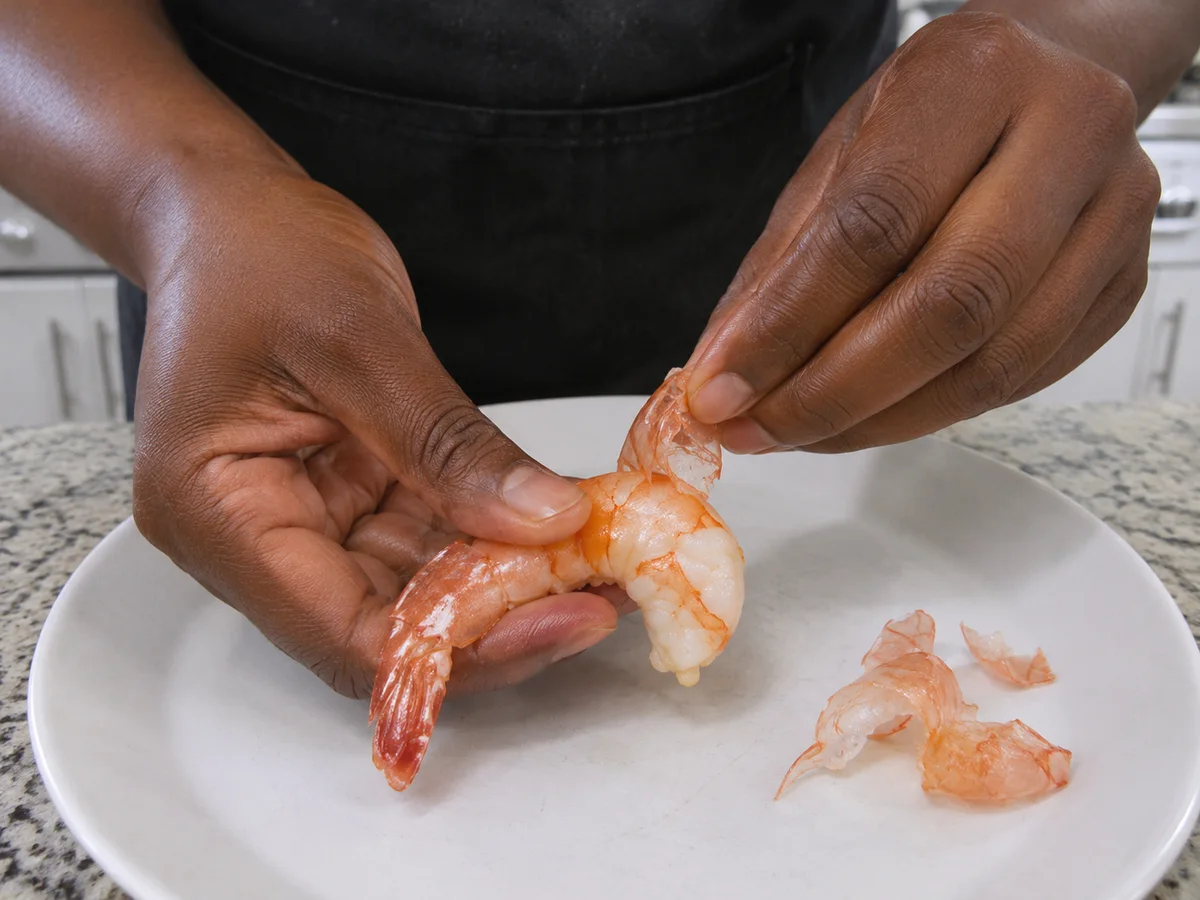
New Brunswick's introduction to professional cooking records both removing the covering of certain plant foods and freeing shellfish flesh from its shell. That double meaning explains why the same French verb can appear beside a basket of nuts and a tray of shrimp. It does not mean that the movement, tools or scale of work are identical. Seeds prepared commercially may have been processed in a way quite unlike preparing a few portions by hand. A cook may simply say to remove the shells or peel the shrimp without using the professional term. When comparing kitchens, describe the material separated and the result obtained rather than deducing an origin from a French word. The illustration for this entry shows only one use, removing shell from a cooked shrimp. It cannot explain how a seed is shelled or establish how uncooked seafood should be prepared.
Separate shrimp shell rather than pulling everything at once
The shell segments surround the flesh and are easier to detach when you find an edge that already opens. Lift that edge and ease the covering apart while supporting the flesh with the other hand. Pulling one end without supporting the rest can leave flesh inside the shell or break a portion intended to stay whole. Where shape matters, gradual removal helps you see what is coming away. For shrimp that will subsequently be chopped, an intact shape may matter less, but hard fragments remaining among the flesh still matter. A tail can deliberately be retained for some presentations. It is clearer to state that choice than to impose a single tail convention on every dish described as using shelled shrimp. Inspecting the prepared pieces is useful even when most of the work felt easy or the shells seemed to lift away cleanly.
Head, shell and digestive tract are different things
Shrimp can be sold with or without heads, with or without shell, and with or without the shell section protecting the tail. The digestive tract, sometimes visible as a line along the back, concerns another operation. Its presence does not prove that shell removal was incomplete, and shell removal does not automatically remove it. In reading a recipe, check whether the writer explains these actions separately or simply bought a prepared product. The word often appears in an ingredient list. There it describes the state of the shrimp entering the dish, rather than demonstrating that shelling occurs in the written steps. A link can illustrate use of an already shelled product, but its description should acknowledge that limit. It should not promise a demonstration of the hands performing the action when the reader will find only instructions for cooking a ready-prepared ingredient.
Identify the layers around nuts and seeds
With a food enclosed in a shell, the first issue is opening or separating the outside without unnecessarily crushing what it contains. A rigid shell is handled differently from a thin seed coat. The pressure used also depends on whether an intact nut is wanted or whether the contents will later be ground. In either case, removing fragments of covering before continuing prevents them being mixed into the edible material. For a product purchased already shelled, look at what remains around the seed. The fine skin may be present even though the outer shell is gone. Depending on the preparation, that skin can affect appearance or mouthfeel. In some French culinary contexts, monder refers to removal of such a skin. Keeping that distinction visible avoids either demanding the same work twice or accidentally omitting a separate action needed for the intended texture.
Compare peeling, opening and crushing
Peeling usually suggests removing skin from the flesh of a plant food, sometimes with a tool that cuts away a thin layer. Opening a shell can begin shelling but is not sufficient if the contents remain attached or hard fragments have not been separated. Crushing aims to break material into pieces. It can help open a covering, but does not necessarily aim to preserve all parts intact. These actions can be combined in one recipe, so naming them in order helps explain what should remain whole and what will be broken down. In another language, begin with a precise description such as removing the shrimp shell or opening the groundnut pod. A broad term can otherwise conceal a change from one operation to another. The dictionary should clarify the object being worked on rather than suggest that one hand movement fits every ingredient.
My advice: check what reaches the recipe
When an ingredient list specifies a shelled product, determine whether it must retain its shape, a tail or a thin skin that affects texture. Compare what you buy with what the recipe actually needs. The same weight measured with coverings does not yield the same usable quantity as an already prepared product. If working by hand, keep the wanted food and discarded coverings separate as you go, then check for small hard fragments. Put a container for the shells beside the board: fine fragments are harder to see after they mingle with prepared pieces. Finally, label the specimen actually illustrated. A cooked shrimp having one shell segment removed is neither an example of seed processing nor an instruction for removing the digestive tract. This precision makes the image informative instead of asking it to represent every meaning of a broad culinary verb.
A reading and observation exercise
When checking quantities, distinguish purchase weight from the weight actually added to the recipe. Record whether heads, shells or skins were included at weighing. This is more useful than assuming one yield for every size and product. An already prepared ingredient can simplify the work without proving that the recipe itself teaches the preparation technique.
A verified recipe example
The first step removes the outer skins of soaked cowpeas by rubbing and rinsing. This is a seed-envelope example; it does not use the same motion as removing a shrimp shell.