Blind bake
Bake a pastry shell without its final filling.
Baking without the filling, rather than without colour
Blind baking means putting a pastry shell in the oven without its filling. The French expression cuire à blanc does not instruct you to keep the pastry pale at all costs. It distinguishes the stage when pastry bakes alone from a stage when it already holds fruit, cream or a savoury mixture. Depending on what happens next, the shell may return to the oven with its filling or finish baking before the filling is added. This distinction matters: a shell intended for a cold cream cannot depend on a later baking stage to dry its centre. Conversely, a shell that still has another baking stage ahead may not need deeply coloured edges yet. The term explains the order of operations. The rest of the recipe tells you how far to take this first stage and what the finished shell should support.
What a glossary can establish
The Académie du Goût describes blind baking for pastry shells, including shortcrust and puff pastry. It identifies lining paper and a distributed weight, such as baking beans, dried pulses or a purpose-made chain. That explains the principle, rather than prescribing one temperature and time for every tart. Nor does a glossary establish where or when the technique was invented. The same practical question arises whenever pastry needs to acquire structure before receiving a filling that requires different treatment. A local recipe may describe this exact sequence without using a specialist French term. A dictionary link should explain what that recipe actually does. A photograph of a finished tart does not prove that the empty shell was baked first, however crisp its edge looks or however attractive the filling may be. Reading the method provides the evidence that the photograph cannot supply.
The shape that the tin supports
Pastry pressed against the base and sides of a tin forms a cavity. Heating can change that shape: the base may rise, a side may slip down or contract, and different areas may bake at different rates. Paper separates the weights from the dough. Weights help keep the base in position during the part of baking when it might otherwise distort. Nevertheless, the sides need attention too. Dough stretched upwards to reach the rim can pull back as it heats. Laying it in place without stretching avoids asking weights on the base to solve tension in the sides. Look for weak points before baking: a thin angle, a small hole or a section that does not sit against the tin. Finding those areas early is more useful than hoping the filling will later conceal a damaged shape or an unevenly supported wall.
Distribute the weights rather than making a heap
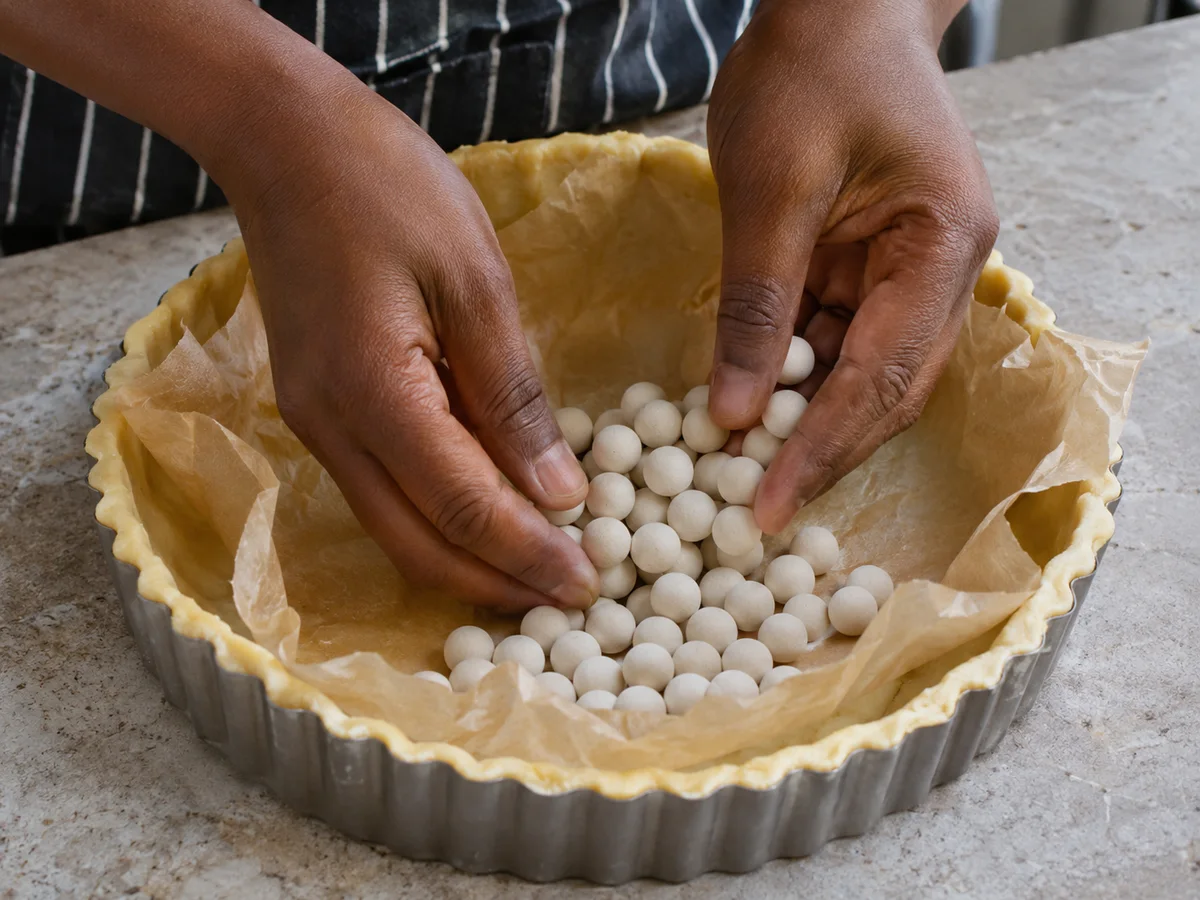
Weights are not intended to form a mound in the middle of the tart. They work where they keep paper and pastry in contact, including near the junction between the base and sides. If the paper stands away from that area, weights piled centrally can leave the surrounding pastry free to move. You also need enough accessible paper to lift out its contents in a controlled movement. The illustration shows ceramic weights being placed before baking. They are equipment rather than an edible filling. After baking, both the paper and its contents can be very hot. Set out a stable, heat-resistant place for them before lifting them out. Speed is a poor measure of success here. A spilled weight or a pastry edge caught by the paper creates more work than a steady, deliberate removal with the receiving surface already prepared.
Look at the centre as well as the edge
The edges are exposed to the oven while much of the base is covered. Looking at the rim alone therefore cannot establish whether the centre has baked sufficiently. When the paper is lifted, do not assume every part has received the same treatment. For a fully baked shell, returning it to the oven without the weights exposes the previously covered surface. If the recipe calls for another baking stage with a filling, stop at the state it specifies for this stage. Uniform colour is not always a useful target, because the base and edge may not colour together. A shiny, soft patch beneath the paper is worth noticing: it prevents a golden rim being mistaken for evidence that the whole shell is finished. The important question is whether the shell is ready for its next use, rather than whether one visible area resembles a finished tart.
Lining, docking and filling are different actions
Lining a tin means fitting a rolled sheet of pastry into it. This may precede blind baking but does not name the oven stage. Docking means making small holes in the dough, usually with a fork; it is different from holding the base down with weights. Whether to dock depends on the pastry and the intended filling. A very fluid mixture needs different consideration from fruit placed in a completely baked shell. Pouring a filling onto raw pastry and baking both together is not blind baking, even if something unusual happens to that filling afterwards. In translation, “baking the empty pastry shell” expresses the principle more clearly than a literal reference to whiteness. Several related actions may appear in the same method without becoming interchangeable. Naming each one makes the sequence easier to follow and helps identify the source of a misshapen or insufficiently baked shell.
My advice: begin with the filling's next step
Ask whether the filling will bake, set in the refrigerator or simply be added for serving. The pastry must be ready to receive it at that particular point. A cold, wet filling cannot repair an insufficiently baked base. A filling that must bake does not necessarily require the pastry edge to have reached its final colour beforehand. Notice when the shell is removed from its tin too. Thin pastry that is still hot does not have the same strength as pastry that has had time to firm. With a loose-bottomed tin, support the centre while lifting; holding only the pastry rim makes its most fragile part carry the load. A useful dictionary example shows the empty shell in the oven or explicitly describes that sequence. A finished dessert may be appealing, but it cannot demonstrate the order in which the pastry and filling were cooked.
A reading and observation exercise
For a reading exercise, compare two recipes: one fills a completely baked shell with cold cream, while the other returns its partially baked shell to the oven. Mark the point where the weights leave each tin. This reveals why the same initial action can have different stopping points without supplying a common temperature or cooking time.