Cream
Add cream; in pastry, beat butter and sugar until soft and combined.
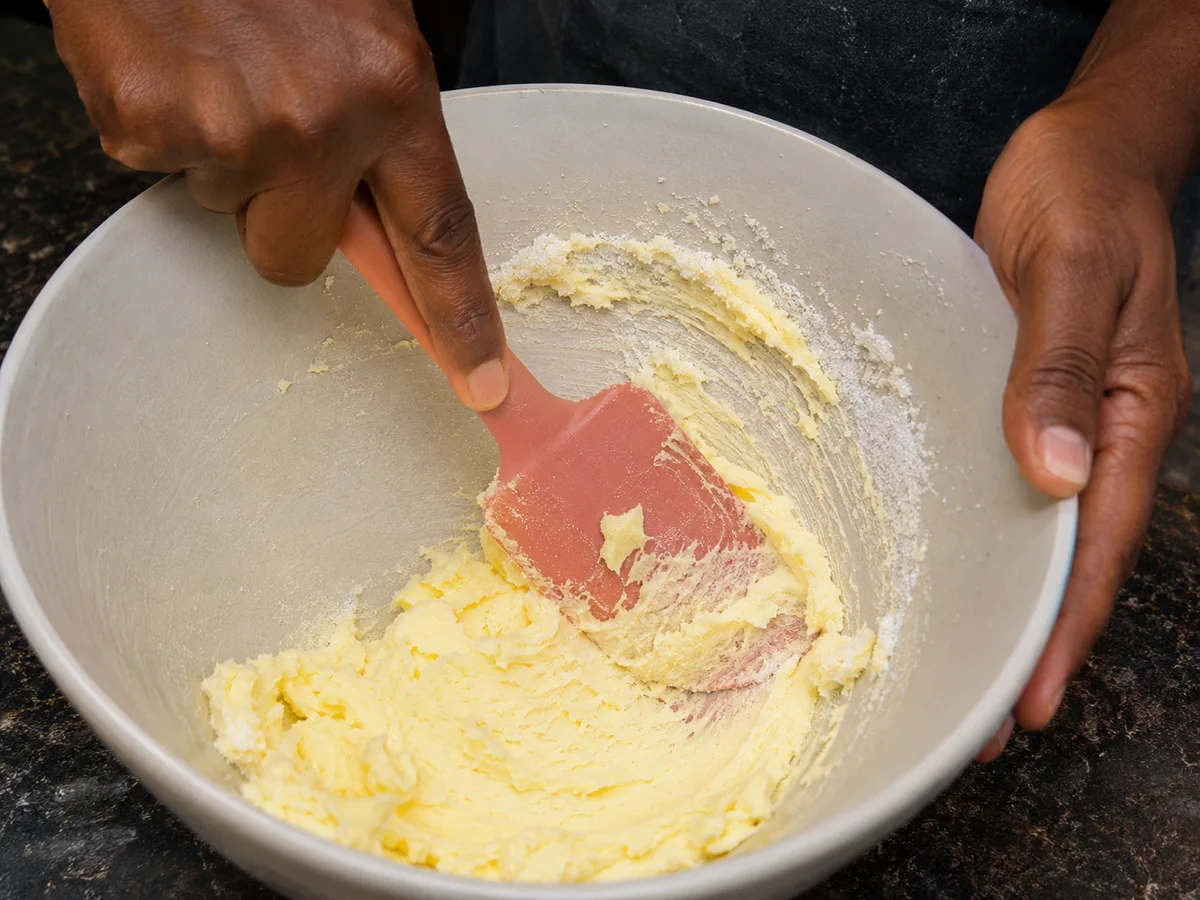
What does the verb ask you to do?
When they read the French word crémer, many cooks immediately reach for the cream. Sometimes that is exactly right. In a cookery instruction the verb can indeed mean to add cream to a preparation. In a baking text, however, it may ask you to work a fat, usually butter, on its own or with sugar until it is soft and smooth. In this second sense, pouring in cream on the strength of the word alone would change the mixture. The ingredient list, the order in which the ingredients appear and the result the writer expects are better guides than the verb in isolation. If the instruction says to cream the butter and sugar, look at what is happening to the mixture in the bowl. If it says to finish a soup with cream, find the cream in the ingredient list and establish when it should go into the liquid.
Two professional uses, without a claim of invention
The training document Terminologie de la pâtisserie, produced by the École hôtelière des Laurentides in June 2012, uses the verb for working a fat, either alone or with sugar, to a creamy consistency. The New Brunswick Department of Education’s introductory professional cookery curriculum, in its 2009 version, records the use of the word for adding cream or covering food with it. These are not conflicting accounts of how to make one dish. They record two different uses of the same French word. They show that both senses are taught in French; they do not tell us when anyone invented either technique or where it was first practised. A home baker in Dakar, Port Louis or elsewhere may use a comparable method without referring to it by the French professional term. The illustration for this entry shows the baking sense, not the addition of cream to food.
In the bowl: soft butter is not melted butter
Before working the butter, see how it yields to gentle pressure. Hard, cold pieces resist and slide around the bowl instead of spreading evenly. Liquid butter is equally unlike a pliable paste: it spreads at once and does not hold a clear mark where a spatula has passed. Between those states, the butter can be pressed against the side of the bowl and gathered back together. If sugar is called for, the softened fat allows it to be distributed before other ingredients go in. Do not insist that every grain disappear if the recipe uses sugar with perceptible crystals. The mixture may grow paler and gain volume as it is worked. That does not mean that every preparation should reach the same degree of whiteness or rise to the same height in the bowl. Texture and evenness tell you more than a fixed number of minutes.
What changes when you switch tools?
A firm spatula lets you press out the first few stiff patches and feel exactly where the butter still resists. A mixer distributes the work differently and can incorporate more air. Consider how much mixture you have, the size of the bowl and the texture the recipe calls for. In a wide bowl a small quantity may sit entirely beyond the reach of the beaters. In a thick mixture a very flexible spatula may bend without moving the mass at all. Look for greasy streaks, hard lumps or a layer of sugar still sitting on the bottom although the top looks even. Stop the mixer before reaching in with a spatula. Scrape the sides and base, then restart if needed. Looking in several places is a better test than judging the mixture by the sound of the motor or the colour of the surface alone.
A different question in soups and sauces
Adding cream changes the liquid already in the pan. The preparation may become paler or feel rounder on the palate, but the effect depends on the cream and on the other ingredients. A small addition will not necessarily give body to a stock that is already too thin. Nor is cream a guarantee that a sauce will stay smooth under every condition: acidity and the way heat is applied matter with some dairy products. With an unfamiliar recipe, add the cream at the point specified and watch what happens. Boiling the mixture harder in an attempt to repair its consistency is not a reliable response. Coconut milk or a plant-based cream will also change a dish, but the result is not automatically interchangeable with dairy cream. Identify the product the recipe uses and what it is meant to contribute before treating such choices as equivalent.
Creaming, whisking, whipping and thickening
Whisking describes a tool or a movement; on its own it says little about the transformation you want. Whipping cream is intended to produce a foam that holds its shape. That is neither working softened butter nor pouring cream into soup. Thickening describes the desired effect on consistency. Cream is only one possible ingredient, and simply including it does not ensure that it will thicken the dish in the intended way. The French expression beurre pommade describes butter in a soft, spreadable state; it does not imply that any sugar has been added. These distinctions give a multilingual dictionary a better starting point than a single English equivalent. Say that butter is worked with sugar when that is the instruction; say that cream is added when the instruction concerns the liquid.
A practical check: identify the material and the result
Before you start, identify both the ingredient named in the instruction and the result needed for the next stage. A butter-and-sugar mixture that must accept other ingredients is not judged in the same way as a soup whose richness and fluidity are being adjusted. When an instruction is ambiguous, do not substitute one ingredient for another on a guess. Reading the next part of the method will often settle the question. The same principle applies to illustrations and related recipes: a useful example shows the particular action, not merely a finished cake or a pale sauce.
A reading and observation exercise
Compare a little softened butter with a little melted butter in separate bowls. Draw the same spatula through each and watch whether the trail remains. This demonstrates a difference in the starting material rather than a universal beating time. It does not make the two states interchangeable in a recipe that specifies one of them.
Sources and further reading
Terminologie de la pâtisserie — matière grasse travaillée · Nouveau-Brunswick — ajouter de la crème