Insert slivers into slits
Insert thin slices of an ingredient into slits in food before cooking.
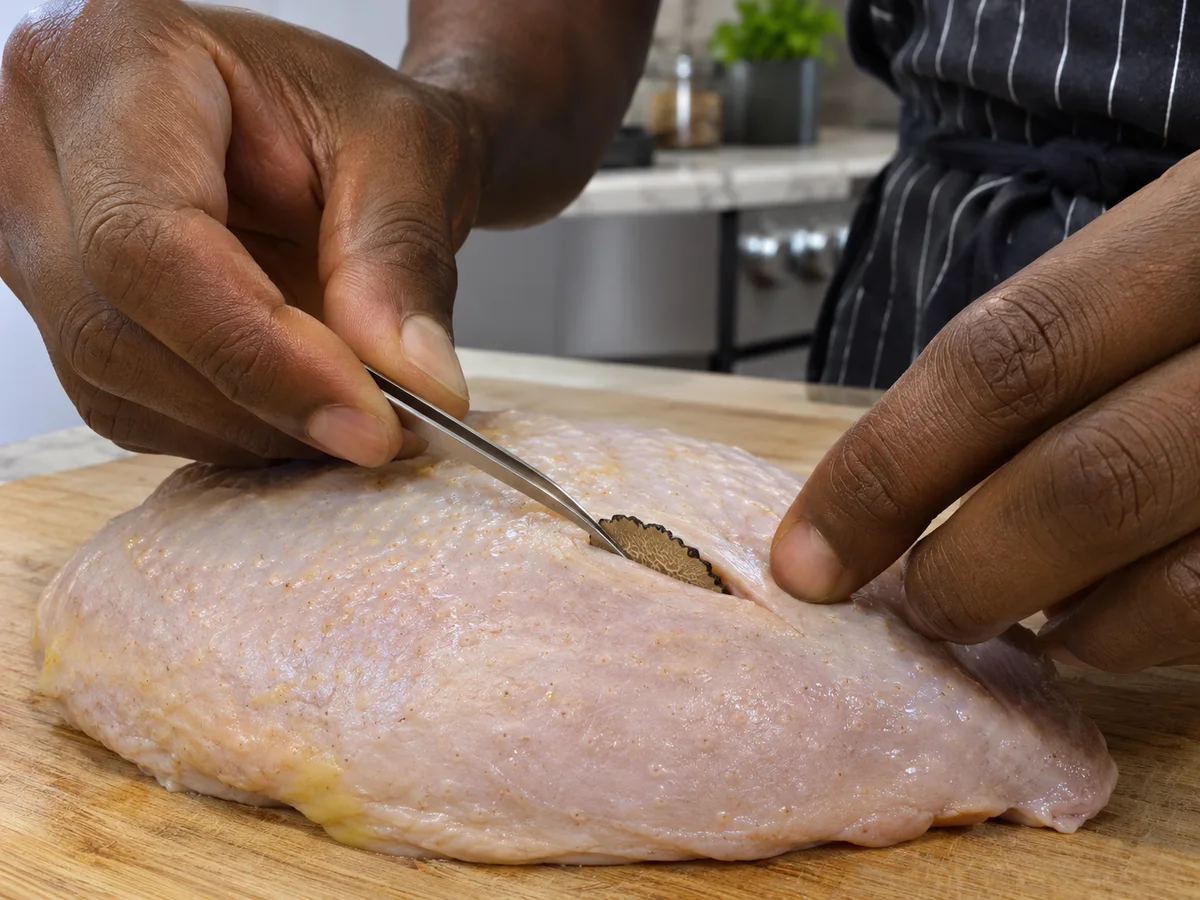
A small opening that holds a sliver
In classical French professional cookery, contiser means making a small, shallow cut in a piece of food and slipping a thin aromatic garnish into it. French glossaries often illustrate the verb with a fish fillet or poultry and a slice of truffle. The slice does not fill the piece: it occupies a specific spot at the surface or just beneath the skin. The term therefore describes two connected actions, opening and inserting. A cut with nothing tucked into it does not in itself demonstrate the technique. Nor does a garnish simply laid on top. The verb is easiest to understand when you can point to the exact place on the piece where the thin slice is held.
What the glossaries actually document
Nicolas Mercier's professional glossary, consulted on 20 November 2026, describes a careful cut in the skin of poultry, game or certain fish, into which a slice of truffle is slipped. A training glossary available through the regional education portal of Murcia also uses the term in connection with raw fillets. These sources document French professional usage. They give neither a date for the invention of the technique nor evidence that every filled incision in any cuisine should be given this name. For an African example, an incision alone would only be a clue. One would also need to check what is inserted, how the piece is handled, and what the source calls the technique. A comparison can be useful without becoming a claim about where a method or name belongs.
Read the surface before making the incision
The area you choose should hold the slice without requiring a deep cut into the flesh. Thin skin that tears readily cannot be handled in the same way as thick poultry skin. A piece that has already split or is poorly supported may open farther than intended if held in the air. On a stable board you can see the blade's path and stop before you create too large a pocket. The small scale of the gesture matters more than a prescribed length. The aim is to make just enough room to insert the aromatic ingredient. If several slices are to be inserted, look at their spacing before making the first cut, particularly wherever the skin is taut or may draw back. An even pattern can contribute to presentation, but a decorative line is not a reason to weaken the piece.
Do not let the garnish dictate the depth of the cut
A thin, supple slice slides in more readily than a thick piece with hard corners. If it catches, the most useful response is not necessarily to enlarge the opening. You can reconsider the size of the garnish or how you offer its edge to the slit. Forcing it may crush it, and a wider cut can let it slip out as soon as the piece is moved. Hold the piece without stretching it, introduce one edge and slide the slice in without folding it. To grasp the principle without cooking with truffle, picture a thin leaf slipping into a shallow slit. That comparison explains the movement; it does not present any leaf as a documented culinary substitute. The aromatic ingredient should be the one specified in the recipe or chosen for an explicitly identified experiment, not the product of an invented universal rule.
Inserting, scoring, stuffing and larding are not interchangeable
To score or incise something is first of all to cut into its surface. Cuts may help a skin stay flat, make a piece easier to carve, or accommodate a garnish. Contiser specifies which of these situations is meant: the shallow opening receives a thin insert. Stuffing generally involves more space, such as a cavity or an enclosing layer that contains the filling. Larding traditionally refers to inserting strips of fat into the flesh; the material and the path of insertion differ from those of a small surface cut. Barding is different again: a layer of fat covers the piece rather than sitting in an incision. These distinctions are not intended to correct the words a cook uses in their own language. They help a reader interpret what is expected when a particular verb appears in a manual.
Why do it, and what can you observe?
One advantage is that the aromatic ingredient remains in contact with a particular part of the piece. A diner may encounter a more noticeable fragrance at that spot, and a visible slice may be part of the presentation. The technique is not meant to spread fragrance evenly all the way to the centre or to tenderise the flesh. It is no substitute for seasoning the surface evenly or for another operation chosen to achieve a different result. When checking the work, look for a cut that does not go right through the piece, an insert that has not torn the skin, and edges that do not protrude enough to interfere with moving it. Cooking may change how the surface looks. A sliver no longer clearly visible afterwards does not by itself tell you whether it was tucked in or laid on top. That is why an illustration should show the technique at the moment it is performed rather than just the finished plate.
My tip: distinguish an experiment from a documented technique
When a recipe says only to score the fish, do not infer an inserted garnish without reading the rest. If it asks for a slice to be slipped into a shallow cut, identify the skin or surface in question and check whether the slice is sized to fit. Getting the garnish ready first avoids changing knives or needlessly moving a raw piece in the middle of the work. Keep utensils and surfaces that have touched the raw piece separate: proximity to an aromatic ingredient does not make it suitable to reuse raw as a finishing garnish. When linking from a dictionary entry, say whether the example documents the precise movement, shows a related technique, or merely shares an ingredient. If it shows only scoring or stuffing, do not list it as a verified example of contiser. That distinction matters especially across languages: an explicit translation of the movement is more useful than an impressive technical word that makes the reader imagine a different operation.
Prepare the slices before moving the piece
A useful practice is to cut the aromatic slices before handling the fish or poultry. Aim for an even thickness, check whether a slice can bend without breaking, and keep the remaining slices nearby on a separate support. This preparation avoids gradually deepening a cut simply to accommodate an insert that was too thick in the first place. Once a slice is inserted, move the food with a broad support rather than pulling on the edge of the incision. Observe whether the insert stays in place without pressure or a deep pocket to trap it. If neighbouring cuts join together, reconsider their spacing on the next piece instead of assuming that more incisions give a better result. This exercise concerns precise placement, not a required amount of truffle or a universal number of slits. In a written description, identify the surface involved and what happens to the insert when the piece is transferred. Those observations explain the technique more clearly than a general claim that the finished dish looks elegant.
Sources and further reading
Nicolas Mercier — entrée Contiser · Portail Educarm — lexique de formation · Anses — éviter les contaminations croisées, non source historique