Confit
A term used notably for meat gently cooked in fat or fruit prepared in sugar; its meaning depends on the product.
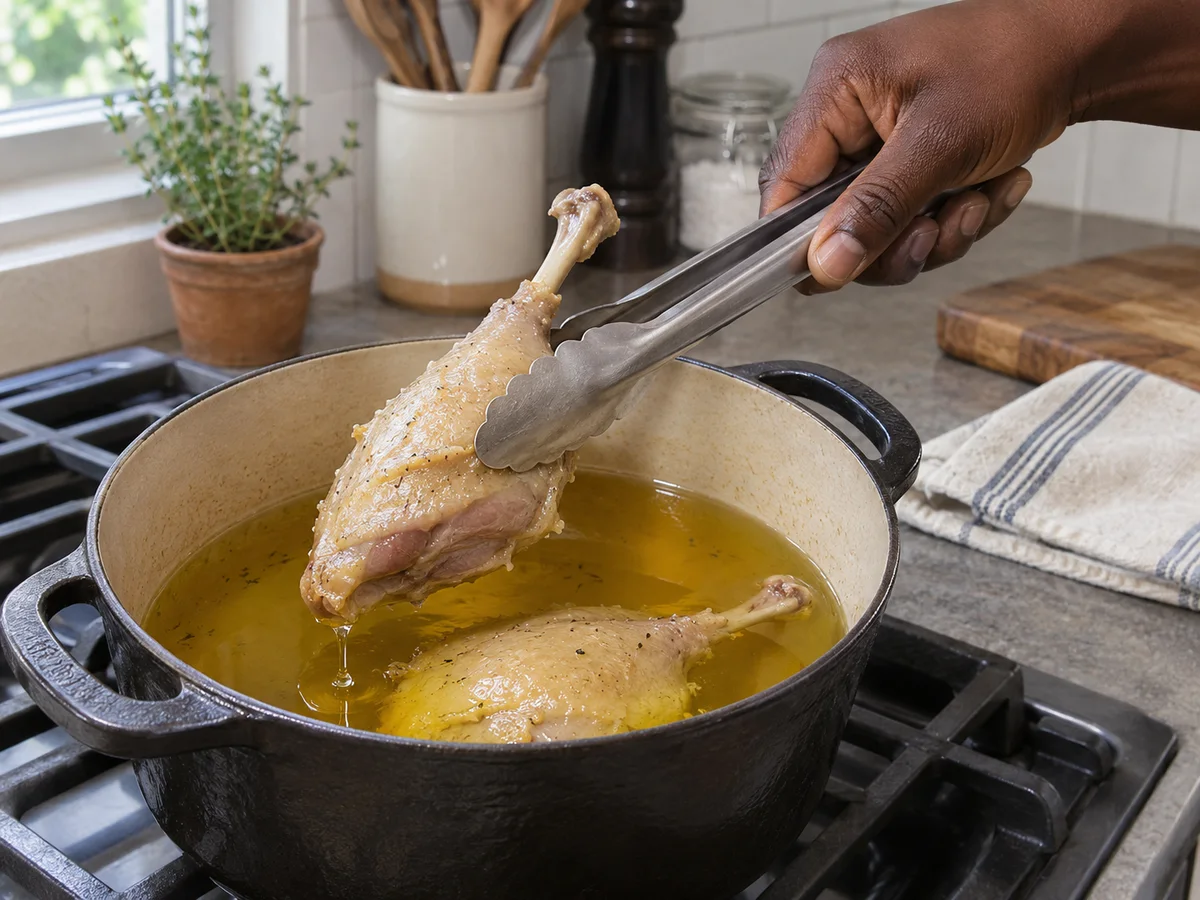
Kinshasa: a documented example, two readings of a recipe
In November 2022, Radio Okapi’s recipe feature presented duck confit with braised red cabbage and sautéed potatoes. The report documents use of the word and a way of serving the dish in Kinshasa; it is not enough to credit the city with inventing confit or to make the recipe a national template. The RecettesAfricaines version starts with duck legs that have already been cooked as confit. The two accounts therefore begin at different stages: in the first, the duck undergoes cooking in fat; in the second, what takes place in the pan is a finishing step. The difference shows why a shared title is never a substitute for reading how the dish is prepared.
A noun and an adjective
In the kitchen, the word confit does not always tell you what is in a dish. As a noun, it can mean meat cooked in its own fat; duck confit is a familiar example in French culinary vocabulary. As an adjective, the word describes the condition of an ingredient or how it was prepared. Candied fruit, cooked-down onions and a piece of confit poultry do not call for the same interpretation. Ask what the ingredient is, what medium it was prepared in and how the result is meant to be used. Most importantly, the word alone does not tell you whether the product contains sugar or fat, whether it tastes sweet or whether it is intended to be kept out of the refrigerator. This entry presents distinct senses while retaining the same searchable term.
What the sources document
The Académie française dictionary describes the noun as meat cooked in its own fat and preserved under that fat. Its article on confire, confit and confiture helps distinguish forms and uses in the same family of words. The culinary teaching glossary of the Versailles education authority illustrates cooking in fat with poultry. For plant foods, the DGCCRF guidance on the use of the term for products preserved in oil raises a different question: how the product was actually prepared, and what the name tells you beyond the fact that it sits in oil. These sources offer complementary perspectives. They do not show that every contemporary use of the word refers to precisely the same practice. They establish neither a single date for the invention of the method nor an exclusive national origin for all preparations described by the word.
In fat: tenderness comes before crispness
When referring to meat confit, the presence of fat does not mean the goal is to fry the surface until it becomes dry and crisp. The cooking method emphasises gentle heat that gives the flesh time to become tender. At the table, any contrast between soft meat and crisp skin also depends on the finishing step. Browning a piece at the last moment can transform its surface after the flesh is already tender, without being the step that made it tender. The distinction helps when reading a recipe that sets out both operations in order. A piece served immediately after cooking can resemble a confit in technique or texture even though no preservation stage has taken place. Conversely, packaging does not tell you how the piece was cooked. It is more precise to describe the cooking, any subsequent packing or storage process, and the finishing step separately.
In a sugar medium: think about the individual piece
For candied fruit, sweetness and texture go together. Fruit can remain recognisable in a filling even when it is flexible and translucent; its role is different from that of a smooth purée. Small pieces can provide distinct accents of flavour in a dough or batter, while larger pieces can be presented separately. Depending on the ingredient and the process, the peel can matter as much as the flesh. Citrus peel prepared for this purpose retains a perceptible bite and a different aroma from the pulp. The word alone does not identify a precise process or explain all the stages performed. When describing the product, say what you can see and what is documented: whole piece or fragment, peel or pulp, firm or soft texture and whether a sugary medium is attested. Do not infer the method from sheen alone.
Onions, tomatoes and other descriptive uses
A restaurant menu may use the French phrase oignons confits to emphasise the sweetness and soft texture of onions. The phrase does not prove that they are a preserved product or that they were treated like poultry. Likewise, a soft tomato with a concentrated taste may be described as confite, even when its recipe emphasises evaporation and flavour. The useful question for the reader is whether the adjective identifies a documented process or sums up what the food feels and tastes like. If information is lacking, it is better to keep the cook’s expression and describe what is known, without reinterpreting the dish as a variation on one model. The name of a particular confit ingredient can also belong to a market, a workshop or a family. A broader French usage does not provide evidence for a local name or local practice in another language.
Compare cooking down, caramelising and marinating
The French verb compoter focuses on softening and the way pieces break down into a supple mixture. That description might apply to onions someone calls confits, but it does not tell us on its own what medium was used. Caramelising concerns sugar under heat, or deliberate browning in everyday kitchen language; something described as confit does not have to turn brown to take that name. Marinating generally means leaving food in a mixture to give it flavour or prepare it for a later stage. That contact alone does not describe a result achieved through gentle cooking. Finally, jam has its own culinary use. Comparing it to candied fruit on the basis of sugar alone would lose the distinction between a product that spreads and a piece that remains separate. These distinctions help the reader understand a recipe and choose a technique, without imposing one kitchen’s vocabulary on another.
My advice: describe the product before deciding how to use it
The word itself does not mean the food can be kept at room temperature. For a bought product, follow the maker’s storage instructions rather than relying on visible fat, sugar, texture or the name on the label. For a dish in the kitchen, first ask what you want from the result: tender meat that can be finished for serving, a filling with distinct pieces, or a soft accompaniment that mixes with the sauce. This does more to clarify a recipe than a single all-purpose English translation. When comparing several kinds of confit, make a note of the ingredient being worked, the medium mentioned in the source and the condition of the food at serving. If any of these details is unknown, leave it open. A dictionary entry is more useful when it makes the differences understandable than when it promises a definition that can be applied mechanically to every dish.
Sources and further reading
Académie française — sens nominal · Académie française — famille des mots · Académie de Versailles — CONFIRE · DGCCRF — emploi du terme pour les végétaux dans l’huile · Radio Okapi — usage à Kinshasa, 24 novembre 2022