To set (with gelatin or gelling agent)
To firm up a preparation by incorporating a gelling agent, traditionally jelly or gelatin, to achieve a set upon cooling.
Definition and Scope
The term "coller" (to set) in cooking refers to the action of integrating a gelling agent into a liquid or semi-liquid preparation to give it a firm and stable texture after cooling. This process is fundamental for the structural integrity of many preparations, particularly in pastry and cold charcuterie. It involves transforming a fluid state into a more solid, often elastic or wobbly state, through the action of a substance capable of forming a three-dimensional network that traps the liquid. Gelatin, of animal origin, is the most commonly associated agent with this technique, but other gelling agents such as agar-agar or pectins can be used, each with its specific properties. Setting with a gelling agent is distinct from simple starch-based thickening, which thickens without necessarily gelling, or from reduction, which concentrates flavors and texture through evaporation. It should also not be confused with "coller" in the sense of joining solid pieces, which involves assembling solid elements with a binder.
Desired Outcome
The primary objective of setting a preparation with a gelling agent is to achieve a stable product that can be unmolded, cut, or plated without collapsing. The final texture must be homogeneous, free of undissolved gelling agent lumps, and present a pleasant mouthfeel. Depending on the concentration of the gelling agent and the nature of the preparation, the result can range from a very soft and wobbly texture, as for a panna cotta, to a firmer and denser texture, as for certain terrines. The transparency or opacity of the preparation can also be a desired aesthetic criterion. Successful setting ensures not only the structural stability of the dish but also a consistent sensory experience, where texture fully contributes to overall appreciation. The setting process should be gradual and uniform, without separation of liquid and solid phases.
Equipment and Product Selection
The necessary equipment is generally simple: a whisk or a spatula for incorporation, suitable containers for preparation and cooling, and possibly a thermometer to control the temperature. The choice of gelling agent is crucial. Animal gelatin, available in sheets or powder, is the most common. It requires prior hydration in cold water before being dissolved in a warm (but not boiling) liquid and incorporated. It is important to check for certification (e.g., halal) if animal origin is a concern. Agar-agar, derived from seaweed, is a powerful gelling agent that must be boiled to activate and yields a firmer, less elastic texture than gelatin. Pectins, of plant origin, are often used for jams and jellies. Depending on their type, they require a balance of sugar and acidity or the addition of calcium; their conditions of use are not interchangeable. Each gelling agent has its own instructions and constraints, and it is essential to follow the manufacturer's recommendations and test proportions on a small volume to ensure the desired result, as a gram-for-gram replacement between gelling agents is generally not appropriate.
Understanding the Technique
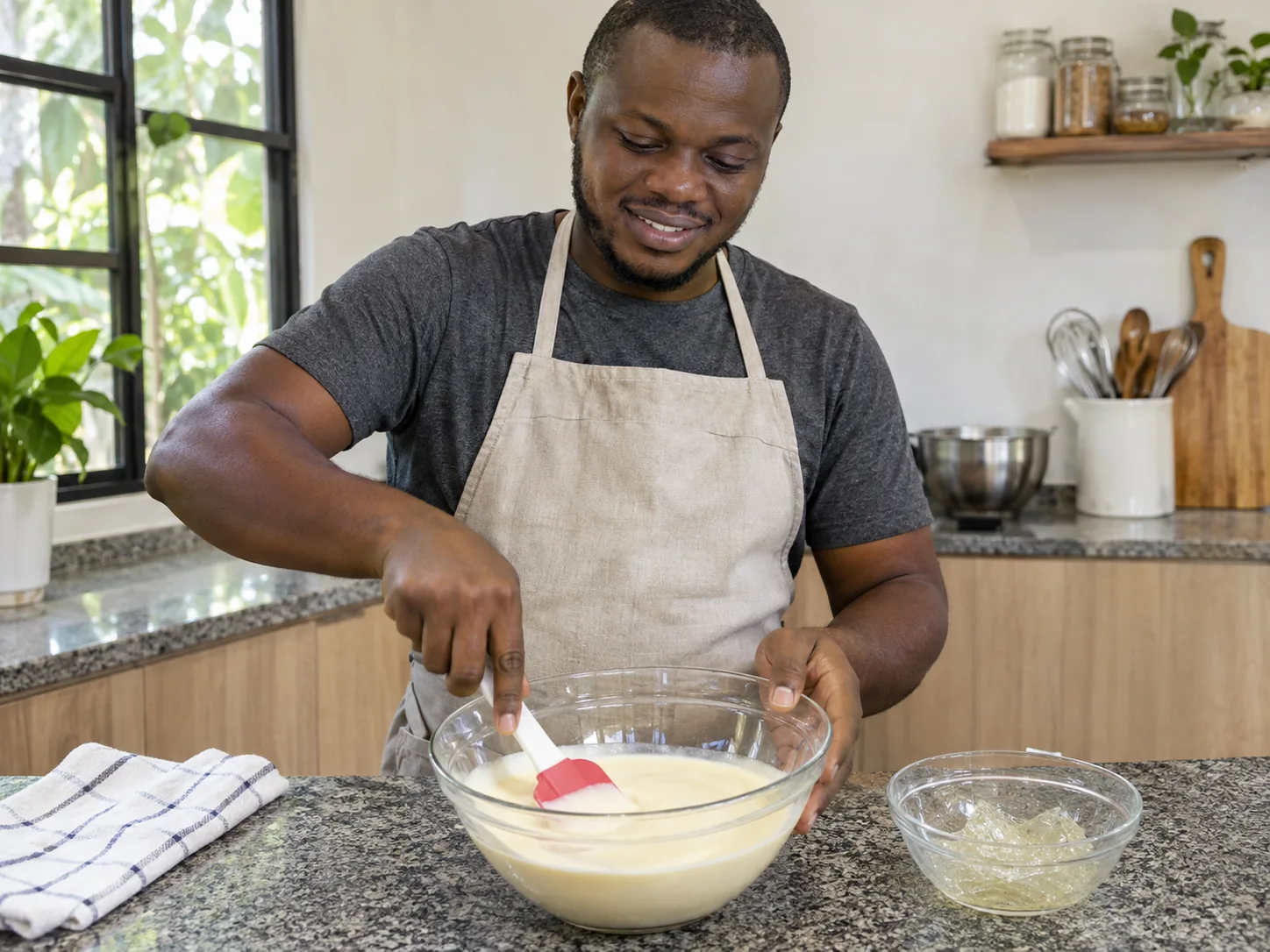
The technique of setting with a gelling agent involves several key steps. First, hydration of the gelling agent: for sheet gelatin, this means submerging it in very cold water until it softens. For powdered gelatin, it must be mixed with a small amount of cold liquid to form a granular mass. Second, dissolution: the hydrated sheet gelatin is then drained and dissolved in a small amount of warm liquid (but not boiling, as prolonged boiling can alter its gelling power) or incorporated into a preparation warm enough to dissolve it, according to instructions; a merely lukewarm base may be insufficient. Third, incorporation: the dissolved gelling agent must be added gradually to the preparation to be set, stirring constantly and gently with a spatula or whisk to ensure homogeneous distribution. It is often advisable to temper the gelling agent by adding a small portion of the preparation to it before incorporating it into the whole, to avoid thermal shock that could create lumps or an uneven set. Finally, cooling: the preparation must be placed in the refrigerator to allow the gelling agent to act and the setting to occur.
Observation Criteria
Several criteria allow for evaluating the success of a setting process. Visually, the preparation should be homogeneous, without traces of undissolved gelling agent or phase separation. The surface should be smooth and shiny, unless a matte texture is intentionally desired. To the touch, the preparation should exhibit a certain firmness and elasticity, without being too hard or too soft. When unmolded, it should retain its shape without collapsing. In the mouth, the texture should be pleasant, melting or wobbly depending on the desired effect, and not leave a grainy or rubbery sensation. The absence of an off-flavor related to the gelling agent is also an indicator of success. The speed and uniformity of the set are also signs of good gelling. A set that is too slow or uneven may indicate a problem with temperature, gelling agent concentration, or incorporation.
Educational Applications in Various African Cuisines
In a workshop dedicated to textures, one can compare a fluid preparation and a gelled preparation made from ingredients found in different African cuisines. These exercises do not attribute a cultural origin to the use of a gelling agent. For example, for a dessert based on tropical fruits like mango or guava, one could imagine a set mousse or jelly for an elegant presentation. In a learning kitchen setting, one could create vegetable or legume (beans, lentils) terrines set with agar-agar for a vegan option, offering an alternative to traditional dishes without gelling agents. For thick beverages or fermented milks, setting could help stabilize a denser texture for presentations in verrines. It is important to note that some fresh fruits, such as pineapple or papaya, contain enzymes (bromelain and papain) that can prevent gelatin from setting. In these cases, an appropriately heated fruit preparation can overcome this obstacle; it is not assumed that simple reheating is sufficient, and the result is controlled by testing. These applications are pedagogical examples for exploring the possibilities of setting, and not attested traditional recipes.
Distinctions from Related Techniques
It is crucial to distinguish setting with a gelling agent from other culinary techniques that may seem similar but rely on different mechanisms. Starch-based thickening, for example, thickens a sauce or cream by the action of starch swelling in the presence of heat, and can also form a gel upon cooling depending on the starch and formulation; however, culinary vocabulary distinguishes this thickening from the addition of gelatin. A béchamel is thickened with starch, but it is not "set" with a gelling agent. Reduction, on the other hand, concentrates the flavors and texture of a liquid by evaporating water, as for a reduced meat jus, but does not involve the addition of an external agent for setting. Whipping cream or meringue involves incorporating air to give volume and some stability, but the structure is airy and not gelled. Finally, the term "coller" can also refer to the action of assembling solid elements, such as sticking pieces of sugar paste with icing, which is a different application from gelling for setting. Understanding these distinctions allows for applying the correct technique at the right time for the desired result.
Errors and Corrections
Several common errors can compromise the setting process. One of the most frequent is boiling gelatin for too long, which can reduce its gelling power depending on conditions, particularly acidity. The correction is to dissolve gelatin in a warm but not boiling liquid, or to incorporate it into a lukewarm preparation. Another error is improper hydration of gelatin, making it difficult to dissolve or creating lumps. Always use very cold water for hydration. Uneven incorporation of the gelling agent can lead to a heterogeneous set, with some areas firmer than others; gradual incorporation and constant stirring are essential. Using fresh fruits containing proteolytic enzymes (pineapple, papaya) without prior cooking is a classic error that prevents gelatin from setting; one chooses a suitably treated fruit preparation or another appropriate gelling agent, then checks the set with a test; a so-called brief cooking without further precision does not guarantee the result. Finally, incorrect dosing of the gelling agent, too weak or too strong, will yield an unsatisfactory texture; a test on a small volume is always recommended to adjust proportions.
Variations and Adaptations
Setting with a gelling agent offers numerous variations and possibilities for adaptation. Beyond animal gelatin, agar-agar is a popular plant-based alternative, yielding a firmer and less elastic texture, and requiring boiling for activation. Pectins are used in fruit preparations, but the appropriate type and its activation conditions are chosen rather than generalizing the role of sugar and acidity. Other families, such as certain carrageenans, can form gels under specific conditions. Xanthan gum is primarily a thickener; alone, it does not replace the set of a gelatin jelly. Adaptation of the technique can concern the setting temperature (some gelling agents set at room temperature, others, like gelatin in many preparations, require appropriate cooling, without imposing freezing), transparency (some gelling agents yield clearer preparations than others), or heat resistance (agar-agar is more heat-stable than gelatin). The concentration of the gelling agent is also a key variable for adjusting the firmness of the preparation, allowing for the creation of textures ranging from very wobbly to very firm. These adaptations allow cooks to explore a wide range of textures and meet specific dietary or cultural constraints.
My Advice
To master the art of setting with a gelling agent, precision is your best ally. Never underestimate the importance of correctly hydrating your gelling agent and dissolving it at the right temperature. A small test on a spoonful of your cooled preparation will give you valuable insight into the final firmness before committing to the entire batch. If you are working with acidic ingredients or fresh fruits, be vigilant and do not hesitate to adapt your choice of gelling agent or prepare your fruits accordingly. Think about the texture you want to achieve from the outset: wobbly for a panna cotta, firm for a terrine. Each gelling agent has its personality; learn to know it. Setting is not just a stabilization technique; it is a creative tool that opens the door to surprising textures and elegant presentations. Experiment with infusing flavors into your base liquids for aromatic jellies, or incorporate textured elements for interesting contrasts. Patience is also a virtue: allow the preparation enough time to set properly in the cold for an optimal result.
Sources and further reading
2026-11-19