Clarify (Clarifier)
To make a liquid limpid, to separate the phases of melted butter to isolate pure fat, or to separate the white and yolk of an egg.
Definition and Scope
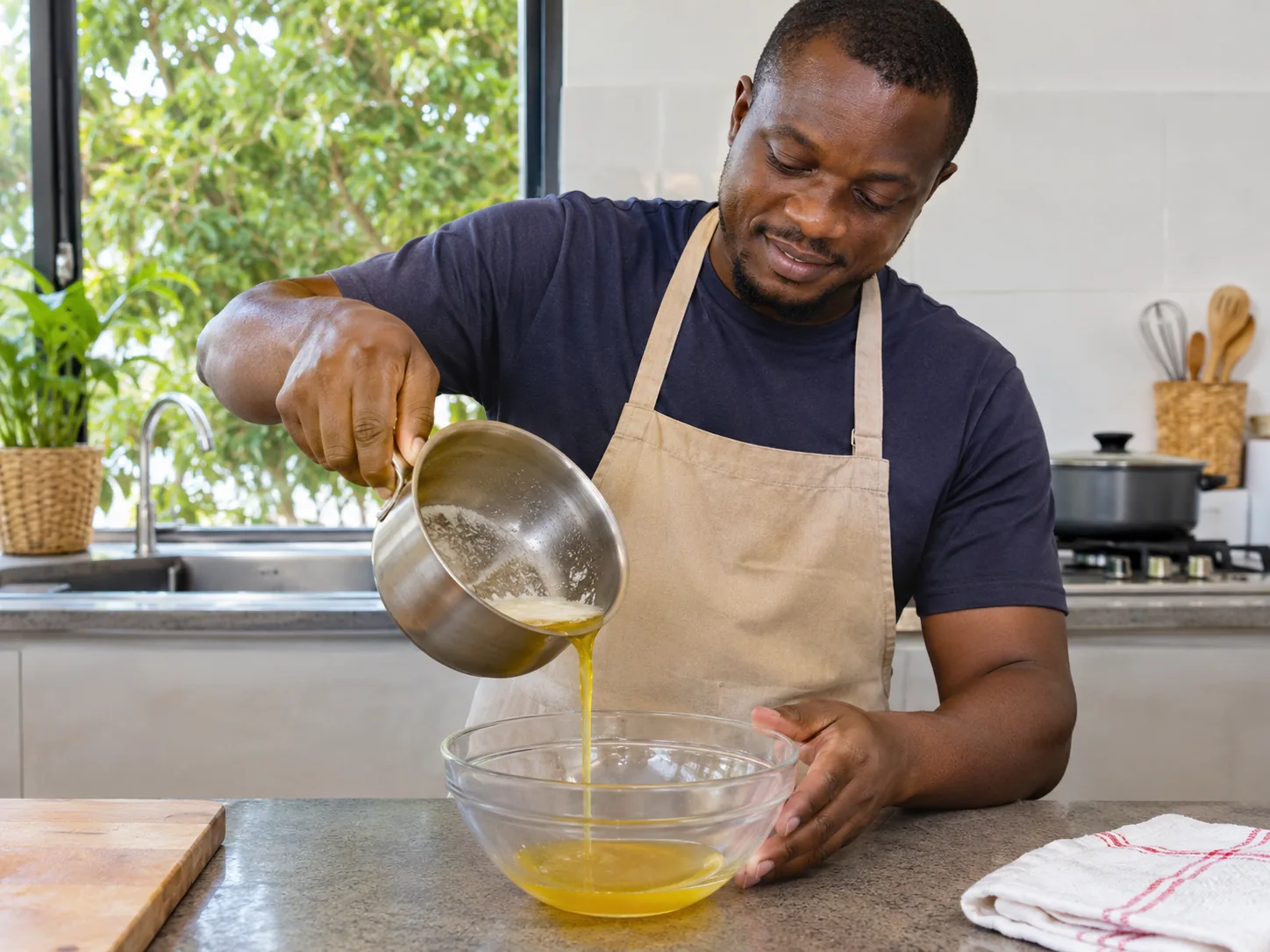
The term "clarify" is polysemic in cooking, referring to three distinct operations that share the objective of component separation. Firstly, it involves making a broth or consommé perfectly clear, by eliminating suspended impurities. Secondly, clarifying butter consists of gently melting it to separate the fat phase from milk solids and water. Finally, clarifying an egg means meticulously separating the white from the yolk. Although the techniques vary considerably for each application, the common principle is to isolate a useful component for preparation by separating it from others or by making a substance more transparent.
Desired Outcome
For a broth, the expected result is crystalline clarity, without any suspended particles, with a clean flavor that is not necessarily more concentrated, and a brilliant color. For butter, the goal is to obtain a translucent fat phase, as well separated as possible from milky residues and some of the water. This does not guarantee the absence of milk proteins or lactose. Gentle melting does not necessarily impart a nutty aroma, which is associated with a different cooking process. For eggs, clarification aims to obtain whites perfectly free of yolk for preparations requiring impeccable coagulation or whipping, and intact yolks for sauces, creams, or emulsions where their richness is paramount. Each result is an improvement in the texture, appearance, and sometimes the functionality of the ingredient.
Equipment and Product Selection
To clarify a broth, a fine-mesh sieve, cheesecloth, or a clean cloth is needed, along with egg whites (sometimes mixed with ground meat or vegetables) as a coagulating agent. The broth should be thoroughly degreased beforehand. To clarify butter, a heavy-bottomed saucepan for gentle heating, a ladle or spoon for skimming, and a heat-resistant container to collect the clarified butter are necessary. The butter should be of good quality, ideally unsalted. To clarify eggs, two small individual bowls are essential for separating each egg one by one, thus minimizing the risk of contaminating a batch of whites with a broken yolk. Freshness of the eggs is an advantage, as fresh egg whites are firmer and separate more easily from the yolks.
Understanding the Technique
Clarifying a broth involves slow and gentle cooking after adding the clarifying agent. One observes the formation of a 'raft' on the surface, which traps impurities. The technique then consists of delicately piercing this raft to retrieve the clear broth from underneath, or very gently straining it. For butter, the technique is one of gradual melting over very low heat, without boiling. One observes the formation of a white foam on the surface and the sedimentation of milk solids at the bottom. The key technique is to slowly pour off the golden upper phase, leaving the milky residues at the bottom. For eggs, the technique is delicate: crack the egg on a flat surface, open the shell in two, and pass the yolk from one half to the other, allowing the white to drain into a bowl, until only the yolk remains in the shell.
Observation Criteria
For a clarified broth, the main criterion is transparency: one must be able to see through it without any opacity or particles. The color should be uniform and brilliant. For clarified butter, the color should be a deep, uniform golden yellow, with no trace of milky white or burnt brown. It must be perfectly translucent and have a buttery smell without any burnt notes. For eggs, the whites must be completely free of yolk, without the slightest orange or yellow trace. The yolks must be intact, round, and firm, with no tearing of the membrane. Any mixture, even minimal, compromises the functionality of the whites for certain preparations.
Educational Applications in Various African Cuisines
Although terms and techniques may vary, the principle of clarification is applicable in many African cuisines. For example, to improve the clarity of meat or fish broths used in light soups or sauces, egg whites could be used as a clarifying agent, similar to a consommé. In contexts where cow's butter is used, such as in certain regions of East or North Africa, clarifying butter would allow for obtaining a more stable fat for high-temperature cooking without implying an extended shelf life. This is similar to the preparation of ghee, although clarified butter is not automatically ghee. Egg separation is a universal technique, useful for preparations like fritters where only the yolks are needed for richness, or for meringues or mousses where whipped whites are essential. These applications are pedagogical examples to illustrate the versatility of the technique, and not attested culinary traditions.
Distinctions from Similar Techniques
Clarifying a broth is distinct from simple straining. Straining removes large particles but does not guarantee perfect clarity; clarification by egg white coagulation captures fine particles. Clarifying butter is not the same as making ghee, although the process is similar. Ghee often involves longer cooking to develop more pronounced nutty flavors and a more complete removal of water, and should not be automatically equated with simple decantation after melting. Clarified butter remains a milk derivative and does not guarantee the absence of allergens. Separating eggs is a distinct technique from simply cracking them: it requires precision to isolate the two components without mixing them, which is not the case when using the whole egg.
Errors and Corrections
For broth, a common error is to boil too vigorously after adding the clarifying agent, which can break the raft and release impurities. The correction is to maintain a very gentle simmer. For butter, heating too quickly or too strongly can burn the milk solids, giving a bitter taste to the clarified butter. The correction is to melt over very low heat and monitor carefully. For eggs, the most frequent error is piercing the yolk, thus contaminating the white. If this happens, it is best to set aside the contaminated white and start again with a new egg in a new bowl to avoid compromising the rest of the whites. Patience and delicacy are key for all these operations.
Variations and Adaptation
Variations must be chosen according to the meaning of the word. For broth, the garnish of the clarifying mixture can be modified according to a proven method, but adding any protein-rich vegetable is not enough to replace the role of egg whites. Filtration through cheesecloth can complement the operation without alone producing the same effects as coagulation. For butter, the basic exercise remains gentle melting followed by separation; prolonging cooking until browning transforms the result and does not represent merely a more thorough clarification. For eggs, a clean food separator can facilitate the technique if one is less skilled at handling shells. In all cases, one works egg by egg in a small intermediate container before combining the useful whites. None of these variations transform a visual observation into a health guarantee.
My Advice
Whatever the clarification operation, patience is your best ally. For broth, do not rush the cooking and straining. For butter, slow melting facilitates separation and allows you to monitor deposits without burning them. For eggs, take your time for each separation, always using an intermediate bowl for each egg to avoid spoiling an entire batch if a yolk breaks. Practice makes these techniques more intuitive and precise. Remember that visual clarity or purity does not mean the product is sterile or allergen-free. Clarified butter, for example, may still contain traces of lactose or casein, although reduced.
Sources and further reading
2026-11-19