Caramelize (Caraméliser)
To transform sugars by heat to develop caramel color and flavors, a process distinct from Maillard reactions.
Definition and Scope
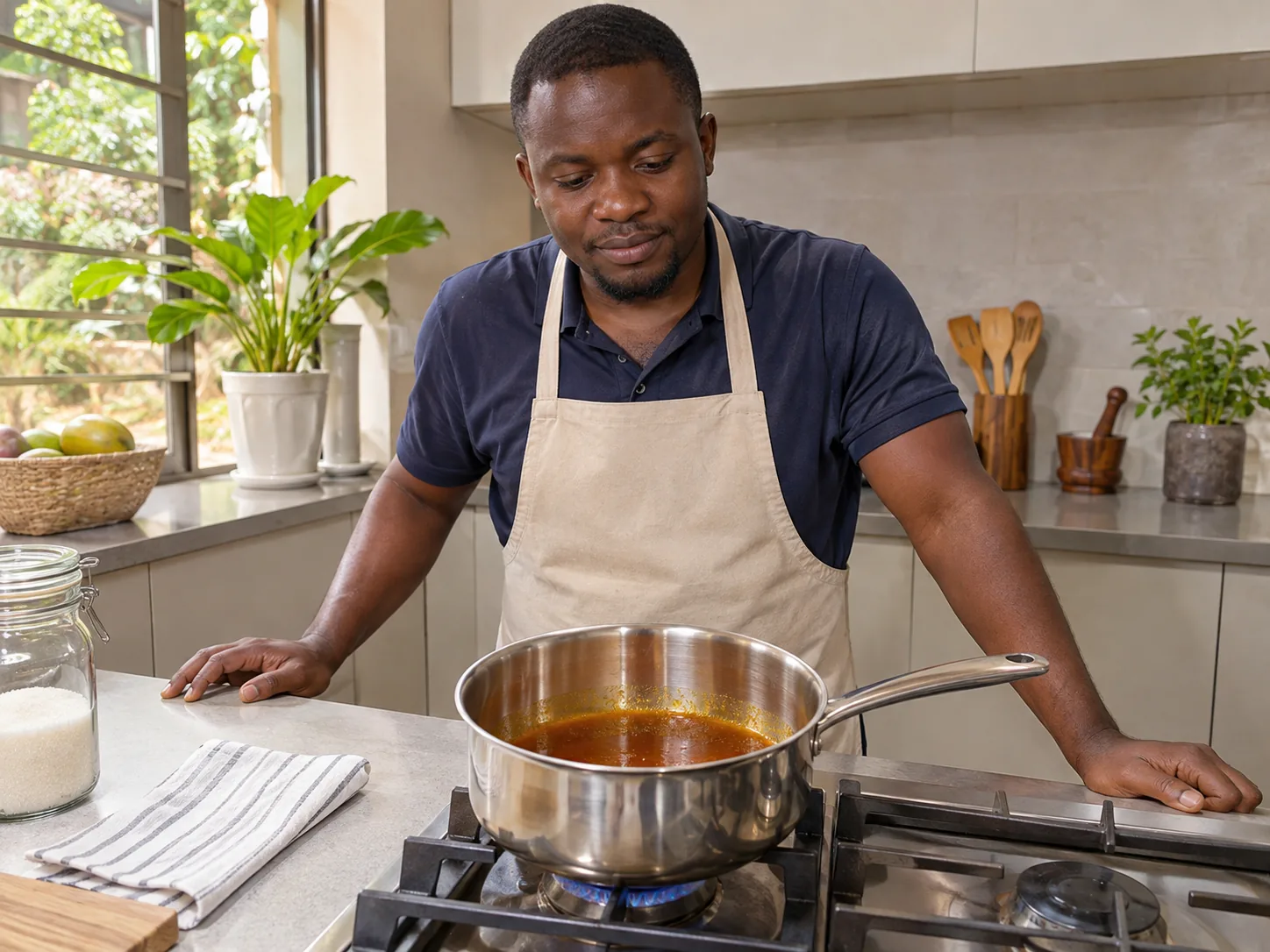
Caramelization refers to the transformations of sugars under the effect of heat, leading to the development of characteristic caramel colors and aromas. It does not require proteins to occur. However, in a complex food, it can coexist with other transformations; therefore, simply observing a brown color is not sufficient to identify the phenomenon. Maillard reactions, in particular, involve reducing sugars and amino groups, which are notably present in proteins. Sugar heated alone and seared meat do not brown through the same primary mechanism. In culinary vocabulary, to caramelize can also mean to coat a mold with caramel or to color a layer of sugar deposited on a preparation. Temperature, water content, the nature of the sugars, and heating duration influence the result. There is no single temperature valid for all sugary products. This entry thus distinguishes the word as used in a recipe, the observation of color, and the explanation of the transformations.
Desired Result
The ideal result of caramelization is a viscous liquid, amber to golden-brown in color, with a complex and rich aroma characterized by notes of hazelnut, butter, vanilla, and sometimes dried fruits or coffee. The texture should be smooth and homogeneous, without lumps or undissolved sugar crystals. Color is a key indicator of progression: a caramel that is too light will lack aromatic depth, while a caramel that is too dark will quickly develop bitter notes. The goal is to achieve a balance between the sweetness of the sugar and the subtle bitterness that develops with heat, creating a balanced and pleasant flavor. The final consistency can vary depending on the application: pure caramel, once cooled, can become brittle, while a caramel sauce typically contains liquid and sometimes fat. Simply prolonging the coloring does not replace the formulation of the final texture. Transparency and shine are also desired qualities, indicating good sugar fusion and the absence of localized burning.
Equipment and Product Selection
For caramelizing, a heavy-bottomed, light-colored saucepan is preferable. The thick bottom ensures uniform heat distribution, minimizing hot spots that could burn the sugar locally. The light color of the saucepan allows for better observation of the caramel's developing color, which is essential for process control. A heat-resistant spatula or pastry brush can be useful for moistening the sides of the saucepan to prevent crystallization, although in the dry method, stirring is generally avoided. The choice of sugar is also important. Sucrose (table sugar) is the most common and offers predictable caramelization. Other sugars like glucose can be added to control crystallization, but for simple caramelization, pure sucrose is sufficient. It is imperative to use clean and dry utensils to avoid introducing impurities or moisture that could disrupt the process. Safety is paramount: hot caramel reaches very high temperatures and can cause severe burns. It is therefore essential to use protective gloves and maintain a safe distance, especially when adding liquids, which can cause violent and dangerous splatters.
Understanding the Technique
Two common approaches allow for the observation of caramel formation. In the dry method, sugar heats in the pan without added water initially; the areas near the bottom evolve first, requiring careful monitoring. In the wet method, the sugar is first dissolved, and the syrup concentrates during heating. As much of the water evaporates, the temperature can increase further, and coloration develops. It is not inferred that absolutely no water remains, nor that reaching a given shade corresponds to an identical value for all syrups. Understanding the technique relies on the progression of color, homogeneity, and control of the pan. One does not leave the workstation during this phase. Removing the saucepan from the heat source reduces heat input, but the bottom remains hot: cooking can therefore continue for a moment due to inertia. This evolution is anticipated rather than waiting for an already too-dark color.
Observation Criteria
The first benchmark is a homogeneous color, observed against a background light enough to distinguish nuances. White sugar allows for better tracking of the transition from translucent to golden then to amber than an already strongly colored sugar. The second benchmark is the smell, assessed without bringing the face close to the pan: a change towards a pungent note suggests interrupting the process. Smoke is not a desired outcome. The third benchmark is the absence of black areas or fragments that burn while the rest of the sugar is still evolving. A thermometer designed for sugar can complement observation, provided it is used according to its instructions; it does not transform an isolated temperature into a guarantee of results. Fluidity when hot does not, by itself, predict consistency after cooling. To compare trials, one primarily notes the sugar used, the appearance, the heating process, and the cooled result. One does not touch or taste burning caramel.
Educational Applications in Various African Cuisines
For a workshop on African desserts, exercises in drizzling or coating familiar ingredients can be proposed, without presenting them as traditional recipes. A comparison might involve a small decoration of cooled caramel accompanying a millet cream, and a caramel sauce formulated separately to top a dessert. Both preparations use the word 'caramel' but do not offer the same texture. Another exercise can compare the color of a pan-fried banana to that of sugar heated alone. The banana contains water, fiber, and several compounds: its browning is not interpreted in the same way as that of pure sugar. The goal is to learn to describe what is seen, and not to automatically attribute all coloration to caramelization. Mango, dates, and peanuts can inspire pairings, but their presence in an example is not sufficient to attest to a local tradition. Therefore, the exercise, ingredients, and desired effect are clearly presented.
Distinctions from Similar Techniques
The essential distinction concerns Maillard reactions. These involve reducing sugars and amino groups, whereas caramelization transformations can occur in sugar heated without added proteins. In practice, a food can undergo several phenomena simultaneously, and a photograph of its color does not allow for their quantification. Reduction is something else entirely: it removes water by evaporation and concentrates a preparation. A syrup can be reduced without taking on a caramel color. Melting sugar and obtaining a sufficiently colored caramel are also not equivalent observations. Finally, coating a mold with an already prepared caramel is an operation of spreading it over a surface: the verb 'caramelize' then describes the dressing of the mold. These vocabulary differences serve to interpret instructions. When a recipe asks for a color, a texture, or a topping, one verifies what is expected instead of indiscriminately applying the same technique to all brown foods.
Errors and Corrections
A primary defect is crystallization, which results in a grainy appearance instead of a homogeneous mass. This phenomenon can be favored by crystals remaining on the sides of the pan or by a mixing technique unsuitable for the chosen method. Prevention begins before coloration, with a clean pan and a technique chosen in advance. This entry does not recommend pouring water into burning caramel to salvage it: contact can cause vaporization and dangerous splatters. For a beginner's exercise, it is better to stop the attempt, allow the equipment to cool safely, and restart using a reliable method. Another defect is a blackened hue accompanied by a pungent odor. Adding sugar does not remove the burnt taste. This caramel should be discarded after cooling rather than attempting to mask the defect. Caramel removed in time can still darken in a hot pan; observing this delay helps in anticipating during the next attempt. Success is judged on a controlled transformation, not on salvaging a failed preparation at all costs.
Variations and Adaptation
The dry method and the wet method require different approaches; neither exempts from supervision nor guarantees the absence of crystallization. Some formulations include glucose or an acid addition to modify the sugar's behavior. These are not added randomly: they change the composition, and their usefulness depends on the desired result. Preparing a sauce with butter or cream also constitutes a distinct formulation from pure caramel. Introducing an ingredient containing water can cause vigorous boiling even if it has been warmed: simply warming the liquid does not eliminate the risk. To learn this operation, one follows a detailed method, with appropriate equipment and supervision, rather than a summary dictionary indication. For a first visual comparison, it is sufficient to observe the sugar in a stable pan, without adding liquid during the hot phase. Decorative caramel and flexible sauce will then be studied as two separate uses.
My Advice
My main advice for caramelization is patience and constant observation. Never rush. Sugar can seem inactive for a while, then very quickly go from the perfect color to burnt. Always use a heavy-bottomed, light-colored saucepan to better judge the color. If you are a beginner, start with the wet method; it is more forgiving. Don't be afraid to experiment with small quantities to familiarize yourself with the process. And above all, safety first: hot caramel is extremely dangerous. Never touch burning caramel, ensure your pan is stable, and keep children away from the work area. Do not attempt to cool burning caramel by an improvised addition of water. Adding liquid, even hot, is a distinct operation to learn with a precise method and appropriate protection. Keep the handle out of a traffic area and plan a heat-resistant surface to set down the pan without haste. Mastering caramelization is a rewarding skill that opens the door to many culinary creations, from the simplest to the most sophisticated. Practice, observe, and trust your senses to achieve perfect caramel.
Sources and further reading
2026-11-19