Brunoise
Brunoise is a culinary cutting technique that involves dicing vegetables into very small, uniform cubes, typically 1 to 5 millimeters per side, for quick cooking and refined presentation.
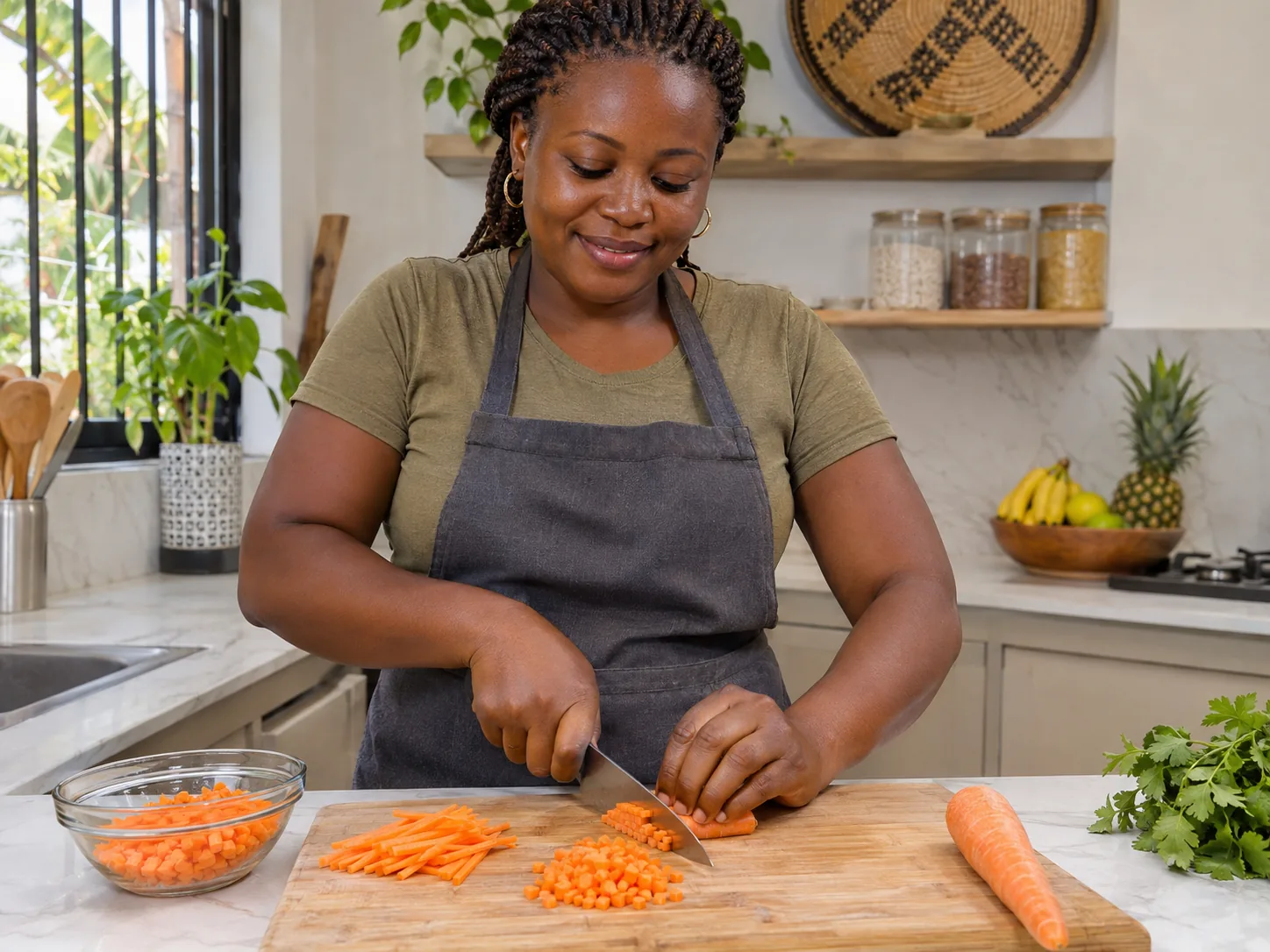
Definition and Scope
Brunoise refers to a method of preparing vegetables where they are reduced to very small, remarkably uniform dice. The primary objective is to obtain pieces whose dimensions are small enough to allow for rapid and homogeneous cooking, while offering a delicate texture and discreet visual integration into culinary preparations. Although dimensions can vary, a size of 2 millimeters is often cited as a pedagogical reference, but it is crucial to understand that there is no rigid universal standard. The regularity of the cubes is a more important criterion than mere smallness. This technique applies to a wide variety of vegetables, from firmer ones like carrots or celery, to softer ones like tomatoes or bell peppers, requiring specific adaptations for each.
Desired Outcome
The ideal result of a brunoise is a collection of small cubes perfectly identical in size and shape. This uniformity promotes more even cooking for a single vegetable. In a mixture, two vegetables of the same size may still require different cooking times; geometric regularity does not erase their compositional differences. From a taste perspective, brunoise allows for a rapid diffusion of the vegetable's flavors into the dish, without its texture dominating. Visually, it adds a touch of finesse and sophistication, often used to garnish clear broths, delicate sauces, or as a subtle aromatic element in stuffings or vinaigrettes. A clean cut limits crushing before cooking; the final texture primarily depends on the vegetable itself, cooking time, and mixing method.
Equipment and Product Selection
To effectively create a brunoise, a well-sharpened chef's knife is essential. A dull knife will make cutting difficult, dangerous, and imprecise. A stable, preferably non-slip, cutting board is also crucial for safety and precision. The choice of vegetables is important: prioritize fresh and firm vegetables. For beginners, dense-fleshed vegetables like carrots, celery stalks, or turnips are easier to work with because they offer good resistance and a flat surface after trimming. Softer or irregularly shaped vegetables, such as tomatoes (from which juice and seeds must be removed) or bell peppers (whose skin and curvature must be managed), require more dexterity and adaptation. The goal is always to obtain flat surfaces to facilitate cutting into sticks and then into cubes.
Understanding the Technique
Brunoise is broken down into several sequential steps. First, the vegetable is trimmed and stabilized to create one or more flat surfaces. For example, a carrot will be cut into sections, then each section will be trimmed on all four sides to form a regular cuboid. Second, these blocks are sliced into thin, uniform lamellae (slices). The thickness of these lamellae will determine the final size of the cubes. Third, the lamellae are stacked and cut into bâtonnets (julienne) of the same thickness. Finally, these bâtonnets are grouped together and cut crosswise to form the small cubes. Throughout the process, it is essential to keep fingers curled into a 'claw' to protect the knuckles from the knife's edge and to guide the blade with precision. The knife's movement should be fluid and regular, utilizing the entire length of the blade.
Observation Criteria
To evaluate the quality of a brunoise, several criteria must be observed. The first is uniformity of size: all cubes should be as close as possible to each other in dimensions. The second is regularity of shape: the cubes should have clean edges and flat faces, without being crushed or shredded. The third is the cleanliness of the cut: there should be no irregular pieces or crushed debris mixed with the dice. Clean trimmings from paring can be reserved for another use or for torn fibers. Finally, speed of execution, while important for professionals, comes with practice and should not compromise precision. A good brunoise is visually harmonious and ready to be integrated without requiring additional sorting.
Pedagogical Applications in Various African Cuisines
In a pedagogical context, brunoise can be introduced to enrich the texture and presentation of many African dishes. For example, for a fish soup or a 'vegetable stew' from West Africa, a brunoise of carrots, bell peppers, and onions can be added at the end of cooking to provide a touch of color and a subtle crunchy texture, as an explicitly proposed variation in presentation, without presenting it as an attested traditional preparation. In an East African 'pilau,' a brunoise of onions and ginger could be used for a faster and more homogeneous diffusion of aromas. For 'mixed salads' or 'cold sauces' inspired by Maghrebi cuisines, a brunoise of cucumber or tomato can offer an appreciable finesse. These examples are pedagogical applications to illustrate the technique, and not attested culinary traditions. The objective is to show how a cutting technique can be adapted to enhance the sensory experience.
Distinctions from Similar Techniques
It is essential to distinguish brunoise from similar cutting techniques. 'Julienne' consists of fine sticks (approximately 1-2 mm per side and 4-5 cm long), which are an intermediate step of brunoise, but not the final product. 'Macédoine' is a cut into larger cubes (approximately 5 mm to 1 cm), often used for salads or more rustic garnishes. 'Mirepoix' is a coarse cut of aromatic vegetables (onions, carrots, celery) into irregular cubes of about 1 to 2 cm, intended for long cooking and often removed or blended. 'Chopping' is a reduction into very small and irregular pieces, often done with a knife or food processor, where shape is not a criterion. Brunoise is distinguished by its small size and especially by its regularity and precise cubical shape.
Errors and Corrections
Common errors when making a brunoise include irregular cubes, crushed or torn pieces, and unprotected fingers. Irregularity often stems from poor vegetable stabilization, lamellae or bâtonnets of different thicknesses, or a poorly guided knife. Correction involves more careful initial trimming to create flat surfaces, increased attention to consistent slice thickness, and regular practice of the knife movement. Crushed pieces indicate a dull knife or excessive pressure rather than a fluid cutting motion. Lack of finger protection is a major safety error: fingers must always be curled into a claw, using the knuckles as a guide for the blade. Patience and repetition are key to overcoming these difficulties.
Variations and Adaptation
Although brunoise is defined by its small size and regularity, adaptations are necessary depending on the vegetable. For firm-fleshed vegetables like carrots or celery, the standard method of lamellae then bâtonnets then cubes works well. For softer or watery vegetables, such as tomatoes, it is preferable to remove the pulp and seeds to work only with the firm flesh, to avoid a soggy result. For bell peppers, they must first be peeled (if desired, for a finer texture) and the internal white membranes removed, then flattened to obtain a more stable cutting surface. The size can also be slightly adjusted depending on the application: a brunoise intended for a broth garnish may be slightly smaller than a brunoise for a stuffing, but regularity remains paramount. There is no single 'perfect brunoise,' but an intelligent adaptation to the ingredient and its use.
My Advice
First, focus on regularity, not on speed or extreme smallness. A perfectly regular 3 mm brunoise is much more useful and aesthetically pleasing than an irregular 1 mm brunoise. Take the time to properly trim your vegetable to obtain flat surfaces; this is the foundation of a successful cut. Check that your knife is properly sharpened and maintained before you begin. And above all, protect your fingers by firmly curling them into a claw. Practice makes the movement more fluid and precise. Don't hesitate to practice with inexpensive vegetables. Brunoise is a fundamental skill that, once mastered, opens the door to great finesse in your culinary preparations, no matter which cuisine you explore.
Sources and further reading
2026-11-19