Herb bundle
A bundle of aromatic herbs used during cooking and removed afterwards.
Definition
A bundle of aromatic herbs used during cooking and removed afterwards.
Definition: an arrangement that can be removed
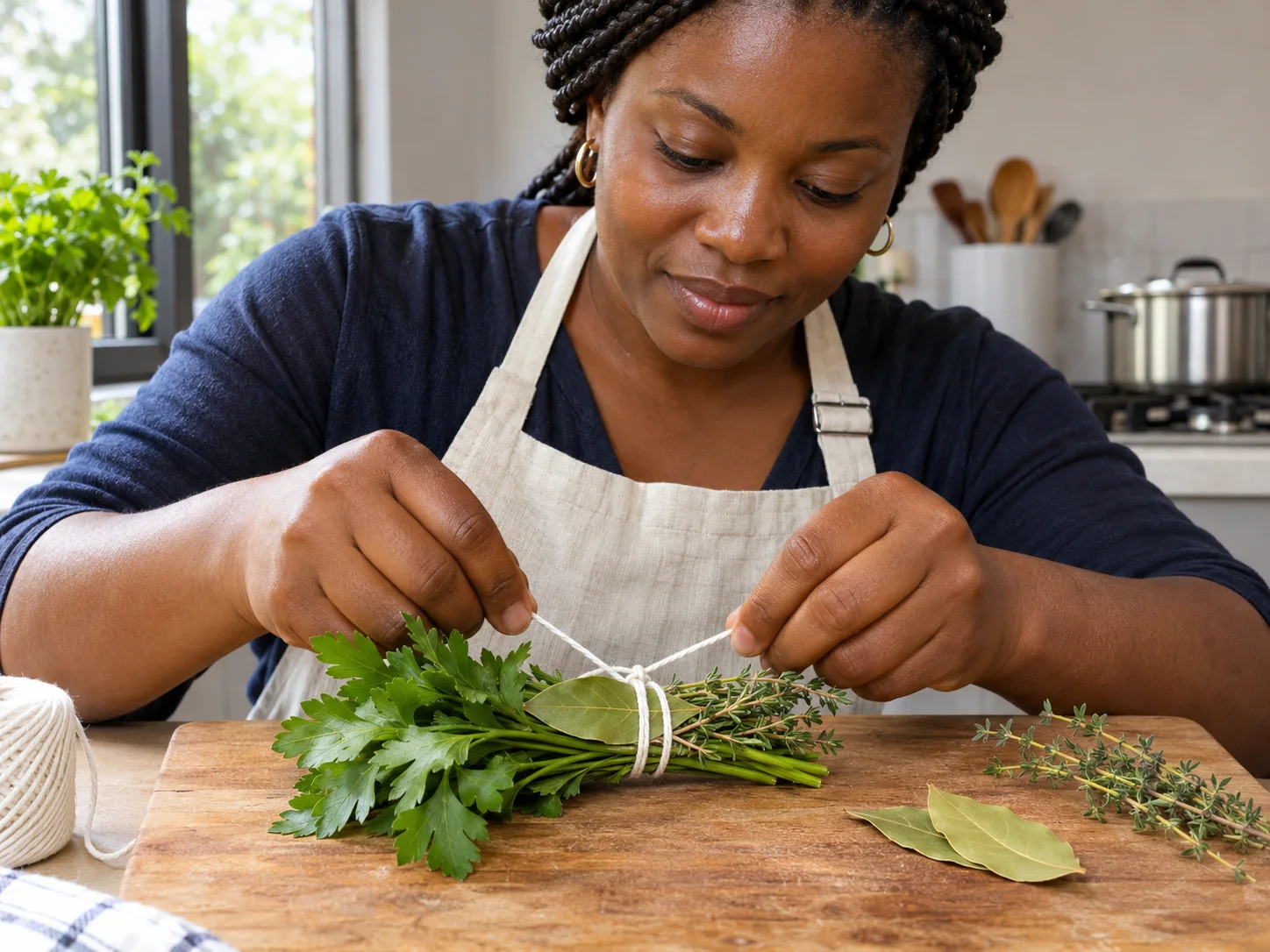
A bouquet garni is an arrangement of aromatic herbs intended to flavour a cooking liquid, sauce or simmered preparation and then be removed. Its distinctive feature is therefore not simply the presence of several plants: it is their organisation into an identifiable, recoverable unit. A little chopped parsley scattered through a sauce is not, by itself, a bouquet garni. A single sprig of thyme can perform a comparable aromatic function, but does not necessarily constitute an arrangement. The expression describes both this prepared ingredient and a tool for managing flavour: the cook selects the plants, gathers them, observes their effect and removes them when the preparation has acquired the intended character.
A classic combination, not a universal rule
Thyme, culinary bay and parsley form a classic combination in French culinary terminology. The AdT-Recettes technical sheet describes this arrangement and mentions possible adaptations. That does not mean every kitchen must combine exactly the same plants, or that every product sold under the name is a small fresh bundle. For example, the Ducros product sheet describes a dry mixture containing additional aromatics. This product demonstrates a contemporary commercial use of the name, not a compulsory composition. To interpret a recipe, the reader therefore needs to consider the plant list and the product's form, rather than relying solely on the words printed on a packet.
A French term in an African dictionary
This entry explains a tool from French culinary vocabulary encountered in recipes and conversations about cooking. It neither attributes its invention to an African country nor presents its use as shared by every tradition on the continent. In African or diaspora cooking, the useful question concerns the actual dish being prepared: is the intention to reinforce a stock, accompany a sauce, support a stew or leave room for other seasonings? Adding a classic bouquet does not by itself make a preparation more authentic. Conversely, adapting the arrangement to available ingredients does not undermine the coherence of the technique, provided that the cook explains what is being used.
Choosing herbs according to the desired result
Selection begins with aroma and the intended role. An aromatic stem and a tender leaf do not behave in exactly the same way when left in liquid. The aim may be a discreet background rather than an immediately recognisable fragrance. A more pronounced presence is also possible, but it must remain compatible with the other ingredients. Before multiplying the herbs, it helps to imagine the dish without the bouquet: which aromas does it already possess? A sauce carrying several spices does not necessarily need an additional complex arrangement. The bouquet is a means of adjusting a composition, not proof of skill achieved by adding as many plants as possible.
Assembly: hold together without compressing
The plants are gathered into a small, stable arrangement. Food-grade kitchen string holds the components during cooking and makes their retrieval easier. The aim is not to produce such a tightly packed object that the herbs are difficult to wet. Liquid must be able to come into contact with them. An outer leek leaf or muslin suitable for food contact can help retain small fragments; the AdT-Recettes sheet documents these options. What matters is the wrapper's function rather than its decorative appearance: it gathers the aromatics and prevents their dispersal without turning the bouquet into a garnish intended to be eaten.
Equipment must suit the use
A preparation that will be heated requires equipment intended for cooking. Craft string, decorative ribbon or packaging of unknown suitability for food contact should not be recommended as substitutes. The cook also checks that the bouquet can be removed without having to find each individual stem. An arrangement so fragile that it falls apart as soon as the dish is stirred no longer performs its role particularly well. Muslin still needs to be checked for sound condition. Equipment choice therefore relates to the cooking method and final service: part of the simplicity of a successful bouquet is how easily it can leave the preparation.
When to introduce it and when to remove it
There is no single timing suitable for every recipe, volume of liquid and combination of herbs. The bouquet accompanies cooking to develop flavour; it should not be forgotten merely because it is tied together. The moment when the cook tastes matters as much as the moment when the bouquet is introduced. If the preparation already has the desired balance, removing the bouquet avoids deliberately prolonging its aromatic contribution. Cooking that continues afterwards may still change the dish through reduction or transformations of other ingredients. Removal therefore does not freeze every flavour in place: it marks the end of contact with this particular arrangement.
Tasting without confusing aroma with seasoning
A bouquet garni replaces neither salt nor the other elements that create balance in a sauce. A stock may smell of herbs yet lack definition; another may be sufficiently seasoned but carry an excessively dominant vegetal aroma. Those observations must be distinguished before making a correction. Adding salt to compensate for an unpleasant herbal note does not address the same question as removing the bouquet. Similarly, reduction concentrates several components at once: it does not select only the aroma the cook wants to strengthen. Tasting the liquid itself, rather than merely smelling the herbs above the pan, helps the cook decide more precisely.
Stocks, sauces and simmered preparations
Stocks and sauces provide a setting in which the use of a bouquet is easy to understand: aromatics remain present for part of the cooking, while the liquid is retained for serving or for another preparation. In a stew, the same principle can accompany vegetables, meat or fish when the recipe calls for it. Its usefulness does not depend on the presence of meat; it depends on the desired aromatic profile. However, these possibilities should not become a general obligation. A preparation whose flavour already rests on a particular combination of condiments may benefit from having no additional bouquet, or from a simpler arrangement that is explicitly described.
Fresh, dried and already fragmented mixtures
A fresh bouquet brings together stems and leaves whose identity and condition are immediately visible. A dried product may consist of small fragments gathered into a container intended for cooking, or of a mixture designed to be scattered. These forms differ when removal is considered. A mixture scattered directly into a sauce cannot be retrieved like a tied bundle. The cook must then accept that fragments will remain in the preparation, or choose a different arrangement at the outset. The commercial name alone does not settle the issue: the manufacturer's instructions, ingredient list and recipe help determine whether the product suits the intended result and texture.
Distinguishing bouquet, aromatic garnish and decoration
The bouquet garni belongs among techniques for flavouring during cooking. An aromatic garnish may contain other vegetables and have a different purpose or presentation; it is not automatically gathered into a removable unit. Fresh herbs added at serving can instead contribute visual presence, texture and a fragrance perceived directly in the mouthful. These three uses are not mutually exclusive, but neither are they interchangeable. A removed bouquet does not replace a fresh-leaf finish. Attractive decoration does not prove that the liquid was flavoured during cooking. Naming each technique makes the recipe's structure clearer instead of grouping every use of herbs under one expression.
My advice: make the choice explicit
When passing on a recipe, writing only “a bouquet garni” leaves considerable room for interpretation. Naming the selected plants and explaining whether they form a bundle, a sachet or a dispersed mixture makes the instruction substantially more useful. In the kitchen, I recommend preparing an arrangement in which every component has an understandable role, then checking its effect on the liquid before considering another addition. Finding and removing the bouquet before serving is part of the technique, just as preparing it is. The desired result is not invariably a strong herbal fragrance: it is a coherent accompaniment to the dish, without forgotten stems or plants added solely to follow a vague formula.
Adapt the herbs to the dish.
Sources and further reading
Explore further : Atlas · RecettesAfricaines
Sources accessed on 19 November 2026. AdT-Recettes (May 2015) documents composition and practical variants; Ducros illustrates a current commercial blend, not a universal standard.
AdT-Recettes — Bouquet garni · Ducros — Bouquet garni à la provençale