Rounding (Bouler)
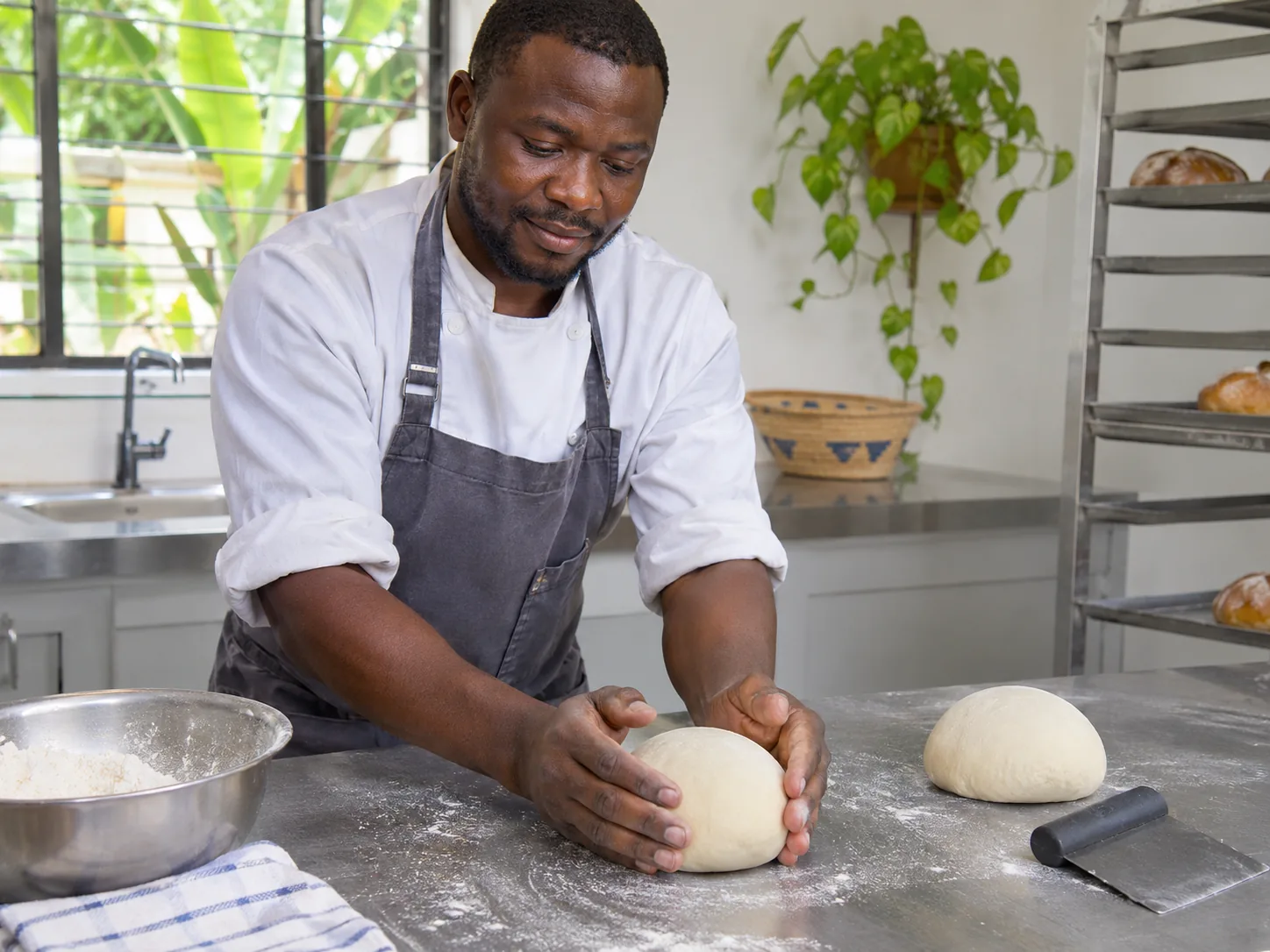
To shape a dough portion into a round by organizing a surface envelope and bringing the seams underneath the ball to create surface tension and a regular shape.
Definition and Scope
Rounding, or 'boulage' in French, is a fundamental technique in baking and pastry that involves shaping a portion of dough (pâton) into a spherical or ovoid form. This action should not be confused with kneading, which aims to develop the gluten network and incorporate air, nor with fermentation, which is a biological process. Rounding typically occurs after kneading and an initial resting period (bulk fermentation or 'pointage'), or after dividing the dough into individual portions. Its primary objective is to impart structure and tension to the surface of the dough, which is crucial for subsequent stages such as the second fermentation (proofing or 'apprêt') and baking. It is an initial shaping that prepares the dough for its final development, creating a smooth, taut outer envelope that traps fermentation gases.
Desired Outcome
Rounding aims to achieve a dough portion with a smooth, taut, and tear-free surface, and a regular, homogeneous shape. This surface tension is essential because it allows the dough to retain the gases produced by the yeast, thereby promoting harmonious development and increased volume during baking. A well-rounded dough portion exhibits a clear and closed 'key' or seam on its underside, where the edges of the dough have been brought together and sealed. A regular shape helps in comparing the development of dough portions of the same weight. Baking and crumb structure also depend on the formulation, fermentation, and oven. Successful rounding also contributes to the dough's strength, making it easier to handle and shape for final stages, such as forming baguettes, round loaves, or other specific shapes. Above all, it prepares the dough for consistent handling; neither the alveolation (open crumb structure) nor the crispiness of the crust is guaranteed by this single action.
Equipment and Product Selection
The equipment needed for rounding is minimal: a clean, lightly floured or oiled work surface, and possibly a dough scraper for dividing the dough portions. The choice of product is crucial: the rounding technique must be adapted to the hydration and composition of the dough. Wheat doughs, rich in gluten, develop an elastic network that allows for significant surface tension. For these doughs, a lightly floured work surface is ideal to allow for slight adherence without excessive sticking. For high-hydration doughs, a lightly oiled work surface can facilitate movement. In contrast, gluten-free doughs (millet, cassava, rice, corn) do not develop the same network and require a different, often gentler, approach to avoid tearing them. The goal remains to create a coherent shape, even if the surface tension will not be comparable to that of a wheat dough.
Understanding the Motion
The rounding motion involves hand coordination and a tactile perception of the dough. It consists of bringing the edges of the dough portion towards the center, then rolling it on the work surface with slight pressure, often using the palm or side of the hand, in a circular motion. The objective is to create tension on the upper surface of the dough while sealing the folds under the base. The hand should envelop the dough, pull it towards oneself, then gently push it while rotating it. This repeated movement creates a smooth, taut surface, while the folds are progressively brought under the dough to form the 'key'. The force applied must be just enough to create tension without tearing the dough. The work surface should offer moderate adherence to allow the dough to roll without excessive slipping or sticking.
Observation Criteria
Successful rounding is recognized by several criteria. Visually, the dough portion should be spherical or ovoid, with a smooth, uniform surface, free from cracks or tears. The 'key' or seam, formed by gathering the edges of the dough, must be well-closed and located underneath the dough. To the touch, the dough should exhibit a certain tension and elasticity; it should slightly resist gentle finger pressure and spring back to its shape. Its firmness is assessed relative to the dough used: a very hydrated dough will remain softer than a firm dough. A large, isolated pocket under a very thin skin may indicate irregular shaping, but the goal is not to indiscriminately remove all fermentation gas. A well-rounded dough portion will have better hold during proofing and better oven spring, contributing to a more aerated crumb and a more aesthetic crust.
Educational Applications in Various African Cuisines
Although rounding is often associated with wheat doughs, its principles can be adapted to various bread and fritter preparations in African cuisines. For example, for fritters made from wheat flour or flour blends, light rounding can help achieve more regular shapes and a more homogeneous texture after frying. For doughs made from millet, sorghum, or cassava, whose pure flours do not form the characteristic gluten network of wheat, rounding will not aim to develop elastic tension, but rather to compact the dough and give it a coherent shape for baking or frying. In these cases, the motion will be gentler, aiming to smooth the surface and eliminate cracks, rather than to create a taut envelope. An educational example could be to demonstrate how to form small balls of millet dough for thick porridges or flatbreads, using a palm motion to round without forcing. For wheat-based breads, such as certain traditional breads in North or East Africa, rounding follows classic principles for developing gluten structure.
Distinctions from Similar Actions
It is important to distinguish rounding from other shaping actions. Kneading, as mentioned, is the initial stage of dough development, aiming to mix ingredients and develop the gluten network. Rounding occurs afterward. 'Folding' or 'stretching and folding' is a technique that involves folding the dough over itself during bulk fermentation to strengthen its structure and redistribute gases, but it does not aim to form a final ball. Final shaping gives the dough its definitive form, for example, a baguette or a miche. It usually occurs after a resting period following pre-shaping, then comes proofing before baking. Rounding is an intermediate step, a pre-shaping that gives the dough its first structured form after division. It prepares the dough to be handled and stretched during final shaping, and can also constitute the definitive shaping when a ball is the desired form.
Errors and Corrections
Several errors can occur during rounding. Excessive force can tear the dough, especially if it is fragile or under-hydrated. If the dough tears, it is best to let it rest for a few minutes to relax before resuming rounding with a gentler motion. A work surface that is too floured will prevent the dough from adhering enough to create tension, resulting in a soft, shapeless dough. Conversely, a work surface that is too sticky will make movement difficult and risk tearing the dough. Using a light scraper to detach the dough can help. Insufficient rounding will leave the dough without tension, with an irregular surface and unsealed folds, which will hinder its development. Rounding for too long or too intensely can over-tension the dough, making it difficult to handle afterward. Careful observation of the dough and adaptation of the motion are key. If the dough is too sticky, a light oiling of the hands or work surface can be a solution, rather than an excess of flour.
Variations and Adaptation
Rounding can be adapted depending on the type of dough and the desired result. For very hydrated doughs (like some artisanal bread doughs), rounding can be performed with less direct contact, using a scraper or by folding the dough over itself several times before lightly rolling it to form a ball. For firmer doughs, more energetic rounding may be necessary to create tension. The size of the dough portion also influences the motion: small portions can be rounded with one hand, while larger ones require the use of both hands. Adaptation is also crucial for gluten-free doughs: the motion will be more of a 'shaping into a round' than a 'rounding' in the strict sense, aiming to compact the material without seeking non-existent elasticity. The objective is always to give a regular shape and some cohesion to the dough portion, even if the underlying mechanisms differ.
My Advice
Rounding is a skill acquired through practice and observation. Do not seek a universal speed or force; each dough is unique and reacts differently. Focus on the sensation of the dough under your hands. If the dough is sticky, resist the urge to add too much flour, which would dry out your final product. Prefer a light oiling of the work surface or your hands. If the dough tears, it is a sign that it needs to rest. Let it relax for a few minutes before resuming. The goal is not to 'force' the dough, but to 'guide' it towards the desired shape. The key is to find the right balance between surface tension and gentleness of motion to preserve the internal structure of the dough and allow for optimal development during fermentation and baking. Observe the 'key' under the dough: it should be neat and well-closed, a sign of careful work.
Sources and further reading
2026-11-19