Bain-marie (Water Bath)
An indirect heating method where a container holding a preparation is placed within a larger container filled with hot water, allowing for gentle and uniform cooking or warming.
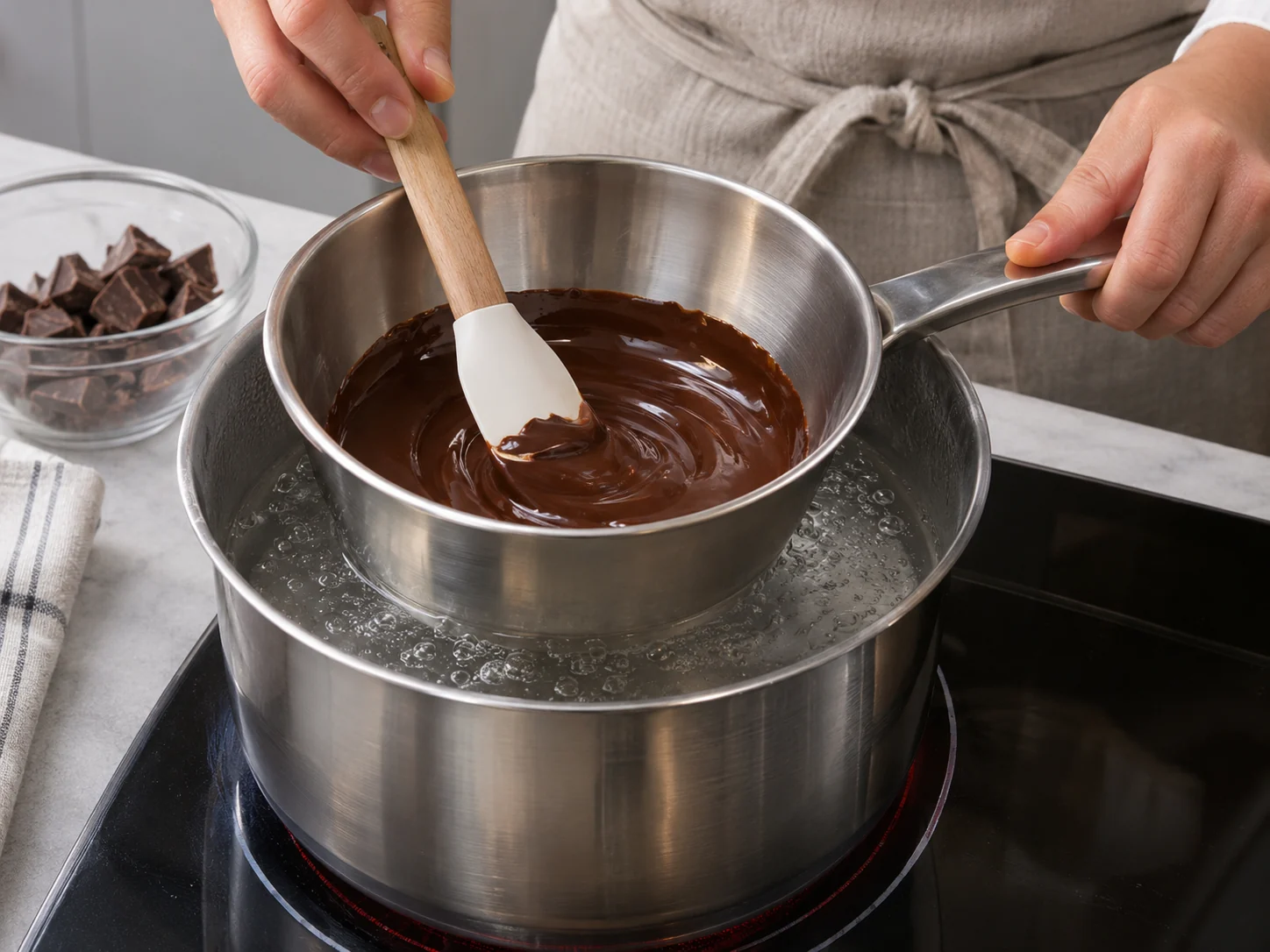
Definition and Scope
The bain-marie is a fundamental culinary technique that involves heating or keeping a preparation warm indirectly. Instead of directly exposing the preparation's container to a heat source, it is immersed, or more precisely, placed in a bath of hot water. This water, heated by an external source (cooktop, oven), transfers its heat gently and controllably to the preparation. The principle is to regulate the preparation's temperature by using water as a thermal intermediary, thereby preventing thermal shock, overheating, or abrupt coagulation. The bain-marie is used for delicate preparations that cannot withstand direct, intense heat, such as emulsified sauces, custards, melted chocolate, or for the slow and homogeneous cooking of certain mixtures. Its scope of application ranges from simple warming to complete cooking, including melting and gentle pasteurization.
Desired Outcome
The primary outcome sought by using a bain-marie is a gradual temperature increase and a homogeneous distribution of heat. For sensitive preparations like chocolate, this results in a smooth, shiny melt, free of lumps or scorching. For custards and egg-based sauces, the bain-marie allows for slow and controlled protein coagulation, preventing a grainy texture or phase separation. The goal is to achieve a creamy, silky texture and uniform cooking from the inside out. When used for warming, the aim is to maintain a preparation at an ideal serving temperature without it continuing to cook or drying out. The gentleness of the heating also preserves the organoleptic qualities of the ingredients, particularly volatile aromas and delicate textures.
Equipment and Product Selection
To create a bain-marie, two containers are needed: a larger one for the water and a smaller one for the preparation. The preparation container should ideally be made of a heat-conductive material such as stainless steel, glass, or ceramic, and its size must be appropriate so that it can rest comfortably in the larger container without touching the bottom, or at least leaving sufficient space for the water. It is crucial that the upper container is not too small, so that the contact surface with the steam or hot water is sufficient for efficient heat transfer. The lower container, typically a saucepan, should be wide enough to accommodate the upper container and a sufficient amount of water. The water used can be cold initially and heated gradually, or hot if a quicker start is desired. The choice of products depends on the preparation: for chocolate, opt for good quality couverture chocolate. For custards, fresh eggs and quality dairy products are essential. The quality of ingredients is always amplified by gentle and respectful cooking.
Understanding the Technique
First identify the arrangement. In an immersed water bath, water surrounds part of the container holding the preparation but cannot enter it. With a bowl or small pan held above the water, its base stays clear of the water and receives heat through steam and the vessel walls. The correct water level therefore depends on the arrangement rather than a universal halfway rule. In both cases the container must remain stable and be removable without spilling. Watch the water's movement, the quantity remaining and the preparation's response. Violent bubbling is not the goal. Melting chocolate or thickening custard must also be assessed directly in the upper container.
Observation Criteria
Several criteria allow for the proper execution of a bain-marie to be observed. The first is the absence of direct contact between the bottom of the preparation container and the heat source or boiling water if steam heating is intended. The water in the lower container should be at a controlled temperature, generally a gentle simmer, not a vigorous boil. The rising steam should be visible and constant, but not excessive. The second criterion is the texture and appearance of the preparation itself: for chocolate, it should melt gradually, becoming smooth and shiny, without any trace of lumps or fat separation. For custards, the texture should thicken gently, becoming creamy and homogeneous, without signs of excessive coagulation or grain formation. The absence of water or condensation in the preparation is an essential indicator of success. Finally, the temperature of the preparation should rise steadily and not in spurts, which can be verified with a thermometer if precision is required.
Educational Applications in Various African Cuisines
Although the term « bain-marie » is of French origin, the principle of indirect heating is universal and can be applied pedagogically in various African cuisines to adapt techniques or modernize practices. For example, to keep delicate sauces like peanut sauce or okra sauce warm without them sticking or burning, a bain-marie can be used. Imagine a peanut sauce prepared for a large event: placing it in a container over a pot of simmering water would allow it to be kept at serving temperature without altering its creamy texture. Similarly, for the preparation of certain creams or flans based on coconut milk or cereals (such as millet or sorghum), the bain-marie can ensure gentle and homogeneous cooking, preventing lump formation and guaranteeing a smooth texture. A pedagogical example could be the preparation of a sweet and spiced millet cream, cooked in a bain-marie to achieve a velvety consistency, similar to a pudding. This method can also be useful for melting shea butter or other vegetable fats for culinary or cosmetic uses, preserving their properties without burning them. Teaching this technique expands the culinary repertoire and improves the quality of delicate preparations.
Distinctions from Similar Techniques
The bain-marie is distinguished from several similar culinary techniques by its specificity of indirect and controlled heating. Steaming, for example, also uses water vapor, but direct contact of the steam with the food is the primary cooking method, not an intermediary to heat another container. Foods are usually placed in a perforated basket above boiling water. Simmering, on the other hand, involves slow and prolonged cooking directly in a liquid, but the container is in direct contact with the heat source, even if it is gentle. Sous-vide cooking is another low-temperature cooking technique, but it uses very precise water temperature control and hermetically sealed bags, which is more sophisticated than a simple bain-marie. Finally, simply keeping food warm over low heat or in a low-temperature oven does not guarantee the same heat homogeneity and control as the bain-marie, where water acts as a thermal buffer. The bain-marie is specifically designed for preparations that require a very gentle temperature increase and protection from direct heat.
Errors and Corrections
Several common errors can compromise the success of a bain-marie. The first is allowing the water in the lower container to boil too vigorously, which can cause water splashes into the preparation, especially if the upper container is not well-fitted. Water is the enemy of melted chocolate, for example, as it causes it to 'seize' and become grainy. The correction is to reduce the heat to maintain a gentle simmer. Another error is allowing the bottom of the upper container to directly touch the bottom of the lower container. This can lead to localized overheating of the preparation, negating the indirect heating effect. The solution is to ensure there is sufficient space between the two bottoms, or to use a support to elevate the upper container. Insufficient water in the lower container can also be problematic, as the water will evaporate too quickly, requiring frequent refills or leaving the preparation without heating. It is important to ensure an adequate amount of water. Finally, using an upper container that is too large or too small can affect the efficiency of heat transfer. A container that is too large may not be sufficiently heated by the steam, while a container that is too small may not have enough surface area for effective heating. Adjusting the size of the containers is therefore crucial.
Variations and Adaptation
The bain-marie has several variations and can be adapted to various situations. The oven bain-marie is a common adaptation for baking custards, terrines, or pâtés. In this case, the baking dish is placed in a larger container filled with hot water, and the whole assembly is placed in the oven. The oven's heat warms the water, which in turn cooks the preparation very gently and uniformly, preventing drying out and the formation of an excessive crust. Another variation is the inverted bain-marie or cold water bath, used to quickly cool a delicate preparation, such as crème anglaise, to stop its cooking and prevent bacterial proliferation. The preparation container is then placed in another container filled with very cold water and ice cubes. For professionals, there are electric or gas bain-marie units that maintain water at a constant and precise temperature, often used for buffet service or large-quantity preparation. The adaptation of the technique will depend on the specific needs of the preparation and the available equipment, but the basic principle of heat transfer via water remains the same.
My Advice
My main advice for mastering the bain-marie is to always prioritize patience and observation. It is a technique that rewards gentleness and regularity. Never rush to raise the water temperature too quickly; a gentle simmer is your best ally. For very sensitive preparations like chocolate, I recommend removing the upper container from the bain-marie just before melting is complete, and finishing stirring off the heat. The residual heat of the chocolate will be enough to melt the last pieces, ensuring a perfectly smooth and shiny texture without the risk of overheating. Furthermore, make sure your containers are perfectly dry before starting, especially if you are working with chocolate. The slightest drop of water can alter the texture. Finally, do not hesitate to experiment with different amounts of water and different heat intensities to understand how heat is transferred and how your preparation reacts. It is by practicing and observing carefully that you will develop an intuition for this essential technique.
Sources and further reading
2026-11-19