Basting (Arroser)
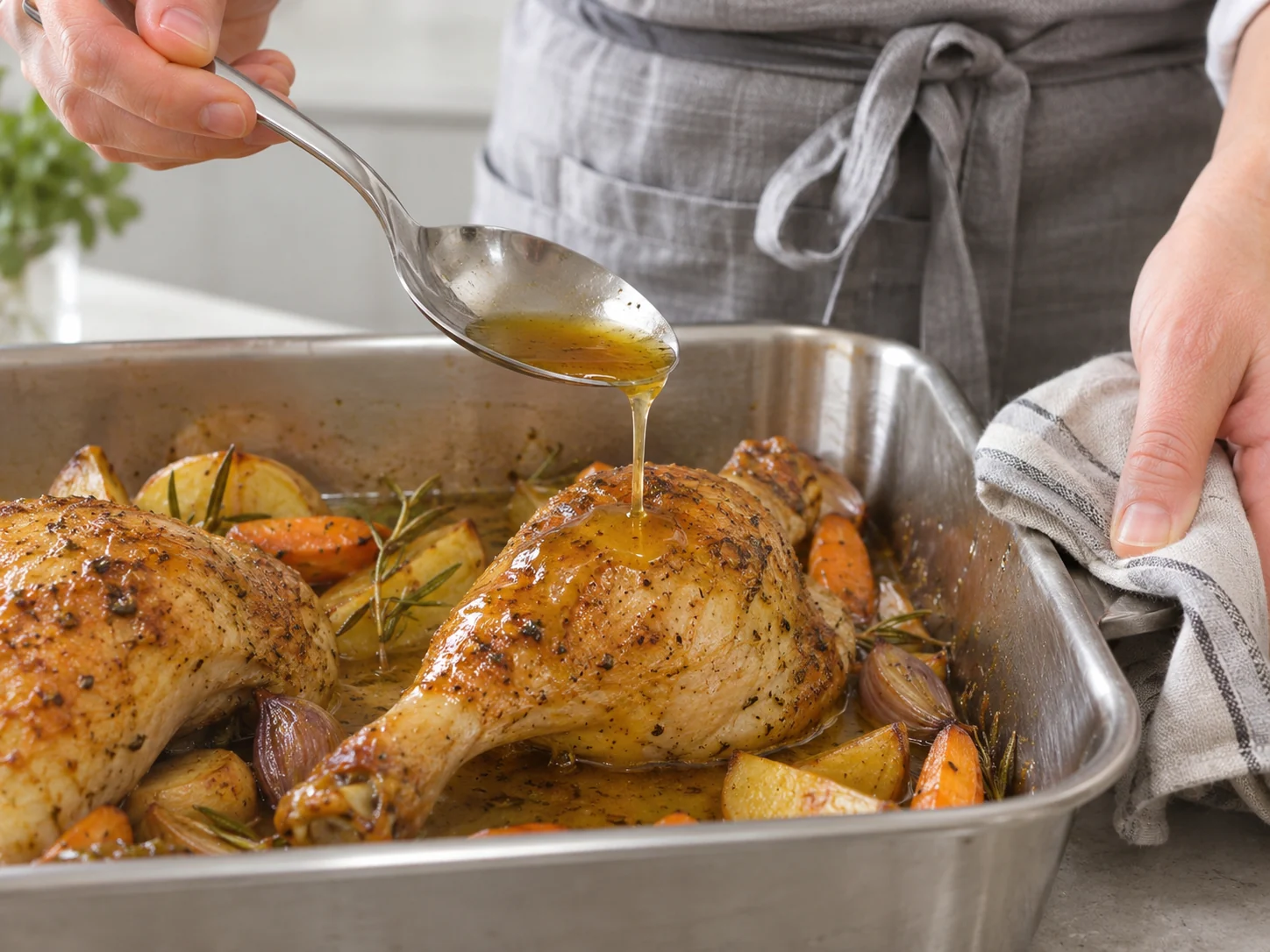
Regularly pouring pan juices or melted fat over food during cooking to maintain moisture, promote browning, and enhance flavors.
Definition and Scope
The culinary technique of basting involves repeatedly taking a liquid – whether it's pan juices, melted fat, broth, or a marinade – and pouring it over food that is currently cooking. This action is typically performed at regular intervals throughout the cooking process and applies to a wide variety of foods, including meats, poultry, fish, and certain roasted or grilled vegetables. Basting is not an initial preparation step but an active intervention during cooking itself, aiming to directly influence the texture and taste of the final product. It differs from simply adding liquid to the bottom of a dish, as it specifically targets the surface of the food.
Desired Outcome
Basting deposits cooking juices, fat and aromatic compounds on the food's surface. It can enrich flavour and change appearance during cooking. It does not inject lost water back into the centre of meat or create a perfectly sealed coating that retains every drop of juice. Tenderness also depends on the cut, temperature and cooking time. The liquids must be distinguished: a watery juice wets the surface, whereas melted fat coats it differently. A surface kept wet may brown less readily; basting therefore does not guarantee crisp skin. The desired outcome should remain specific: distributing flavourful juices, managing browning, or preventing a coating of sauce from drying excessively, depending on the dish.
Equipment and Product Selection
To baste effectively, the choice of utensil is crucial. A long-handled spoon, a medium-sized ladle, or a heat-resistant kitchen baster are the most common tools. The spoon is versatile, allowing for the collection of juices from the bottom of the pan and their precise distribution. The baster is particularly useful for smaller pieces or for very targeted basting. The important thing is that the tool allows for safe handling of hot liquid and its even deposition. As for the products, the basting liquid is usually the cooking juices themselves, but it can be supplemented or replaced by melted butter, oil, broth, wine, or even a light marinade. The choice will depend on the desired flavor profile and the nature of the food. For a roast beef, the cooking juices are ideal; for fish, a lemon butter might be preferred.
Performing the Action
The basting motion should be fluid and regular. The goal is not to drown the food, but to delicately coat it with the hot liquid. The movement begins by collecting the liquid from the bottom of the cooking vessel, being careful not to stir up excessive sediment to avoid clouding the juices. Then, the liquid is slowly and evenly poured over the entire exposed surface of the food. It is important to cover all parts, including the sides and crevices, to ensure homogeneous cooking and browning. The frequency of basting varies depending on the food and cooking method, but an interval of 10 to 20 minutes is often a good starting point. Observing the food's surface allows for adjustment of frequency: if it begins to dry out or brown too quickly in certain areas, basting is opportune.
Observation Criteria
Several visual and tactile indicators allow for judging the effectiveness of basting. Visually, the food should exhibit a homogeneous coloration, ranging from light golden to deep brown, without pale or burnt areas. The surface should have a slightly shiny and appetizing appearance, a sign of good hydration and an even distribution of fats and juices. To the touch (with a utensil, of course), the crust should be crispy or slightly firm, but not hard or brittle, which would indicate dryness. The absence of excessive smoke or a burning smell is also a good sign. If the food appears too dry or if the coloration is uneven, this may indicate insufficient or poorly distributed basting. Conversely, excessive basting can prevent the formation of a beautiful crust.
Pedagogical Applications in Various African Cuisines
Although the term 'arroser' (baste) is of French origin, the principle of coating food during cooking with a liquid to hydrate and flavor it is universal. In a pedagogical context, this technique can be illustrated with adapted examples. For instance, when baking a Senegalese chicken yassa in the oven, one could baste the poultry with the lemony, onion-infused cooking juices to intensify flavors and maintain tenderness. For Cameroonian braised fish, basting with the spicy, oily marinade during cooking over embers would help create a flavorful crust and infuse aromas. Similarly, for grilled meat skewers (Nigerian suya, for example), a light basting with a mixture of oil and spices could be practiced to prevent drying and enhance the taste. These examples are not canonical traditions but pedagogical applications to demonstrate the versatility of the technique in diverse culinary contexts.
Distinctions from Similar Techniques
It is important to distinguish basting from other culinary techniques. 'Brushing' or 'glazing' is similar but often done with a brush and thicker liquids (marinades, glazes), and can occur before or during cooking. Basting, however, generally involves a more fluid liquid and a pouring action. 'Lubricating' or 'greasing' a dish or food before cooking aims to prevent sticking and promote initial browning, but it is not a repeated action during cooking. 'Moistening' or 'adding liquid' to the bottom of a dish is intended to create steam or prevent the bottom from burning, but it does not directly target the food's surface in the same way as basting. Finally, 'glazing' is a finishing technique that involves coating the food with a shiny, thick sauce, often at the end of cooking or afterward, which is different from continuous basting.
Errors and Corrections
Dry meat does not prove that it was basted too little: excessive cooking time or heat may be responsible. Adding more juices cannot reverse established overcooking. Conversely, constant basting can keep the surface wet, slow browning and require too many oven openings. The correction is to return to the dish's objective and observe its surface rather than apply a universal interval. If liquid accumulates, use less; if cooking residues stick to the pan, also inspect the pan and heat level. Pieces of different sizes should be observed separately. Monitoring cooking time remains essential even when the surface looks glossy.
Variations and Adaptation
Basting can be adapted to many situations. For low-temperature cooking, basting is less frequent because evaporation is slower. For high-temperature cooking or grilling, it becomes more crucial and more frequent to prevent rapid drying. The type of liquid can vary: for poultry, one can alternate between cooking juices and a mixture of melted butter with herbs. For fish, a drizzle of olive oil or a beurre noisette can be used. Basting can also be enriched with aromatics: adding crushed garlic cloves, sprigs of thyme or rosemary to the cooking juices before basting allows for the infusion of additional flavors. For roasted root vegetables, basting with vegetable broth or diluted maple syrup can provide beautiful caramelization and a sweet-savory flavor.
My Advice
For optimal basting, I advise you to always use warm or lukewarm liquid. Collecting the cooking juices directly from the pan is ideal because they are already at temperature and full of flavor. If you are using an auxiliary liquid (broth, melted butter), heat it slightly before applying it. A cold liquid will shock the surface of the food, slow down cooking, and could prevent the formation of a beautiful crust. Furthermore, do not hesitate to slightly tilt your cooking dish so that the juices accumulate in a corner, making them easier to collect with the spoon. Regularity is key: frequent and light basting is more effective than abundant and sporadic basting.
Sources and further reading
2026-11-19