Safou
Safou, also called atanga in several Central African contexts, is the fruit of Dacryodes edulis.
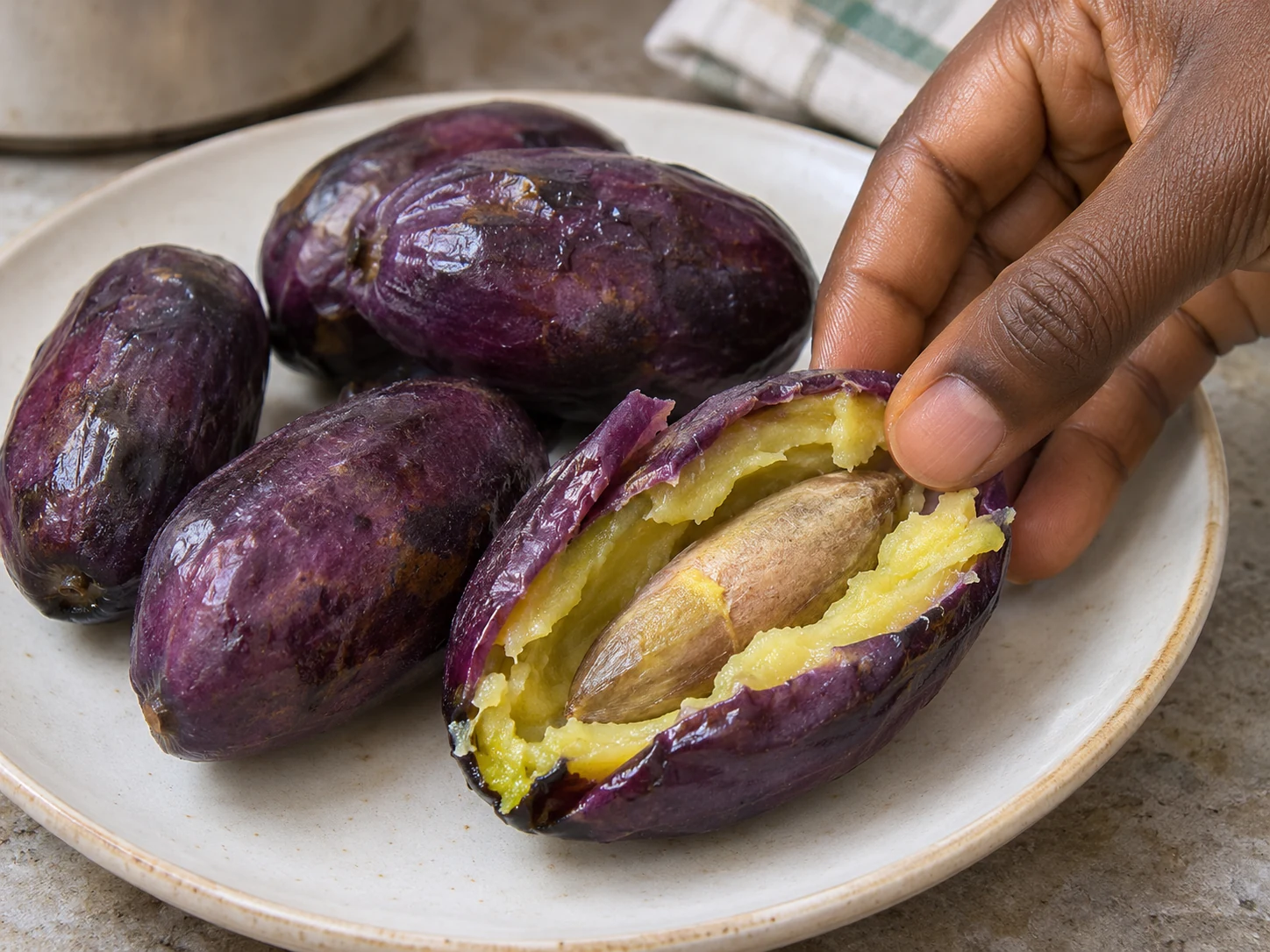
Identity and recipe examples
Safou, also called atanga in several Central African contexts, is the fruit of Dacryodes edulis. Its flesh surrounds a large stone. Comparisons with avocado or a European plum may help describe an unfamiliar texture, but they do not identify the same fruit. Ripeness and the particular batch affect firmness and acidity. The prepared flesh is eaten and the stone discarded. The recipes below illustrate two ways to soften it without making one timing a universal rule for every fruit.
The site's Gabonese Roasted safou uses moderate embers or an oven. The fruits are turned so that one side does not burn before the flesh softens. Marks on the skin can occur, but complete charring is not the cooking objective. Check texture and remove the stone when eating. This is a practical recipe for identified edible fruits, not a botanical identification guide for unknown produce.
Boiled atanga follows a different method: water is brought to a simmer, taken off the heat, and the fruits are immersed for a few minutes until the flesh becomes supple. The title should not be interpreted as an instruction to keep safou in a prolonged violent boil. Reading the actual steps matters. The objective is to soften the flesh around the stone, not to cook the stone itself.
When purchasing, choose clearly identified fruit in suitable condition and ask about storage appropriate to its ripeness. Preparing a few pieces first helps a new cook learn the flavour, including its possible acidity. Describe its culinary role without promising medicinal effects or assigning an arbitrary nutrient value to every fruit. Size, the amount of flesh actually eaten and the chosen preparation all vary. The two linked recipes provide concrete starting points for exploring a characteristic Central African ingredient.
1. ORIGIN, BOTANY AND DISTRIBUTION
1.1. The fruit and the tree Safou comes from Dacryodes edulis, a tree of the Burseraceae family, reaching 8 to 20 meters in height, with compound leaves, small white or pale pink flowers, and producing clusters of oval or oblong fruits. • Fruit: Safou measures 4 to 12 cm, has a smooth, thin skin that turns from green to purple/black when ripe, and oily, tender, fragrant flesh surrounding a hard central pit. Some cultivars will produce short, fleshy fruits, others thinner and firmer. • Tree: Growing throughout the humid equatorial zone (Atlantic coastal strip of Central Africa, forests of the Congo Basin, southern Nigeria, Ivory Coast, Ghana, western Kenya…), the safou tree is a species more or less domesticated depending on the region, sometimes planted around houses, or exploited through wild harvesting. Specific claims about myths or rites require a geographically identified ethnographic source; they are not established here.
Selecting and preparing the fruit
For cooking safou, first establish the fruit's identity and condition rather than assigning an age or an assumed yield to its tree. Those agricultural details cannot be inferred from fruit on a market stall. A cook needs an identified food source, fruit in a suitable condition and storage advice appropriate to its ripeness. Colour, size and firmness can vary. The illustration shows a presentation, but does not replace this information.
The two site recipes give different quantity references: one counts twelve fruits, while the other specifies eight hundred grams. These are not universally equivalent portions. Stone weight and fruit size affect the amount of edible flesh. For planning a meal, noting the number of diners and the amount actually bought helps reproduce a successful preparation more accurately than assuming every fruit has the same edible yield.
In the roasted version, turning the fruits helps distribute heat. In the hot water version, follow the method's instruction to remove the vessel from the heat. Then observe how the flesh softens rather than applying one timing mechanically to every batch. Firmer fruit can behave differently from fruit that is already supple; stronger heat is not an automatic answer.
Prepare the serving dish before handling hot fruit and explain that the large stone is discarded. For storing fruit or prepared leftovers, follow directions appropriate to the product and recipe. This entry does not recommend improvised fermentation or prolonged storage without specified conditions. It presents two checked culinary uses without turning the practices of one supply chain into a rule for every safou sold in every market.
3. CULINARY METHODS AND USES IN AFRICAN CUISINE
3.1. Traditional preparation methods • Roasted over a wood fire, on embers: whole fruit (often split/scored to prevent explosion during cooking), placed in hot ashes or on the grill. The flesh softens, becomes shiny, oily, almost buttery: this is the most celebrated version of safou. • Boiled in water or steamed, ideal for less fleshy varieties, avoiding burning it: the texture becomes silky. • Accompaniment to cassava: the classic duo is cassava stick (fufu, chikwangue, bobolo) + hot safou – throughout the forest zone of Central/West Africa. • Consumed raw at extreme ripeness, especially certain varieties with very tender flesh. 3.2. Modern integrations • Mashed into a puree for spreads, pancakes, safou bread, or even “Afro” guacamole. • Stuffed with fish, minced meat, vegetables, then baked: a festive variation. • Ingredient for sauces for vegetables or meats (particularly in Gabonese, Cameroonian, and Congolese cuisine). • Desserts: compote, blended smoothie, artisanal ice cream, urban cakes and biscuits. • Safou oil or butter used in Afro-fusion cuisine or pastry. 3.3. Street food and diaspora • At the stall, grilled safou is eaten hot, sprinkled with salt, chili, spices. • It is also sold on skewers, accompanying bread or fritters, and can be found in Afro brunches or African specialty restaurants in major global cities.
4. GASTRONOMIC AND CULTURAL VALUE
4.1. Sensory explosion • Unique flavor: a balance between acidity, bitterness, sweet softness, buttery taste, slightly “cheesy” when ripe. • Texture: creamy, melting, soft, oily, it is equally appealing hot or cold. 4.2. Role in meal structure • Served as a starter, snack, main dish (with side dish), or accompaniment to fish, roasted meat, leaf broth. • Important during major seasonal festivities, family reunions, as a snack for children and adults. 4.3. Identity and transmission • The harvesting and cooking of safou marks the calendar: the safou season announces a period of abundance, solidarity, and sharing. • Knowing how to “grill safou without burning it”, choosing the right fruit, showing the best combination with cassava = recognized skill, family pride, a criterion of esteem in the community.
7. SUPPLY CHAIN, MODERNITY AND CONTEMPORARY CHALLENGES
7.1. Agricultural challenges and valorization • Vulnerability of the fruit to breakage, transport, overripeness. • Under-equipment in structured supply chains: few preserves, embryonic industrial processing. • Risk of loss of local varieties due to genetic erosion, deforestation. 7.2. Agroecological and culinary innovations • Selection, grafting, multiplication of high-value varieties (large fruit, thick flesh, maximum lipid content) • Culinary hybridization (safou in urban dishes, pastries, ice creams, fusion sauces) • Emergence of an artisanal or organic “safou oil” sector 7.3. Diaspora and global gastronomy • Safou is entering gourmet grocery stores, global gastronomy (fusion restaurants, African competitions, cookbooks, social networks) • Support for “Afrofood power”, ambassador of biodiversity, showcase of African terroir worldwide
CONCLUSION Safou, a fruit of equatorial generosity, is a living symbol of the richness, memory, solidarity, and innovative power of Central and West Africa. Its melting flesh, its flavors, its versatility, its virtues make it much more than a food: it is a social binder, a family capital, a modern African food fruit that connects childhood, celebration, land, and the future. Preserving, transmitting, and valorizing safou in its uses and knowledge is paving the way for culinary, nutritional, economic, ecological, and symbolic sovereignty essential for present and future African generations.
ENJOY YOUR MEAL!
AI-generated illustration; see the detailed credit attached to the image.
Where to find it
Look for the exact food-grade form required by the recipe at markets and specialist shops. Check the product name, ingredients, condition and storage instructions.
Explore further: Cooking tips · Food hygiene and safety advice.
Sources and checked recipes
https://apps.worldagroforestry.org/treedb/AFTPDFS/Dacryodesedulis.PDF