Slow-cooked tripe
Tripe needs time before it needs sauce. First simmer it until tender, then finish it in softened onions, tomato, garlic and ginger. This recipe adds a distinct offal preparation to the Senegalese manuscript, alongside the existing quickly sautéed liver, without attributing it to a particular region.
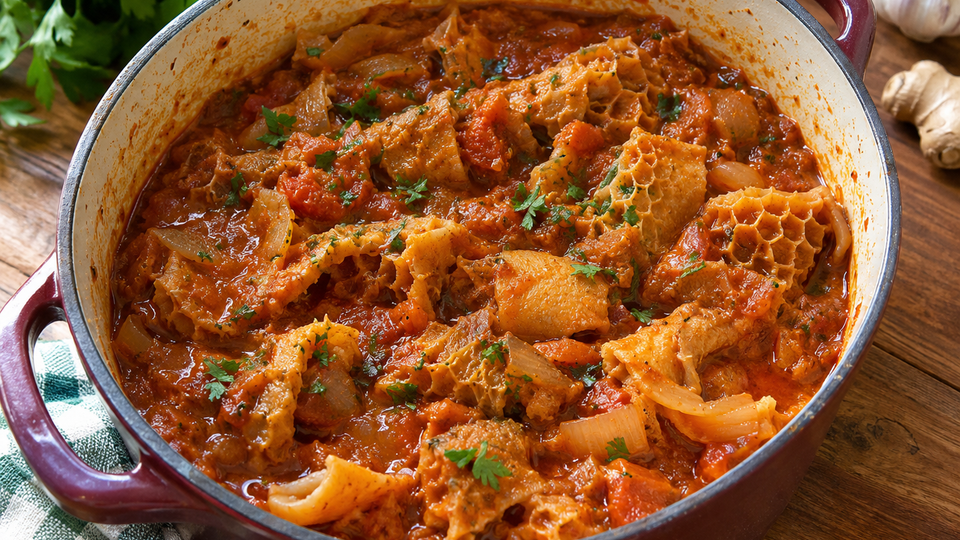
Ingredients
- 1 kg beef tripe cleaned and blanched by the butcher, not fully cooked or already in sauce
- 300 g peeled onions, sliced
- 400 g chopped tomatoes
- 30 g tomato paste
- 3 garlic cloves, chopped
- 15 g fresh ginger, peeled and grated
- 30 ml neutral oil
- 1 bay leaf
- 1 small whole chilli, optional
- 1 litre hot water initially, plus more as needed
- 3 g salt initially, then adjust
- Black pepper
- 10 g washed parsley, chopped
- Bread or cooked rice to serve, quantity as required
Preparation
Cut the tripe into 3–4 cm pieces. Put in a casserole with the bay leaf and 1 litre hot water. Bring to the boil, then partially cover and keep at a gentle simmer. Add hot water if necessary to maintain contact with liquid.
Cook for about 2 hours, then check every 20 minutes. Cool a sample briefly and cut it: it should be easy to pierce while retaining its shape. Continue simmering if it is still tough; time varies with the product.
Heat oil in another pan. Soften onions for 10 minutes. Add garlic and ginger for 1 minute, then tomato paste for 2 minutes, stirring without burning.
Add chopped tomatoes and cook uncovered for 10 minutes. Drain the tender tripe, reserving the liquid, and discard the bay leaf. Add tripe to the sauce with 250 ml cooking liquid, or hot water if preferred.
Add salt, pepper and the optional whole chilli. Partially cover and simmer another 30–40 minutes. Stir occasionally and add small amounts of hot water if needed.
Uncover briefly to obtain a coating sauce with enough liquid for the accompaniment. Remove chilli, adjust seasoning and scatter with parsley.
Introduction
Tripe needs time before it needs sauce. First simmer it until tender, then finish it in softened onions, tomato, garlic and ginger. This recipe adds a distinct offal preparation to the Senegalese manuscript, alongside the existing quickly sautéed liver, without attributing it to a particular region.
Cultural context
Four servings. Preparation 25 minutes; cooking approximately 2½–3½ hours, possibly longer according to the tripe. Ask the butcher exactly how it has been prepared. Blanched is not necessarily fully cooked. Ready-cooked tripe requires less time and is not the starting product used here.
Cut similar-sized pieces for even cooking. A gentle simmer limits evaporation and makes the liquid level easier to manage. Strong boiling does not replace checking texture. Use a clean spoon to sample a piece and let it cool before tasting. Do not begin the tomato finish while the tripe is still resistant.
Soften onions before adding tomato. Stir tomato paste in the aromatics without allowing it to catch. Add the measured 250 ml liquid only once the fresh tomatoes have begun reducing. The final sauce should coat the pieces but remain generous enough for bread or rice. Adjust consistency before final seasoning.
If preparing ahead, cool promptly in shallow small containers, refrigerate, and reheat the portion thoroughly before serving. A little water may be needed when reheating. Bread and rice are serving suggestions, not included in the kilogram of tripe. No kitchen test has been carried out for this formulation.
Tips
Check the butcher’s description and use tenderness rather than the clock as the main guide.
Variations
Fully cooked tripe requires an adapted, shorter cooking time.
Accompaniments
Bread or cooked rice according to appetite; quantities are not included.
Nutrition notes
Tripe supplies protein. The accompaniment also determines the meal’s composition; numerical nutrition is not calculated.