Tapalapa pudding
Slightly stale tapalapa absorbs milk, eggs and vanilla before baking in a dish. The top browns while the inside retains the tender texture of soaked bread. Small pieces remain visible when cut; the pudding should be neither bread soup nor a dry block. Serve small portions once it has cooled enough to hold on a spatula.
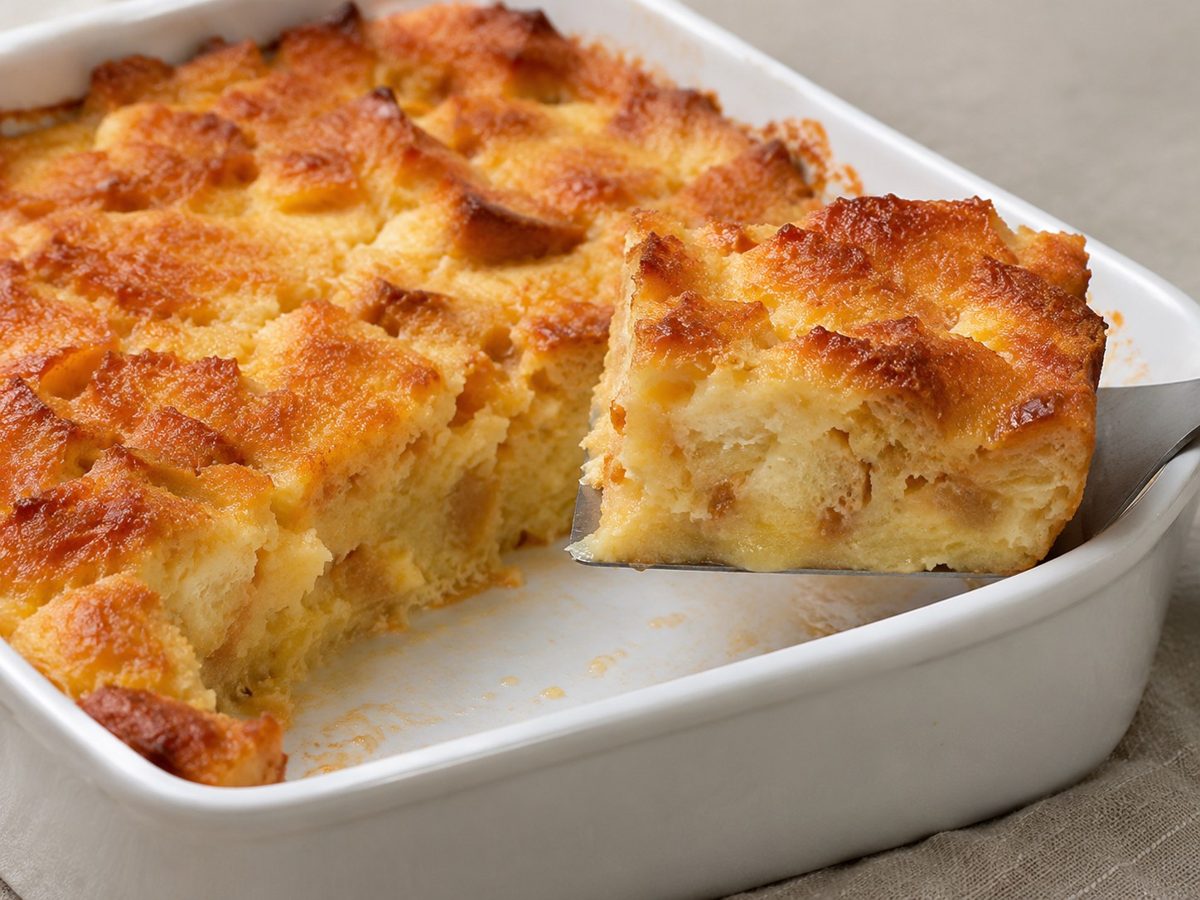
Ingredients
- 300 g slightly stale tapalapa, in 2 cm cubes
- 600 ml pasteurized whole milk
- 3 medium eggs
- 70 g fine sugar
- 30 g melted unsalted butter, plus 5 g for the dish
- 5 ml food-grade vanilla extract
- 1 small pinch of salt
Preparation
Check bread and cut into cubes. If crust is exceptionally hard, remove some rather than leaving large dry pieces in the dessert. Weigh 300 g usable bread.
Gently whisk eggs with sugar, salt and vanilla. Add milk, then 30 g melted butter cooled until warm. Mix without trying to make abundant foam.
Place bread in the bowl and pour liquid over. Mix gently and soak about 30 minutes in the refrigerator, turning pieces once.
Preheat oven to 170 °C and grease dish with the reserved 5 g butter. Gently press a cube: its center must be soaked. If some remain hard, extend resting and immerse them in remaining mixture.
Pour into dish and distribute evenly without packing into a dense layer. Bake about 40–50 minutes until golden on top and set in the center, without free egg liquid.
Check center with a thin blade and, if available, a temperature of at least 71 °C at the center of the egg preparation. If top colors too early, cover loosely and continue.
Rest about 20 minutes before dividing into eight small portions. Serve warm or cool quickly for later cold serving. This formulation contains no raisins, icing or added sauce.
Introduction
Slightly stale tapalapa absorbs milk, eggs and vanilla before baking in a dish. The top browns while the inside retains the tender texture of soaked bread. Small pieces remain visible when cut; the pudding should be neither bread soup nor a dry block. Serve small portions once it has cooled enough to hold on a spatula.
This contemporary adaptation offers another use for the bread in the Senegalese collection. It differs from baobab French toast through soaking the pieces together, oven baking and the absence of bouye. Bread pudding belongs to many cuisines; this version claims no national invention. The title simply identifies the chosen bread, whose crumb and crust affect milk absorption.
Cultural context
At a glance Makes 8 small portions. Preparation 20 minutes. Soaking about 30 minutes. Baking 40–50 minutes at 170 °C in a conventional oven. Rest 20 minutes before serving warm. Equipment: bowl, whisk, knife and a dish about 20 × 25 cm. Allergens: wheat, milk and eggs. Check bread composition for other ingredients. Use sound bread, never moldy bread, even if part appears salvageable.
Choosing bread Tapalapa varies between recipes and bakers. Its crumb may be fairly dense and its crust more or less thick, affecting soaking. The specified weight avoids relying on a variable number of loaves. Use slightly stale but sound bread. Baking a dessert cannot rescue spoiled or moldy bread.
Regular cubes moisten more readily than large slices mixed with crumbs. Keep some crust edges for texture without including pieces almost impossible to cut. Another bread is a possible variation, but observe its absorption. A very light baguette or fat-enriched bread will not necessarily produce the same result.
Allowing time to soak Milk must reach cube centers. A wet surface can surround dry crumb. Gently press a piece after resting to check. Turning once lets upper cubes meet liquid without becoming mush. Refrigerate during resting because the mixture contains eggs and milk.
Some liquid may remain around the bread and helps it set in the oven. Large dry cubes, however, must moisten before baking. Do not automatically add lots of milk: extend contact first and cut stubborn pieces smaller. A major liquid change would require reconsidering eggs and cooking time.
Mixing without crushing The desired texture retains the bread's shape. Complete blending would make a more uniform batter that bakes more compactly. Use a broad spoon to turn and let soaking do the work. Cool melted butter to warm before adding to eggs; very hot butter could coagulate them locally. Keep vanilla measured so bread and milk flavors remain perceptible.
Lightly grease the dish for easier serving; a thick butter layer is unnecessary. Distribute bread evenly to avoid a large dry area on one side and a custard pocket on the other. Some unevenness on top browns pleasantly, but very high points dry before the rest.
Checking the set Golden color alone does not establish a cooked center. The pudding must be set, without egg liquid emerging when two bread pieces are gently parted. A blade may remain moist with absorbed milk and cooked crumb without being coated in raw batter. A thermometer, if available, offers an additional guide for the egg mixture.
Time depends on dish depth and actual oven temperature. A small deep mold needs longer than a wide dish. Start checking around forty minutes and continue in short intervals. If the top is ready before the center, cover loosely without pressing the bread. Do not bake to a completely dry block: resting already firms it.
Serving and storage Twenty minutes' rest makes cutting easier. A very hot portion may slump on the spatula without meaning the whole bake failed. Serve plain in small pieces. Offer fruit separately with its own quantity rather than implicitly adding it. The pudding already contains milk, eggs, bread and sugar and does not automatically need sweet sauce.
Cool leftovers quickly and refrigerate within two hours, sooner in very hot weather. Keep at no more than 4 °C and eat within 48 hours. Reheat the required portion thoroughly without drying the entire tray. Do not leave it at room temperature all day because the bread has already been baked once.
Sources Collection reference for bread: https://www.recettesafricaines.com/recettes/248 Temperature for egg preparations: https://www.foodsafety.gov/food-safety-charts/safe-minimum-internal-temperatures An original contemporary oven-baked formulation.