Salt-crusted sea bream
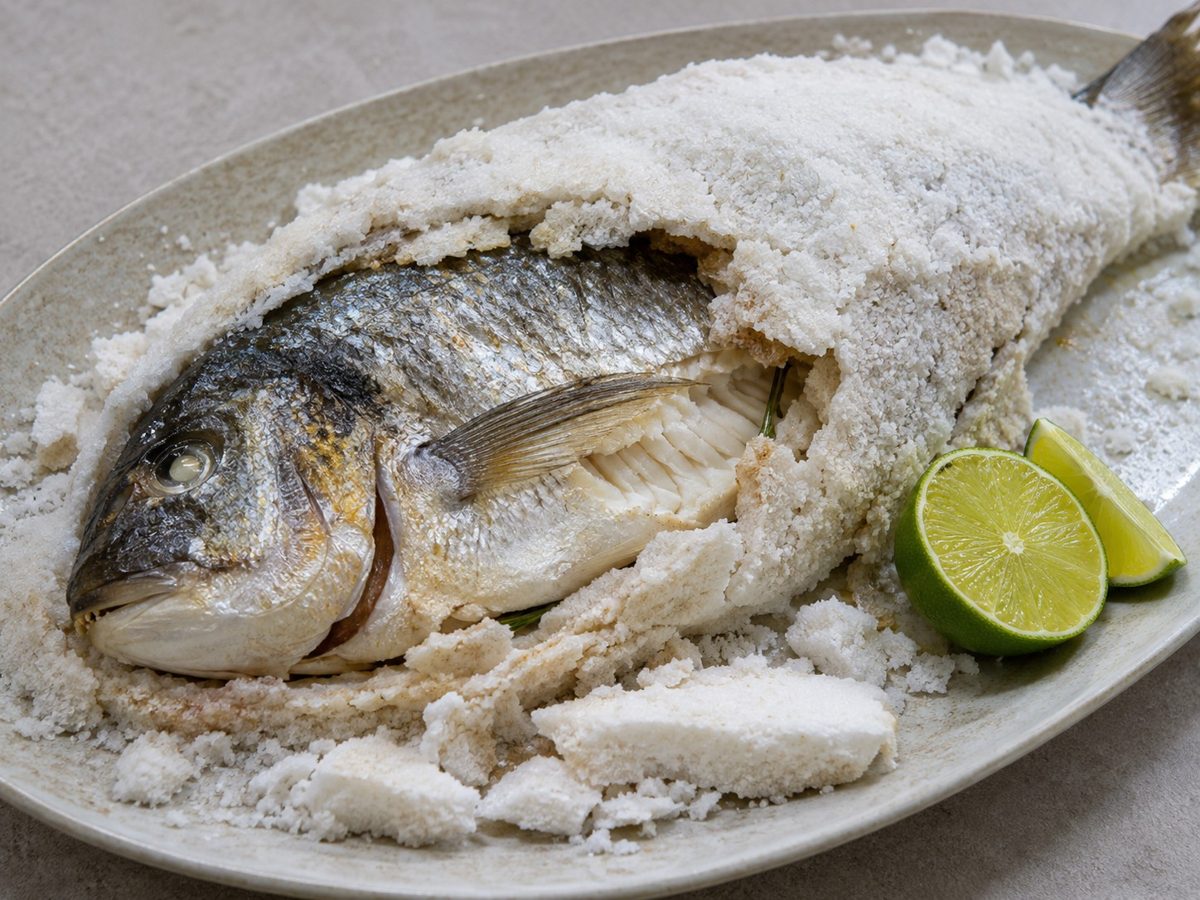
A whole sea bream cooks beneath dampened coarse salt. Break open and remove the crust with the skin to serve fillets. The flesh should stay supple without receiving salt fragments that fall onto the dish. Offer lemon after cooking; no stuffing complicates checking the center.
Ingredients
- 1 whole gilthead sea bream, about 1.2 kg, gutted but not scaled
- 2 kg food-grade coarse salt
- About 180 ml water to moisten salt, added gradually
- 1 small bunch parsley, washed and dried
- 1 small washed lime, quartered for serving
- Optional pepper after cooking
Preparation
Preheat oven to 200 °C. Check the cavity and pat fish dry. Do not slash skin. Place parsley inside without overfilling.
Mix coarse salt with water added gradually. It should resemble damp sand that clumps when pressed, without standing in liquid. Exact quantity depends on salt.
Line tray with baking paper. Make a damp salt bed about 1 cm deep, slightly larger than fish. Place bream over it, then cover completely with salt, pressing lightly especially around back and sides.
Bake about 30–40 minutes. Begin checking at 30 minutes with a thermometer carefully inserted into thick flesh behind the head, avoiding bone. Aim for 63 °C at the center and continue if needed.
Remove tray and rest 5 minutes. Break crust with the back of a sturdy spoon using controlled small taps. Lift large fragments away from fish instead of crushing them onto flesh.
Gently remove upper skin and lift fillets with two spatulas onto a clean dish. Remove backbone and lift lower fillets while avoiding the salt bed.
Check visible bones, divide among four portions and serve immediately. Offer lime and pepper separately. Do not add salt before tasting.
Introduction
A whole sea bream cooks beneath dampened coarse salt. Break open and remove the crust with the skin to serve fillets. The flesh should stay supple without receiving salt fragments that fall onto the dish. Offer lemon after cooking; no stuffing complicates checking the center.
This technique is a contemporary offering for the fish chapter, without an invented Senegalese name or exclusive national-origin claim. It differs from grilled fish, firire and baked sardines: fish remains whole, protected by skin and a crust that is discarded. A specifically sized gilthead sea bream makes the method easier to follow.
Cultural context
At a glance Serves 4 with separate accompaniment. Preparation 20 minutes. Cooking about 30–40 minutes in a conventional oven at 200 °C, depending on thickness. Rest 5 minutes. Equipment: rimmed tray, baking paper, large bowl, cooking thermometer and two spatulas. Allergen: fish. Ask the fishmonger to gut the sea bream for salt baking, retaining protective skin and scales. The crust is not eaten.
Why keep skin intact Skin and scales protect fish during cooking. A deep incision exposes flesh directly to salt and may make it too salty. Specify preparation before the fishmonger starts scaling. Clean the cavity, but there is no need to open it widely along its full length.
Fish must fit the tray without bending. Size and thickness affect time more than body length alone. Much smaller or larger bream needs different checks. Weight includes head and bones, so net flesh is less than three hundred grams per person. Plan accompaniments for the meal.
Making an even crust Salt should clump sufficiently to remain on the sides. Too-dry mixture falls and exposes areas; soaked mixture spreads across the tray. Add water in several stages. No egg white is needed here. Another method using egg would require declaring the ingredient and allergen even if the covering is removed.
Avoid holes over the back or enormous thickness on just one side. The lower bed and salt cover should surround fish fairly evenly. Paper simplifies cleaning but should not extend near a heating element. Use a rimmed tray to retain possible moisture and clear a heatproof space for it after baking.
Checking the center A hard crust does not prove fish is cooked through. A thermometer checks thick flesh behind the head rather than relying only on time. Avoid the backbone, which does not give the same reading as flesh. Insert carefully and check another area if the reading seems inconsistent. Brief resting helps handling but cannot replace enough cooking.
If fish needs a few more minutes, continue before breaking the whole crust. Once removed, cooking proceeds differently and flesh dries more easily. Prepare utensils and plates while fish is still in the oven; serving is better without hunting for tongs or a clean dish amid salt fragments.
Lifting and serving fillets Open calmly. Remove crust fragments outward, then skin. Do not use flesh as a resting place for salty pieces. A wide spatula supports a fillet and a second helps detach it. After removing the main backbone, check small remaining bones, especially portions for anyone who struggles to remove them.
Steamed vegetables, plain rice or simple salad accompany fish. Season according to the actual flesh's taste. No need for very salty sauce on every portion. Squeeze lemon individually. Crust salt has touched raw then cooked fish and must not be recovered as table salt.
Storage Quickly remove remaining flesh from crust and bones. Cool in a shallow container and refrigerate within two hours, sooner in hot weather. Keep at no more than 4 °C and eat within 24 hours. Thoroughly reheat a small portion carefully to avoid drying. Discard anything whose storage was not controlled.
Sources A contemporary crust-baked fish formulation. Internal cooking guidance: https://www.foodsafety.gov/food-safety-charts/safe-minimum-internal-temperatures