Ginger-roasted mango
Ripe but still firm mango is cut into thick slices and briefly baked with a little sugar, neutral oil and ginger. Edges lightly color while the center stays tender. Lime is added mainly after cooking to keep brightness. Juices collected in the dish accompany the pieces, without cream or ice cream in the basic formulation.
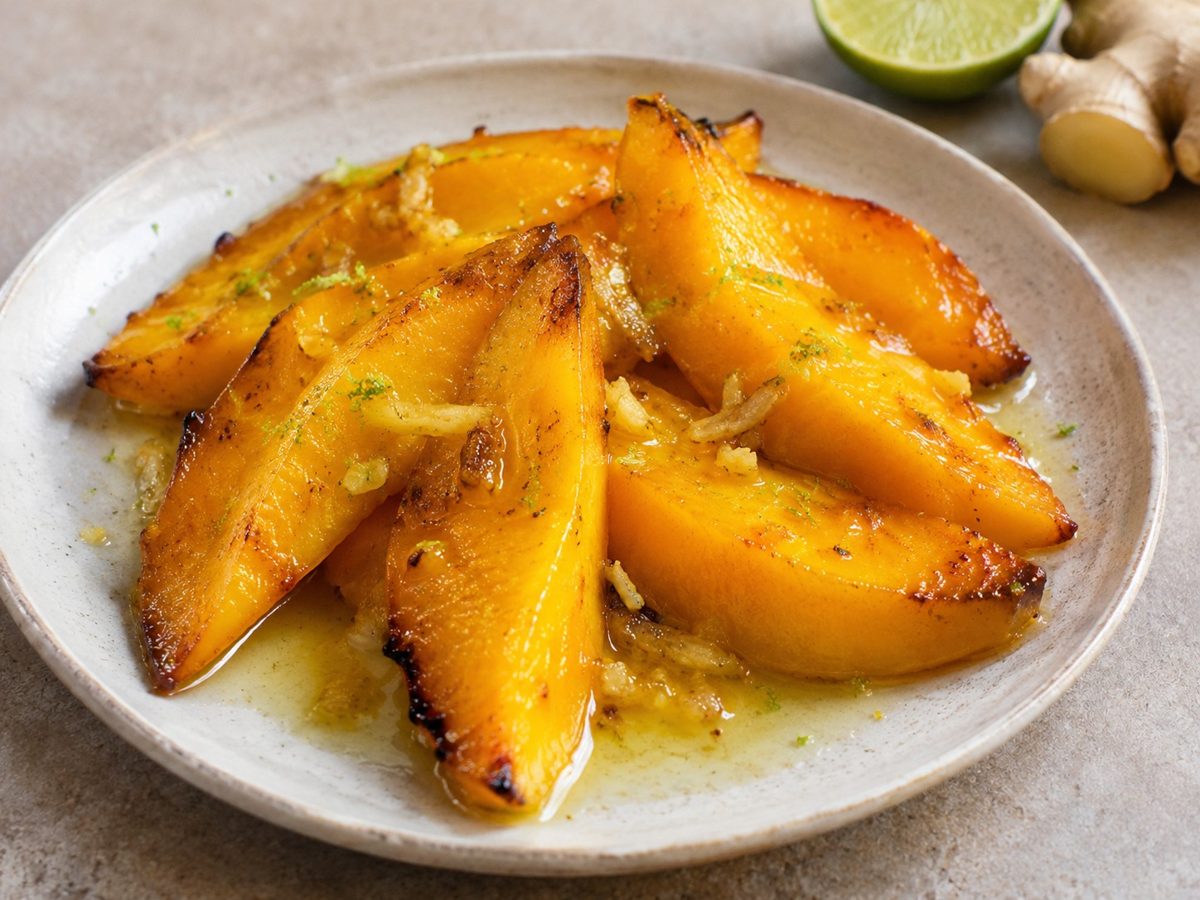
Ingredients
- 700 g ripe but firm mango flesh
- 20 g brown sugar
- 15 ml neutral oil
- 6 g fresh peeled ginger, finely grated
- 15 ml lime juice, including 5 ml before cooking
- 20 ml water for the dish base
- A little fine zest from washed lime, optional, without white pith
Preparation
Preheat oven to 200 °C. Wash and dry mangoes before cutting. Remove cheeks on either side of the stone and salvage remaining parts that can form even pieces. Peel and weigh 700 g flesh.
Cut into thick slices about 2 cm. Reserve very thin pieces for another use so they do not burn before larger ones. Prepare ginger and lime juice.
In the dish mix oil, 20 g sugar, ginger, 5 ml lime and 20 ml water. Add slices and turn gently to coat.
Arrange in one layer without stacking. Bake about 10 minutes. Turn gently with a broad spatula, keeping pieces whole as far as possible.
Continue 5–10 minutes. Edges should begin turning golden and flesh be hot and tender. Remove ready slices if others need longer. Do not wait for the entire surface to darken.
Remove dish and first add half the reserved 10 ml lime. Taste with fruit and add more according to mango acidity. Add a little optional zest.
Cool until warm for a few minutes and divide among four plates with dish juices. Serve warm or cool after rapid chilling, according to the planned meal.
Introduction
Ripe but still firm mango is cut into thick slices and briefly baked with a little sugar, neutral oil and ginger. Edges lightly color while the center stays tender. Lime is added mainly after cooking to keep brightness. Juices collected in the dish accompany the pieces, without cream or ice cream in the basic formulation.
This contemporary preparation extends mango uses already found in the Senegalese collection as juice, jam and compote. Here the fruit remains recognizable after cooking. It receives no traditional name or invented village origin; it is a home variation using familiar ingredients. Cutting, cooking heat and the intention to keep pieces intact on the plate distinguish it from compote.
Cultural context
At a glance Makes 4 desserts. Preparation 20 minutes. Baking about 15–20 minutes in a conventional oven at 200 °C. Equipment: knife, board, scales, small shallow baking dish and spatula. No major allergen deliberately added. Mango weight is net after skin and stone removal. Purchase count depends on size and yield.
Choosing mango that holds together Very ripe mango may be delicious spooned but difficult to roast in slices. Flesh should yield to a knife yet stay firm enough to turn. Exterior color varies with variety and is not reliable alone. Request ready-to-eat fruit suited to cutting, then check texture when opening.
Very fibrous mango retains threads after cooking. Choose smooth flesh if possible. If sound but too soft, compote is a better use; do not insist on roasting at all costs. If still hard and poorly aromatic, heat will not automatically reproduce properly ripened sweetness.
Cutting around the stone Mango stones are broad and flat. Removing cheeks from either side makes large slices easier. Work on a stable board with fruit positioned to minimize slipping. Peeled pulp is slippery; a controlled blade and short strokes are better than force. Avoid extracting the last millimeters as irregular scraps that would burn in the dish.
Net weight adapts the recipe to different fruit sizes. Remaining small pieces can be eaten soon separately or used elsewhere. Do not automatically add them to the planned seven hundred grams. Too thick a layer cooks in its juices, resembling compote rather than roasted slices. Match the dish to the actual weighed quantity.
Using sugar and ginger Mix sugar with liquid to avoid dry piles on some pieces. It helps form glossy juices and complements lightly golden edges, not a hard caramel shell. If the base blackens, the dish is too dry or heat too high; add a small spoonful of hot water and remove ready pieces. Extra lime cannot correct burnt juices.
Finely grated ginger distributes better than long thick strips. Six grams gives a perceptible presence without covering mango. Intensity varies with root freshness. For another version adjust gradually after trying the base. A large dose can make dessert hot and mask differences between fruit.
Controlling the oven One layer exposes edges to heat. A small deep dish collects juices and keeps mango wet. A very large nearly empty one may evaporate juices before fruit is hot. Choose a vessel allowing a little space between slices without a broad bare area covered only with sugar.
Start checking after fifteen minutes. Softer or thinner pieces may finish first. Check with knife tip or spatula without crushing. Fruit should lift as one piece. Lightly colored edges suffice; seeking dark marks everywhere loses juice and aroma.
Serving and storage Serve mango warm on a small plate with one or two spoonfuls of juices. Optional zest is very fine, without bitter white pith. Plain dairy can be offered separately with its allergen declared; it is absent from ingredients and reference image. Four portions can be split into six smaller ones.
Cool leftovers quickly and refrigerate within two hours, sooner in very hot weather. Keep at no more than 4 °C and eat within 48 hours. Eat cold or briefly reheat until evenly hot, knowing pieces will soften further. Avoid repeated baking, which concentrates juices and eventually breaks down fruit.
Sources Collection mango references: juice, https://www.recettesafricaines.com/recettes/12080 ; jam, https://www.recettesafricaines.com/recettes/12089 An original contemporary oven formulation without attribution to a particular tradition.