Potato and cheese soufflé
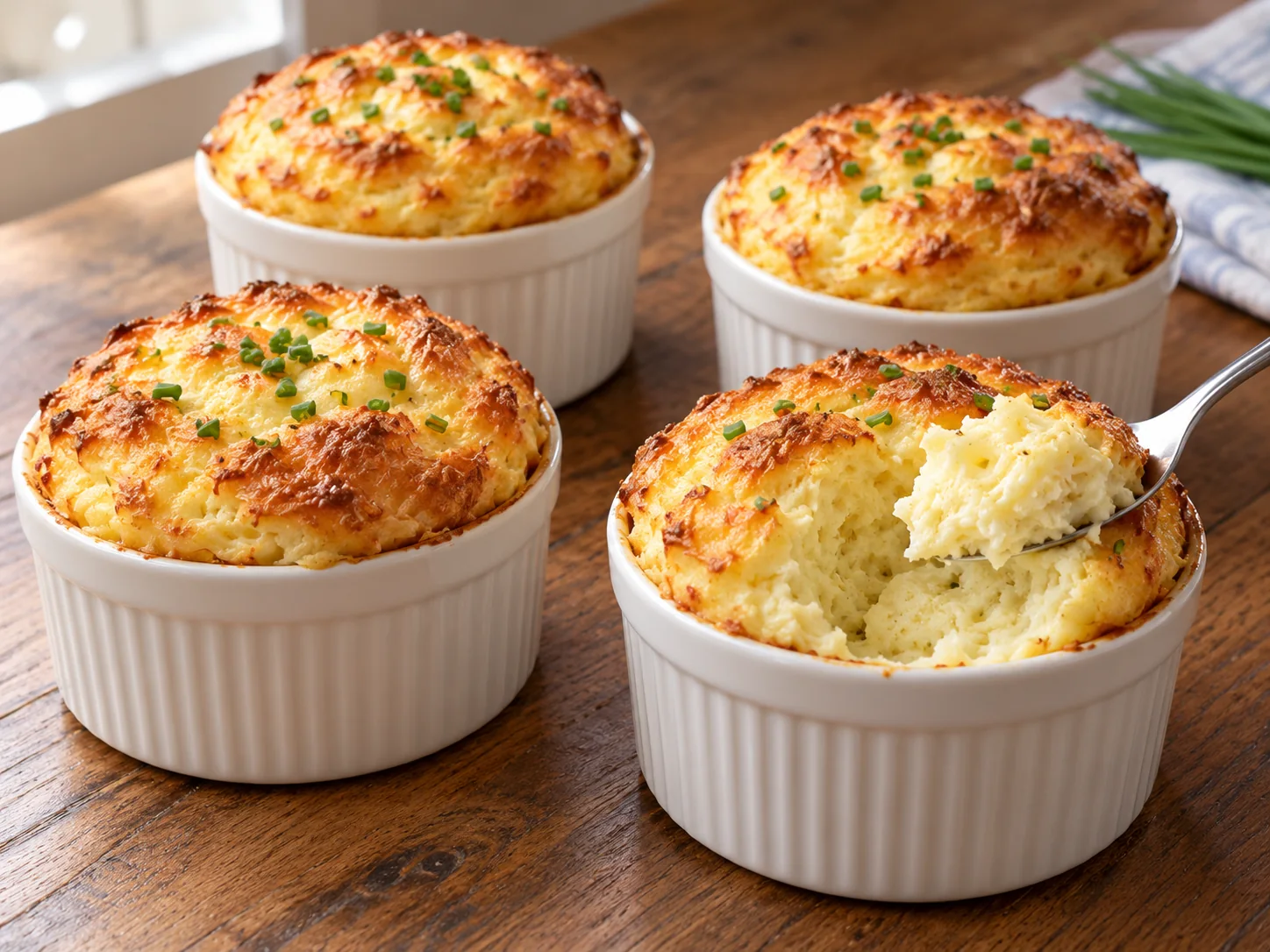
🧀 Mashed potato, grated cheese and whisked egg whites make four individual soufflés. There is no béchamel in the base: potato gives it structure while egg whites provide volume. Use four 300 ml ramekins and serve straight from the oven for a golden crust and airy interior.
Ingredients
- 300 g floury potatoes, peeled, raw weight
- 3 eggs, about 150 g without shells, yolks and whites separated
- 80 ml pasteurised milk
- 80 g finely grated Emmental
- 20 g finely grated Parmesan
- 20 g unsalted butter: 10 g for ramekins and 10 g for mash
- 10 g fine breadcrumbs for ramekins
- 8 g chives, washed, dried and finely snipped
- 1 g sweet unsmoked paprika
- Up to 1 g salt, reduced according to cheeses
- 1/4 teaspoon black pepper
- Enough drinking water to boil potatoes, discarded after draining
Preparation
Cut potatoes into similarly sized cubes, around 2 cm. Put in a pan, cover with drinking water and bring to the boil. Simmer for 15–20 minutes until a knife enters easily. Drain, then return to the pan over low heat for 1–2 minutes, stirring to remove extra moisture without colouring.
Meanwhile, preheat a conventional oven to 190 °C. Butter the four ramekins with the allocated 10 g, then coat bases and sides with breadcrumbs and tip out any excess. Place on a stable tray ready for the oven. Prepare every other ingredient before whisking the whites.
Mash the potatoes while hot. Warm milk with the remaining 10 g butter and gradually mix into the mash. Leave to cool to warm for about 5 minutes, then add yolks, Emmental, Parmesan, chives, paprika and pepper. Mix until evenly distributed. Since cheeses are salty, add no more than the allotted 1 g salt.
Whisk whites until they form firm but smooth, glossy peaks. Mix a first third into the mash to lighten it. Fold in the remainder in two batches with a spatula, lifting from the bottom to the surface. Stop once even, without beating for a long time or trying to remove every tiny trace of white.
Immediately divide between ramekins, filling no higher than three quarters of their height. Wipe any drips from the outside rim. Bake on the middle shelf for about 25 minutes, without opening the door early. Tops should rise and turn golden. Depending on oven and dishes, continue to 30 minutes to cook the centre.
From 25 minutes onwards, check the centre of one ramekin with a clean fine probe: aim for at least 71 °C for this egg dish. A coloured top is not enough if the inside is still liquid. Remove the tray with oven gloves and immediately serve ramekins on heat-resistant plates. Warn diners that they are very hot.
Introduction
Making a soufflé mainly calls for organisation. The mash must be prepared and cooled to warm before adding yolks; ramekins must be buttered before whisking whites; the oven must be hot when the mixture goes in. This avoids leaving a batter to lose volume while still looking for a baking dish.
Choose floury potatoes and weigh them after peeling. Their drier texture provides a better base than very moist salad potatoes. Weigh and finely grate the cheeses so they disperse without large pieces. A soufflé naturally sinks after baking: this does not mean failure, provided that the centre is properly cooked.
Cultural context
🇨🇩 Radio Okapi published a potato and cheese soufflé on 19 August 2021. It belongs to a contemporary repertoire presented in DR Congo, without claiming soufflé as a Congolese invention. This detailed version specifies weights, ramekin capacity and an oven temperature in degrees Celsius. Source: Radio Okapi.
Tips
Do not put potatoes in a blender. High-speed blending can make the base gluey and hard to lighten. A masher or food mill works the texture without turning it into an elastic paste.
Add yolks when mash is warm, not steaming hot straight from the pan. An excessively hot base can set yolks in patches. Conversely, a completely cold, firm base is harder to fold gently into whites.
Dry, grainy whites separated into large clumps do not fold well. Stop at firm, glossy foam. Do not rely on oven heat to repair a batter that has already been stirred too long after the whites were added.
Ramekin capacity matters. Deeper or larger containers change the time needed at the centre. Leave rising space at the top and check cooking rather than automatically applying 25 minutes to a single large dish.
Set out plates and prepare accompaniments before baking ends. Soufflé will not wait long on the worktop. If it sinks a little during serving, prioritise cooking and texture rather than spectacular height achieved with an undercooked centre.
Planning
Have four straight-sided 300 ml ramekins, a stable baking tray, a potato masher, two bowls and a whisk. Breadcrumbs usually contain wheat; eggs and dairy are also present. Check cheese and breadcrumb labels when managing an allergy.
Separate each egg in a small container before combining its white with the others. A broken yolk should not contaminate the whole bowl of whites. The bowl and whisk used for whisking must be clean and free of grease. Keep eggs chilled until preparation and do not taste the raw mixture.
Serving
Serve ramekins on their plates without unmoulding to preserve the outside. The centre should be airy and soft, not runny. Avoid covering soufflés in a heavy sauce that would crush the surface; offer any extras separately.
Storage
Soufflé is best freshly baked. Cool leftovers promptly in small portions and refrigerate within two hours, at 4 °C or below. Eat within 24 hours and reheat only the required portion until thoroughly hot in the centre. It will not regain its original volume: do not try to make it rise again by cooking until dry.
Variations
A relatively dry cheddar can replace the 80 g Emmental at the same weight. Its flavour and salt content may differ, so do not automatically add more salt. Replace chives with the same weight of very finely chopped parsley if desired, dried well after washing.
To avoid wheat in breadcrumbs, use a product labelled gluten-free and check every other ingredient. Eggs and milk remain present. Adding ham, fish or very wet vegetables would change structure and cooking time: these additions are not part of this recipe.
Accompaniments
Serve one ramekin per person with green salad, tomatoes or separately cooked vegetables. Add to the meal according to appetite for a more substantial lunch. Quantities and nutritional estimates cover only the soufflé, without dressing or accompaniment.
Nutrition notes
Eggs and cheese provide protein, potatoes provide carbohydrate, and dairy supplies some calcium. Cheese and butter contribute fat and salt. Values are estimates per ramekin using the stated ingredients, not a laboratory analysis of the finished food. Egg-dish cooking reference: FoodSafety.gov.