Pigs’ feet with vegetables and yoghurt
🥘 Long-cooked pigs’ feet join simmered vegetables and potatoes, then plain yoghurt softens the sauce off the heat. This adaptation makes four bone-in servings. It includes the long initial cooking of raw feet in the total time instead of hiding it behind a quick finish. The final sauce is pinkish, with recognisable vegetable pieces.
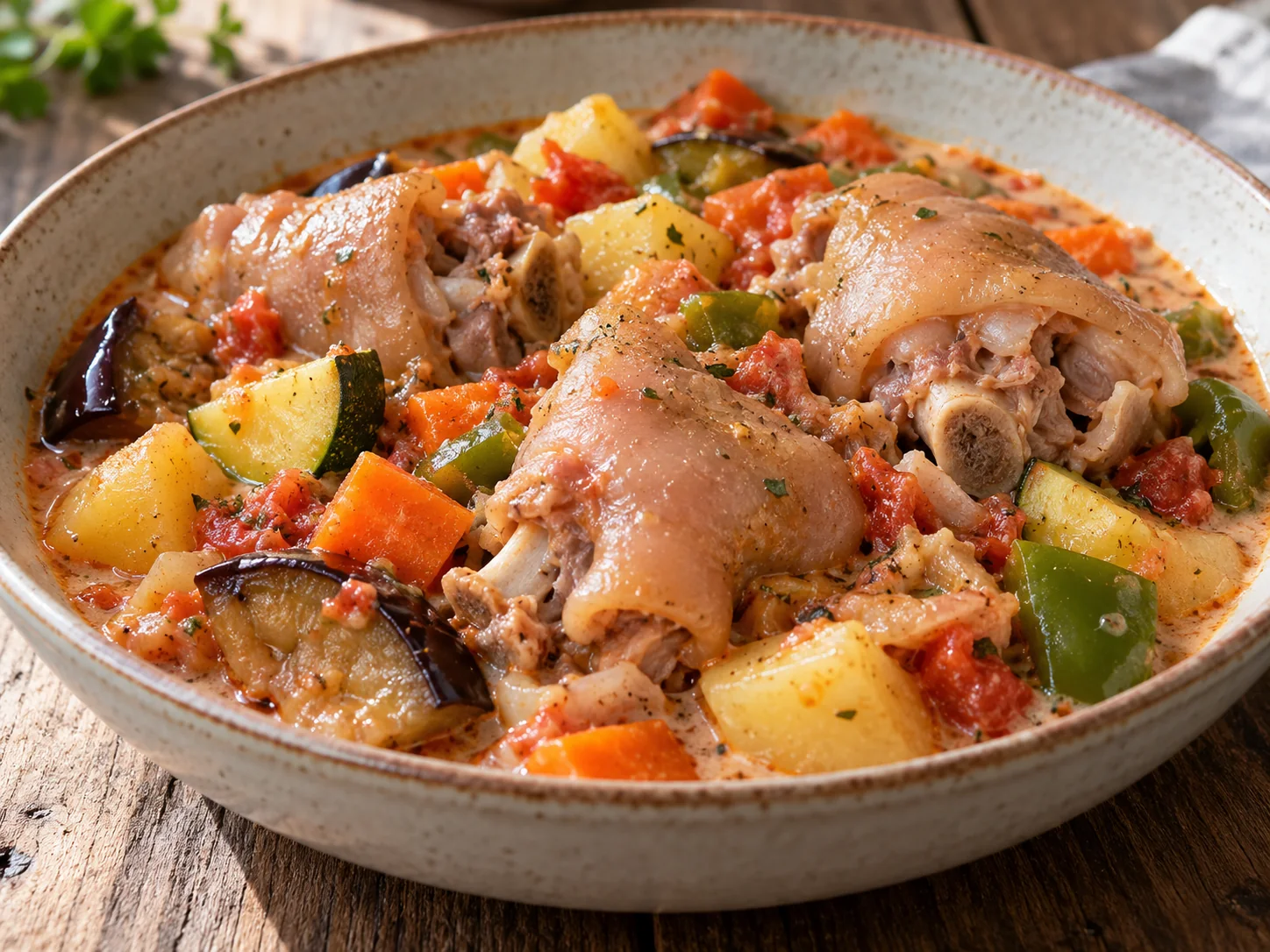
Ingredients
- 800 g raw pigs’ feet, prepared and split by the butcher, bone-in
- 2 litres drinking water for initial cooking, plus a little hot water if needed
- 400 g peeled potatoes in evenly sized cubes
- 200 g aubergine in small cubes
- 200 g courgette in pieces
- 150 g deseeded green pepper in dice
- 150 g peeled carrot in small half-rounds
- 150 g sliced onion
- 400 g chopped ripe tomatoes
- 200 g unsweetened plain pasteurised yoghurt, preferably whole milk
- 20 ml neutral vegetable oil
- 4 g salt at most, to divide
- 1/4 teaspoon white pepper
Preparation
Cook feet for about two and a half hours. Put in the saucepan with 2 litres water and about 2 g of the planned salt. Bring to the boil, then maintain a gentle simmer, partly covered. Add hot water if necessary to keep feet surrounded by liquid. Continue beyond the guide if tissues remain firm.
Check and reserve. Once edible parts are very tender and release easily, transfer feet with a skimmer to a clean dish. Measure 300 ml cooked stock for later. Inspect pieces and remove visible small bone fragments without suggesting feet automatically become boneless.
Start vegetables towards the end of the feet’s cooking. Heat 20 ml oil in the sauté pan. Soften onion five minutes, add carrot, pepper and aubergine and stir another five minutes without burning the base.
Simmer the base twenty minutes. Add tomatoes, potatoes and 300 ml cooked stock. Cover and simmer fifteen minutes, then add courgette and continue about five minutes. Check potato and carrot tenderness; continue if needed, adding a little stock if the base dries.
Combine and heat ten minutes. Add tender feet to vegetables and stir carefully. Maintain steady heat until everything is thoroughly hot. Pepper, taste and add only required salt within the planned limit. If there is abundant liquid, reduce somewhat before yoghurt.
Add yoghurt and serve. Remove from heat and let boiling stop for two minutes. Loosen yoghurt in a bowl with a few spoonfuls of hot sauce, then gently return to the pan. Do not bring back to a vigorous boil. Divide feet, vegetables, potatoes and sauce between four people, mentioning bones.
Introduction
Pigs’ feet contain skin, connective tissues and bones rather than a large mass of muscle. Tenderness takes time. Continue the initial gentle simmer until fleshy and gelatinous parts release easily. A minimum time cannot guarantee identical results for every foot: cutting and the animal affect duration.
Vegetables cook separately towards the end of this first stage. They do not need several hours of simmering. Potatoes already supply the dish’s starch; no other accompaniment is necessary to understand the stated yield. Yoghurt goes in at the end after a short pause off the heat to limit separation.
Order feet prepared, cleaned and split by the butcher. Do not try sawing bones with a kitchen knife. Prepare a large saucepan, wide sauté pan, skimmer and clean dish for cooked meat. The process is long but the steps are straightforward.
Cultural context
🇨🇩 Radio Okapi publishes a recipe named ratatouille with pigs’ feet and yoghurt. It combines feet, aubergine, courgette, pepper, tomato, carrot and potatoes or yam. This publication documents a contemporary proposal shared in DR Congo, without proving ancient origins or a practice common to all families.
This version chooses potatoes and specifies quantities for four people. It counts the feet’s full preliminary cooking and adds yoghurt off the heat rather than boiling it for a long time. The descriptive title avoids treating the preparation as a vegetable-only ratatouille.
📚 Culinary reference: Radio Okapi, 17 December 2015.
Tips
Total time assumes feet become tender in about two and a half hours while vegetables cook in parallel. Some pieces need longer. Allow a margin and judge actual texture without squeezing the whole initial stage to meet mealtime.
Feet have lower edible yield than a boneless roast. Share edible parts fairly rather than giving pieces of identical gross weight. Their gelatinous texture belongs to the dish and does not indicate faulty cooking.
Potatoes must be tender before yoghurt is added. Acidity and a short finish will not easily correct still-hard cubes. Cut similar sizes and test a thick piece with a knife point.
Yoghurt may form small grains in very hot or acidic sauce. Gradual addition off the heat limits this without guaranteeing complete smoothness. Slight separation proves neither correct storage nor spoilage: consider temperature history and dates too.
Reduction concentrates the sauce, and stock already contains some salt. Taste after combining meat and vegetables. No extra stock cube is planned; one could make final seasoning difficult to control.
Planning
Refrigerate feet until cooking. Check cleanliness and remove visible debris appropriately. A vinegar soak is not disinfection and cannot replace cooking. Clean hands, board and utensils after contact with raw pork.
Prepare vegetables with clean equipment. Cut carrot and aubergine small enough to soften in the sauté pan. Keep yoghurt chilled until finishing. Stock added to vegetables must be taken only after feet are fully cooked. Edible yield remains variable because the initial 800 g includes bones.
Serving
Present hot immediately after adding yoghurt. Declare milk and the numerous bones. For someone needing boneless service, take their portion and carefully remove bones before spooning sauce over it; do not rely on the diner to discover small fragments.
Storage
Cool quickly in shallow containers, then refrigerate within two hours at 4 °C or below. Consume within forty-eight hours. Reheat only the needed portion to at least 74 °C in the centre, stirring gently; yoghurt may separate more. Do not keep the dish lukewarm to preserve appearance. Discard plate leftovers rather than returning them to the reserve.
Variations
The source also suggests yam. This recipe uses potatoes only; a substitution requires checking the chosen tuber’s cooking time and usual preparation. Do not add yam on top of stated quantities while retaining identical nutritional values.
Serve chilli in a separate sauce if desired. Yoghurt must be plain and unsweetened. Flavoured yoghurt or a dairy dessert is unsuitable. Commercial fully cooked feet require a different time calculation and label check; the stated three and a half hours here genuinely includes raw feet.
Accompaniments
Potatoes are already part of the dish. Add a carefully washed salad if desired. Bread or another starch portion remains optional and is excluded from estimates. Excessive garnishing would obscure the planned division of feet and vegetables for four.
Nutrition notes
The dish combines pork tissues, vegetables and potatoes. Do not equate the feet’s whole weight with lean meat or present their gelatine as treatment. Figures estimate an edible serving with vegetables and potatoes, excluding bones; they vary with yield, skin and chosen yoghurt. They do not replace analysis of the finished dish.