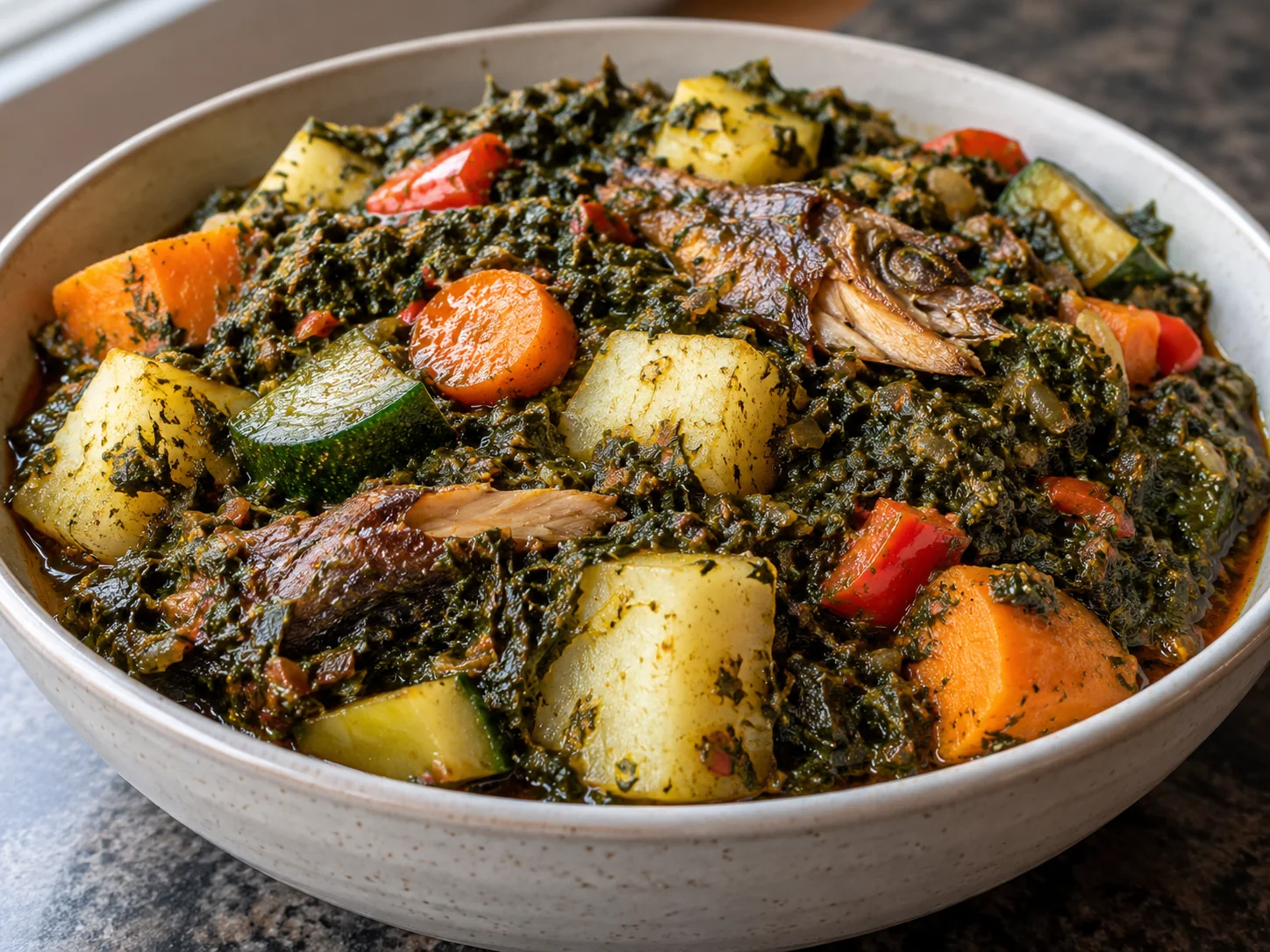
Limbondo with sweet potatoes
🌿 A complete dish of cassava leaves, tubers and vegetables flavoured with smoked fish and red palm oil. This adaptation exclusively uses commercial cassava leaves and root that are fully cooked and ready to eat. The following steps assemble the dish; they are not a method for processing raw cassava.
Ingredients
- 400 g commercial cassava leaves, fully cooked and explicitly ready to eat, drained weight
- 300 g commercial food-grade cassava root, fully cooked and explicitly ready to eat, fibrous core removed, in pieces
- 400 g peeled sweet potatoes, raw weight
- 200 g peeled carrots
- 200 g courgette
- 150 g deseeded pepper
- 100 g peeled onion
- 200 g food-grade ready-to-eat smoked fish flesh, skinless and boneless
- 40 ml food-grade red palm oil
- 300 ml drinking water, plus a little more if needed
- 1 bay leaf
- 8 g chives
- 1 small whole red chilli, optional
- Up to 1 g salt, depending on fish and prepared products
- Enough drinking water to cook sweet potato, discarded after draining
Preparation
Wash vegetables. Cut carrots into thin 5 mm rounds, courgette into half-rounds, pepper into pieces and onion into small dice. Cut sweet potato into 2–3 cm cubes. Separately prepare already-cooked cassava root in similarly sized pieces. Keep fish and cassava products chilled until used.
Cover sweet potato with drinking water in a pan, add bay leaf and simmer about 12–18 minutes. Test a cube: it should be tender but hold together. Drain and remove bay. This only cooks sweet potato; do not add raw cassava root to this pan.
Meanwhile put onion, carrot and palm oil in a large pot. Cook gently 5 minutes, stirring without burning onion. Add courgette and pepper, then 200 ml of the 300 ml water. Partially cover and simmer 10 minutes until carrot begins to soften.
Add fully cooked cassava leaves, already-cooked root and remaining 100 ml water. Gently separate any clumps of leaves to distribute heat. Fold in fish pieces and optional whole chilli. Simmer 8–10 minutes, or follow a longer reheating time if the label requires it.
Add drained sweet potato cubes and snipped chives. Fold with a large spoon. Continue about 5 minutes until everything is thoroughly hot. If the base dries before the centre heats, add a few spoonfuls of water. For a thermometer check, aim for 74 °C at the centre of the reheated mixture.
Taste sauce and adjust only if needed with some of the allotted gram of salt. Remove whole chilli if desired. Check carrots are tender and a small amount of sauce remains. Divide leaves, vegetables, tubers and fish among four deep plates and serve promptly.
Introduction
Leaves provide the stew’s green base, tubers its body and smoked fish a pronounced flavour. Keep some sweet potato and cassava pieces visible with a small amount of sauce binding everything. Cutting carrots thinly allows them to cook with the other vegetables without everything else breaking down.
Before starting, check the exact nature of both cassava products. “Frozen”, “pounded”, “blanched” or “precooked” does not necessarily mean fully cooked and ready to eat. This recipe requires an explicit manufacturer’s statement. If these products are unavailable, choose another recipe rather than applying the stated times to raw leaves or roots.
Cultural context
🇨🇩 On 7 March 2016, Radio Okapi published Limbondo combining cassava leaves, tubers, vegetables and smoked fish. This version keeps that general composition but deliberately changes sourcing and workflow: it requires fully prepared cassava and omits bicarbonate. Weights and timing belong to this home adaptation, not a literal reproduction of the publication. Source: Radio Okapi.
Tips
Read labels before buying to avoid arriving home with raw leaves on cooking day. Green colour or a chopped texture does not prove full processing. Do not turn this into a fresh-cassava recipe simply by lengthening the final simmer.
A large carrot chunk stays hard longer than a thin round. Keep to the 5 mm cut and check tenderness before adding already-cooked ingredients. This prevents excessive cooking of everything else.
Smoked fish varies in moisture and saltiness. Choose food-grade ready-to-eat flesh and follow its label; dried fish requiring other processing is not an automatic equal-weight replacement. Salt only after tasting.
Folding rather than beating preserves tubers. A few fragments naturally thicken the sauce, but crushing every cube changes the balance. A broad spoon is more useful than a whisk.
For advance preparation, cook and cool components correctly, then keep chilled. Do not hold the pot lukewarm for hours. Reheating must reach the centre, not just boil liquid around the sides.
Planning
Cassava contains cyanogenic compounds and needs appropriate processing. Neither brief cooking nor bicarbonate is presented here as a safety guarantee. FSANZ highlights the importance of cassava preparation; our practical choice is to start with fully prepared products from an identified food manufacturer. Do not taste raw cassava to identify its variety. Guidance: Food Standards Australia New Zealand.
Follow packaging storage and thawing instructions. A product still requiring processing to become edible does not match this recipe’s ingredients. Check fish with clean fingers and remove bones even when the pack says boneless. Fish is an allergen and salt content varies. Do not soak ready-to-eat fish at room temperature for an hour.
Serving
Use a serving spoon that takes leaves and pieces together. Serve stew first, then distribute remaining fish and tuber pieces among portions. The result should be moist and cohesive, without a large pool of oil or an over-diluted soup.
Storage
Refrigerate leftovers in small shallow containers within two hours, at 4 °C or below. Eat within 48 hours or sooner if opened-product labels require. Reheat only the necessary portion to 74 °C in the centre, stirring and adding a little water if needed. Do not repeatedly reheat the whole pot.
Variations
Chilli may be omitted; keeping it whole provides flavour without scattering small pieces. Chives may be left out if unavailable. Neither choice changes cassava product requirements.
A fish-free version can use 200 g already-cooked, drained white beans, but becomes a plant-based adaptation with a different flavour. Check salt in commercial leaves and do not retain unchanged nutrition figures. Replacing leaves with spinach also gives a different version; it does not demonstrate identical preparation requirements for both products.
Accompaniments
Tubers are already included: serve alone or with a small extra vegetable portion according to appetite. There is no need to automatically add rice, bread or chikwangue. Nutrition estimates cover only the ingredients and four portions described.
Nutrition notes
Fish provides protein, tubers mainly carbohydrate and vegetables fibre. Calculations depend strongly on prepared leaves and fish selected. Values are therefore rough estimates per quarter recipe, without sides. Sodium can be higher with salted products; no precise vitamin content is guaranteed.