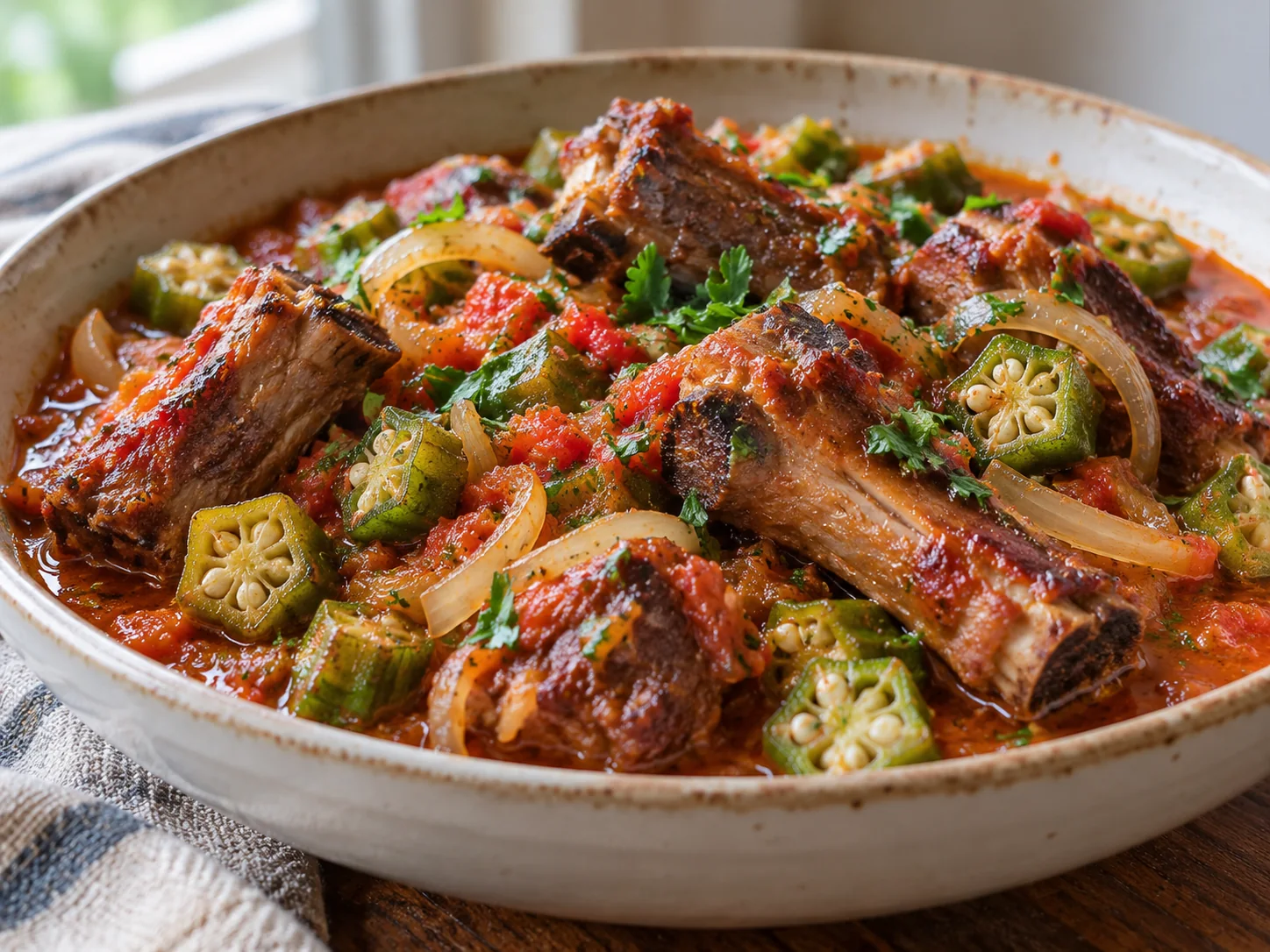
Smoked pork ribs with okra
🍅 Smoked pork ribs and okra rounds simmer in tomato sauce with ginger and parsley. This measured adaptation of a personal Gisele Cooking creation uses commercially fully cooked, tender ribs ready for reheating, without stock cubes. Bones and okra remain visible.
Ingredients
- 800 g commercially smoked pork ribs, already fully cooked, tender and ready for reheating, bone-in and professionally cut
- 250 g trimmed fresh food-grade okra, 1 cm rounds
- 400 g chopped ripe tomatoes
- 150 g chopped onion
- 10 g chopped garlic
- 15 g peeled and grated fresh ginger
- 15 g washed chopped flat-leaf parsley
- 15 ml olive oil
- 450 ml drinking water, plus up to 150 ml hot water if needed
- 2 culinary bay leaves, to remove
- 1/4 teaspoon ground nutmeg
- 1/4 teaspoon white pepper
- Up to 2 g salt, only after tasting
- Optional whole fresh chilli, removed before serving
Preparation
Heat 15 ml olive oil over moderate heat. Soften onion 5 minutes without strong browning. Add garlic and ginger during the last minute. Stir to prevent sticking; lower heat rather than adding unmeasured oil.
Add tomatoes and half the parsley. Cook about 10 minutes, stirring regularly, until tomatoes break down and juices thicken slightly. Add nutmeg and pepper. With measured fat, there is no need to wait for a large oil separation.
Pour in 450 ml water and add both bay leaves. Place already fully cooked ribs in the hot sauce, cover and simmer 15 minutes to reheat, turning gently once if needed. This does not cook raw ribs; follow any more demanding product directions.
Add okra rounds and optional whole chilli. Simmer uncovered gently about 15 minutes. Fold once or twice without crushing. Add some of the extra 150 ml hot water if drying; retain coating sauce rather than frying.
Check okra tenderness and at least 74 °C in the centre of several thick edible pork parts without touching bone. Continue gently if necessary. Timing is guidance: size, starting temperature and manufacturer directions may require longer.
Remove both bay leaves and whole chilli. Look for detached small bones. Add remaining parsley, taste with a clean spoon and salt only if needed, up to 2 g for everything. Divide ribs, okra and comparable amounts of sauce among four shallow bowls; serve hot.
Introduction
Cotis here means smoked pork ribs cut into small bone-in pieces. Buy an explicitly fully cooked, tender, ready-to-reheat product. Smoking alone does not prove cooking: raw smoked or merely salted ribs require a different, longer procedure. Check the label or ask the professional. The forty-five minutes apply only to the precooked product described.
The eight hundred grams includes bones. Nutrition assumes approximately five hundred grams edible yield, which varies with cut and product. Ask the supplier to cut cleanly rather than making splinters with a kitchen knife. Keep chilled until adding to sauce and respect manufacturer directions, including any longer reheating.
Weigh two hundred fifty grams okra after trimming the dry stem tips. Choose young, firm, food-grade pods without mould. This recipe does not promise to eliminate all mucilage: texture varies with cutting and cooking. Even rounds and measured timing give a reproducible result, not a guarantee of completely non-viscous sauce.
Cultural context
🇨🇩 Gisele Cooking presents smoked ribs with okra as a personal creation. This measured contemporary adaptation uses already fully cooked pork. Sources: Gisele Cooking. FoodSafety.gov.
Tips
Smoked does not always mean ready to eat. Fully cooked labelling and prior tenderness are essential; smell or colour cannot establish cooking status.
Very thin okra thickens differently. Keep roughly one-centimetre rounds and avoid beating the mixture to retain recognisable pieces.
If reducing too fast, add hot water little by little. All the extra water at once may dilute flavour and unnecessarily prolong okra cooking.
Measure in thick flesh at the centre, not only in sauce or against bone. Clean the probe before and after and check several different-sized pieces.
Provide a bone plate and warn diners. Carefully debone the portion of anyone unable to manage bones; initial bone-in weight cannot guarantee edible yield.
Planning
Smoked products can contain substantial salt and extra marinade ingredients. Read their allergen list; no added stock cube does not automatically mean low salt. Brief boiling cannot establish an exact salt level. This version does not blanch the already cooked product again and seasons at the end.
Wash okra whole, dry well and slice. Remove only the hard tip without deeply hollowing the pods. Prepare tomatoes, onion, garlic, ginger and parsley first. A wide lidded sauté pan holds the ribs and allows moderate reduction. Have tongs, spoon and food thermometer ready.
Serving
Distribute edible pork fairly: equal bone-in weights may contain different meat amounts. Keep okra visible in sauce rather than hidden beneath pork. Clearly announce pork and bones, supply suitable cutlery and do not leave the dish cooling on the table.
Storage
Promptly divide leftovers into shallow containers and refrigerate within two hours at 4 °C or below. Use within 48 hours or freeze sealed dated portions. Thaw in the refrigerator. Reheat only what is needed gently to 74 °C at the centre, adding water if necessary. Okra may soften further.
Variations
This is not a universal smoked-meat method. Raw ribs, smoked beef or oxtail cannot automatically retain this timing; their tenderising and checks require separate planning.
Plain frozen okra may replace fresh at equal weight, following its packet. Avoid prolonged worktop thawing and adjust reduction for released water. Parsley may be split differently between cooking and finish, but adding salted stock requires revisiting seasoning.
Accompaniments
Serve with plain rice, chikwangue or plantain prepared separately. Choose one and note that its nutrition is excluded. Ribs supply the main protein; another meat is unnecessary. Offer drinking water.
Nutrition notes
Pork supplies protein and okra contributes fibre. Smoked products can be salty; actual product composition overrides generic estimates. Per-portion values exclude accompaniments and assume about 500 g edible yield from 800 g bone-in. Exact product salt and finished micronutrients were not measured.