Godrogodro
A dense Malagasy rice-flour and coconut cake flavoured with caramel and finished in a domestic oven.
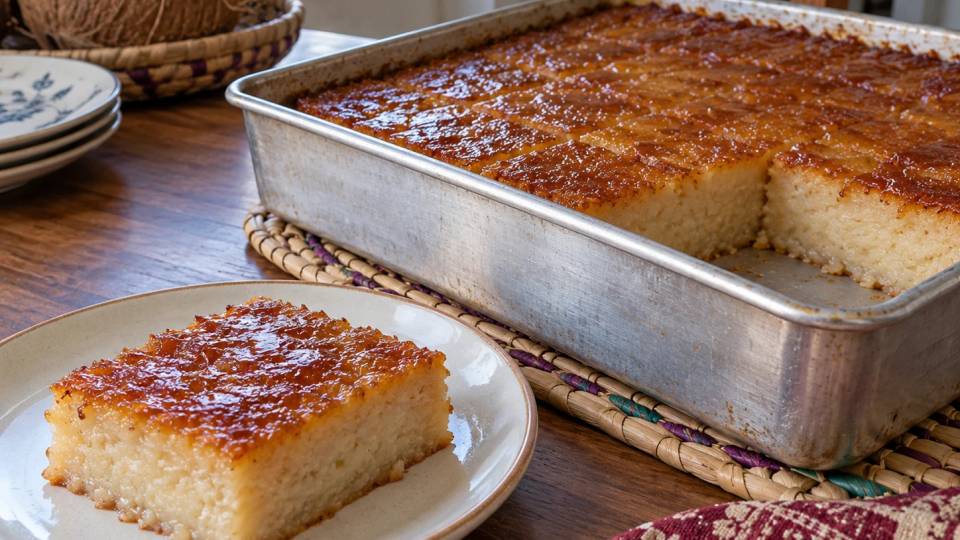
Ingredients
- 200 g fine rice flour
- 800 ml unsweetened coconut milk, mixed until uniform
- 220 g sugar, divided into 100 g and 120 g
- 40 ml drinking water for the caramel
- 20 ml neutral oil, plus 1 teaspoon for the tin
- 1/2 teaspoon ground cinnamon
- 1 small pinch of salt
Preparation
Heat the conventional oven to 180 °C. Oil a square tin about twenty centimetres wide and line the base if needed. Mix the coconut milk thoroughly. Whisk 250 ml of it, cold, with the 200 g rice flour until no dry pockets remain. Keep this mixture beside the saucepan.
Put 100 g sugar and 40 ml water in a sufficiently large saucepan and cook to a light amber caramel, watching constantly. Avoid a dark bitter colour. Separately warm the remaining 550 ml coconut milk. Keep both pans stable and their handles accessible without reaching over the caramel.
Remove caramel from the heat. Add the warm coconut milk in small additions, keeping hands and face away from the bubbling steam and splashes. If caramel hardens, dissolve it again over low heat while stirring. Add the remaining 120 g sugar, cinnamon and salt to obtain a smooth coloured liquid.
Stir the cold rice-flour mixture again because the flour settles. Whisk it gradually into the hot liquid, then use a spatula. Thicken over low heat for three to five minutes while scraping constantly. It should fall slowly from the spatula. Mix in 20 ml oil; do not allow a burnt crust beneath a runny surface.
Immediately spread in the tin and smooth gently. Bake for about forty to fifty minutes, until the top firms and the centre no longer waves like liquid when carefully moved. Cover loosely with oven-safe material if the edges brown too quickly. Tin size and coconut-milk water content affect timing.
Cool on a rack. Refrigerate once the strong heat has dissipated rather than leaving it on the worktop all day. Cut small portions when set, wiping a clean knife between cuts. Keep covered in the refrigerator for no more than three days and take out only the portion needed.
Introduction
Godrogodro is not a fritter or an airy sponge. This version is a low, moist, dense cake: rice flour thickens coconut liquid flavoured with caramel, first on the hob and then in the oven. It is not a wheat cake that must rise.
Use a square tin about twenty centimetres wide and keep an even depth so the centre cooks before the edges dry. Let it cool before cutting because warm portions are fragile. A domestic oven is an adaptation and does not promise the same crust as charcoal cooking. Cinnamon remains subtle. Have a stable cooling rack ready; a first slice broken by lifting too early does not necessarily mean the whole cake is undercooked.
Cultural context
Malagasy recipes document godrogodro with rice flour, coconut and caramel, with differing proportions and heating methods. This measured home-oven adaptation differs from leaf-wrapped koba and small rice cakes cooked in moulded wells; their methods and textures are not interchangeable.
Source: https://www.mamina.org/fr/recette/godrogodro
Tips
Disperse flour in cold coconut milk to prevent lumps.
A smaller tin gives a thicker cake and needs different timing.
Thicken the mixture on the hob while keeping it spreadable.
Judge the centre as well as colour and wait for cooling before assessing texture.
Variations
For a first attempt keep cinnamon as the only spice. A little vanilla can replace it later. Light coconut milk changes water and fat proportions and therefore texture. A separate caramel topping is another, sweeter finish, unnecessary here because caramel already flavours the whole cake.
Accompaniments
Serve a small slice with tea, coffee or water. Fresh pineapple or lime-dressed papaya can complete a tasting plate; cream is unnecessary. Keep reserve portions refrigerated and lift them with a clean spatula.
Nutrition notes
Rice flour supplies carbohydrate and coconut milk contributes richness. Caramel is still added sugar. No wheat flour is deliberately used, but that alone does not guarantee gluten-free suitability: check every product and equipment. Calculated values depend on the milk and actual portions.