Fried plantain
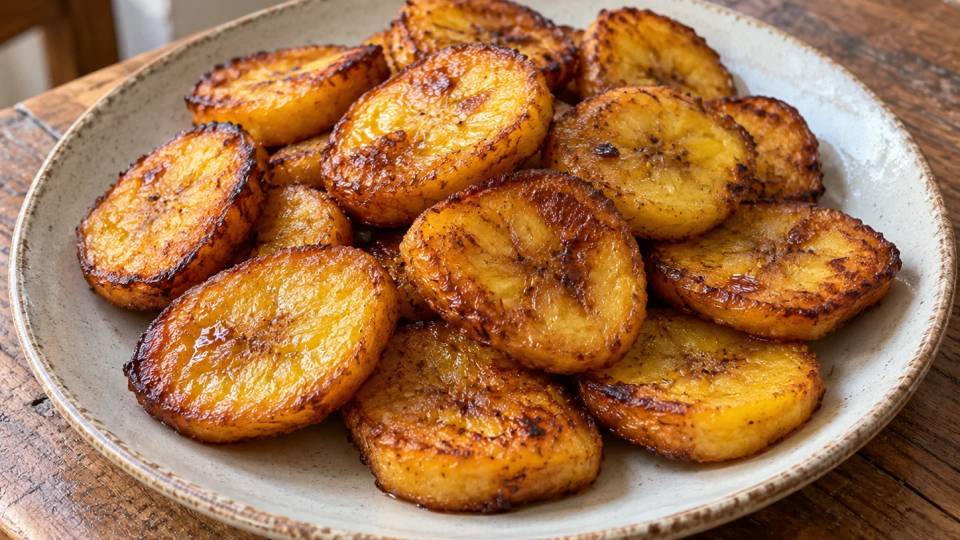
Ripe plantain rounds pan-fried golden, soft inside with lightly caramelised edges, without batter or added sugar.
Ingredients
- 4 ripe but firm plantains, about 800 g peeled flesh
- 180 ml suitable frying oil, adjusted for a shallow layer
- 1 small pinch salt, optional
- 1 lime served separately, optional
Preparation
Inspect yellow fruit with dark patches and firm flesh. Skin markings are not the same as mould, leakage or spoiled flesh; reject abnormal-smelling or damaged areas. Do not automatically substitute very ripe dessert bananas, whose moisture and structure cook differently.
Wash and dry the skins, trim the ends and make a lengthwise incision without cutting deeply into the flesh. Lift off the skin with fingers. If difficult, improve the incision rather than twisting and breaking the fruit. Remove remaining fibres and use a stable board and clean knife.
Cut diagonal rounds about one and a half centimetres thick. Thin slices dry quickly; thick chunks may brown before heating evenly. Do not rinse after slicing, as water near hot oil causes splashing. Gently blot any wet surfaces with clean paper.
Put about half a centimetre of oil in a stable wide frying pan, adjusting the amount to its diameter. Deep immersion is unnecessary. Heat to about 170 °C and add a few rounds in one layer, with room to turn. The oil must not smoke; lower heat if a test slice colours instantly.
Cook the first side about two to three minutes. Edges turn golden and the surface firms slightly. Very ripe sweet fruit browns faster, so watch it. Constantly lifting each round prevents a clean surface forming. Separate touching pieces gently with a spatula instead of pulling the flesh.
Turn with a thin spatula and cook the other side two to three minutes. Tight tongs can crush ripe rounds. Seek golden to locally brown surfaces, not black. Remove ready pieces as needed and check a thick centre is hot and soft. Firmer less sweet fruit needed a different preparation.
Drain in a single layer on a rack or absorbent paper. Add a tiny pinch of salt only if desired; no sugar is needed. Serve hot or warm with lime separately. Do not soak everything in juice or cover while very hot, since condensation softens the surface. Cook another small batch rather than crowding the first.
Refrigerate shallow portions within two hours and use within two days. Reheat once in the oven; the texture is usually less contrasted than freshly fried. Do not keep them overnight in a sealed box on the worktop. Cool the oil before handling and never add water to the still-hot pan.
Introduction
Use ripe but firm plantains that will hold their shape. Unlike mofo akondro, these are uncoated fruit slices, not banana fritters in batter. They are also different from thin dry chips of green plantain. Aim for a soft hot centre and golden edges with the fruit’s own sweetness.
This is a family option within Madagascar’s wider Indian Ocean and tropical context, not a claimed regional invention. Yellow skin marked with black generally indicates a different sweetness and cooking behaviour from green fruit. Flesh that collapses under the fingers is difficult to turn.
Cultural context
Bananas and plantains belong to a broad tropical repertoire with uses varying by fruit, ripeness and household. These ripe pan-fried rounds are a meal accompaniment or snack, not a synonym for Malagasy mofo akondro. The references describe diverse Madagascar fruits and snacks, not an exclusive formula.
Sources: https://www.ambassade-madagascar.fr/decouvrir/repas-et-boissons/ ; https://www.madagascar-destination.mg/culture/gastronomie.html
Tips
Note fruit colour and firmness to reproduce your preferred texture.
Keep thickness even within a batch.
Moderate heat warms the fruit without burning surface sugars.
Offer lime and chilli separately for sweet or savoury serving.
The visible uncoated round is intentional; flour does not repair overripe flesh.
Variations
Oven cooking is an adaptation with a different surface and less direct oil contact. Green plantain slices need another method and will not have this sweet softness. A little cinnamon after frying is optional. Alcohol flambé is unnecessary for this straightforward family version.
Accompaniments
Serve moderate portions alongside a not-too-sweet savoury dish, beans or fresh salad. As a snack, water or light tea is sufficient. Ripe fruit needs no automatic addition of sugar, condensed milk and syrup. A wide dish with separated rounds preserves texture better than a deep damp pile.
Nutrition notes
Plantain supplies carbohydrates and frying adds fat. No added sugar does not mean portion size is irrelevant. Needs depend on the diner and the rest of the meal. Oil poured into the pan is not the amount eaten, so no exact nutrition value is invented.