Caramelized peanuts
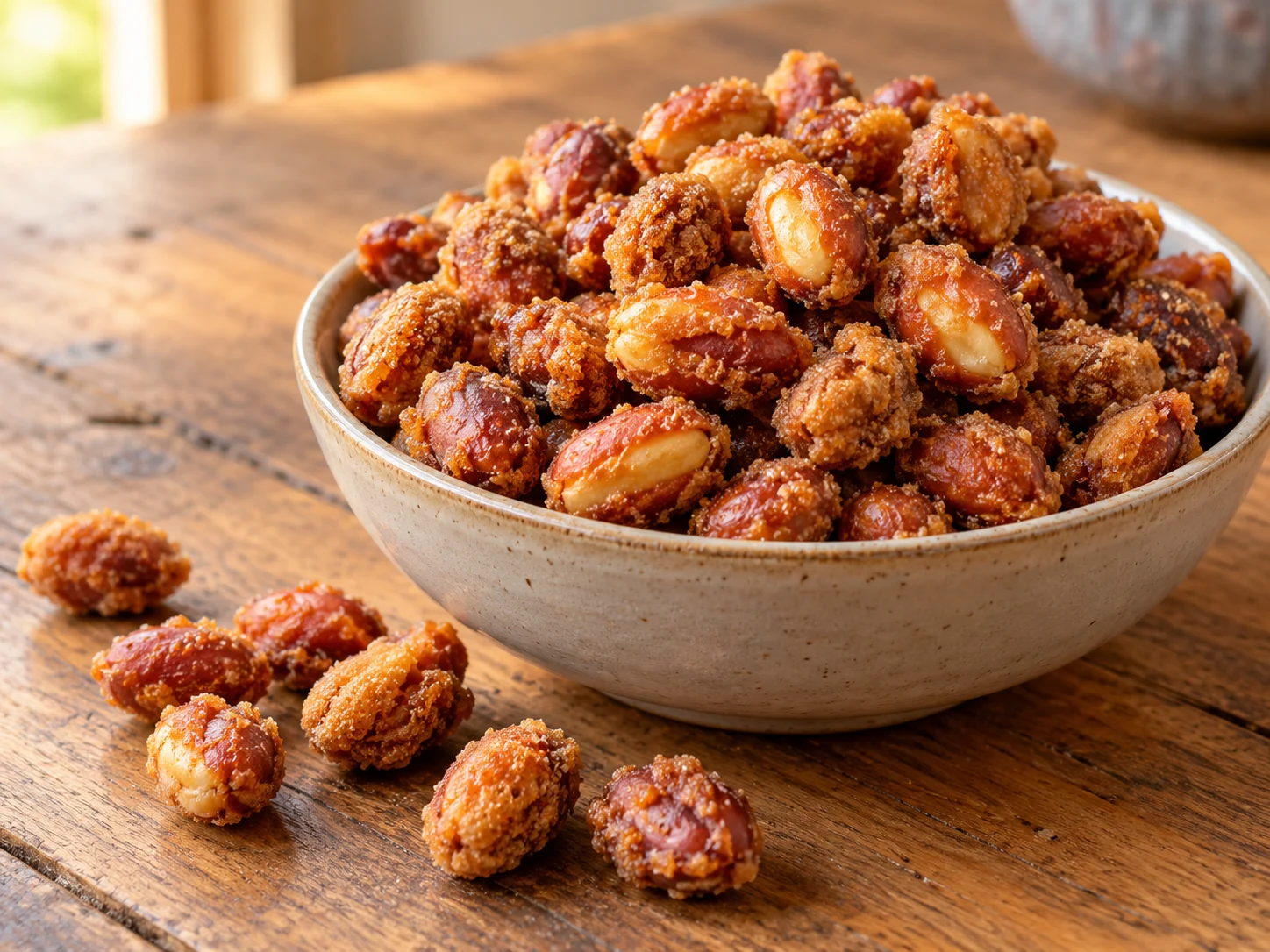
🥜 Roasted peanuts with a thin golden sugar crust, separated into small bites. A home version of sweets sold in Niger.
Ingredients
- 300 g shelled, roasted, plain unsalted peanuts
- 180 g white sugar
- 90 ml drinking water
Preparation
Prepare a baking-paper-lined tray, heatproof spatula and wide heavy-based saucepan. Sort peanuts and discard any with abnormal appearance or smell. Weigh everything first.
Put sugar and 90 ml water in the pan. Heat gently to dissolve, then add peanuts. Stir to distribute in the syrup without crushing.
Cook over medium-low heat, stirring regularly. Water evaporates and syrup thickens. Continue until sugar becomes sandy and whitens around the peanuts; crystallization is part of the method.
Lower heat slightly and stir continuously. Some sugar melts again and turns golden. Fold peanuts from edges to centre for an uneven but distributed coating. Remove before sugar darkens or smokes.
Immediately spread on the tray. Separate using two heatproof spatulas or forks, never fingers. Work in small areas to avoid a compact block. Do not taste while hot.
Cool completely for about 30 minutes. Separate remaining small clusters and divide into twelve servings. Store only when cold and dry to the touch.
Introduction
A sugar crust around each peanut
The intended result differs from a sheet of brittle. Peanuts remain separable, with a rough, lightly caramelized coating. Cooking includes visible crystallization: sugar looks dry, whitens and becomes powdery around the nuts. This does not mean the recipe has failed. Continuing gently melts some sugar again so it sticks, forming the characteristic crust. Judge the stopping point by colour and coating rather than blindly following a fixed time.
Choose the starting peanuts carefully
This recipe uses already-roasted, unsalted peanuts without added seasoning. That lets you focus on sugar without suggesting that brief contact with syrup cooks raw nuts. Peanuts may retain their thin skins or be peeled according to the product. Similar-sized kernels coat more evenly. Rancid or damaged peanuts are not made acceptable by caramel. Use a clean food product stored according to its packaging.
Leave enough room in the pan
The pan must allow stirring when sugar turns powdery. A narrow pan promotes spills and makes coating difficult. Clear the work surface and prepare the tray in advance. Both pan edges and syrup can be very hot. A sturdy heatproof spatula allows turning without bringing fingers close. Do not ask a child to hold the tray or separate nuts during the hot stage.
Observe three sugar states
Initially nuts move through shiny liquid syrup. Evaporation reduces water and thickens it. Then sugar becomes sandy, clinging in small particles and sometimes leaving powder on the base. Further heating melts this powder in places and gives colour. Stir carefully so one area does not burn while another remains white. Not all sugar needs to become perfectly smooth caramel; a slightly uneven surface belongs to this version.
Adjust without rushing
If sugar colours too quickly, briefly remove the pan from heat while continuing to stir cautiously. Gentler heat gives more time to distribute coating. Do not add water to hot caramel to cool it or oil to hide a burnt smell. Let any loose sugar on the tray cool; never pick it up by hand while hot. Slight differences between bites are normal. Aim for golden cooking without bitterness and peanuts that can be shared.
Cool before storing
Final texture appears after complete cooling. A hot nut may feel soft before its coating sets. Spread in one layer where possible rather than immediately piling in a deep bowl, where residual steam can make them sticky. Once cold, separate small clusters without forcing a still-hot block. Serve small portions in clean bowls and close the remainder in a dry container. This preserves the contrast between roasted peanut and sugar crust.
Cultural context
FOPAT’s 2018 report records these sweets sold in Niger. Quantities are a home adaptation. Source: https://reca-niger.org/IMG/pdf/fopat-rapportphase2-0604vf2.pdf
Tips
Use already-roasted unsalted peanuts for this method.
Prepare the tray before heating syrup.
Expect the sandy stage before slight recaramelization.
Stir from the edges to distribute heat and avoid burnt spots.
Separate hot nuts only with suitable utensils.
Declare peanuts as an allergen and check packaging for possible traces.
Serving
Divide into twelve small portions after complete cooling.
Storage
Cool fully, then store airtight and dry for up to 7 days for good quality. Avoid humidity, excessive heat and packing while warm.
Variations
A small pinch of spice can flavour the sugar without changing the method.
For sharing, form small clusters with utensils instead of separating every kernel.
Cashews need a separate adaptation; they are not peanuts under another name.
Accompaniments
Water or unsweetened tea.
Fresh fruit served separately, excluded from estimates.
Nutrition notes
Estimated per twelfth: about 202 kcal, from 300 g roasted peanuts at roughly 585 kcal/100 g and 180 g sugar at roughly 375 kcal/100 g. Peanuts provide fat, protein and fibre, but the coating remains sugary. Values depend on the product and sugar left in the pan.