Cassava cake
A baked adaptation of cassava cake using firm plain commercially processed and fully cooked cassava purée, coconut and vanilla.
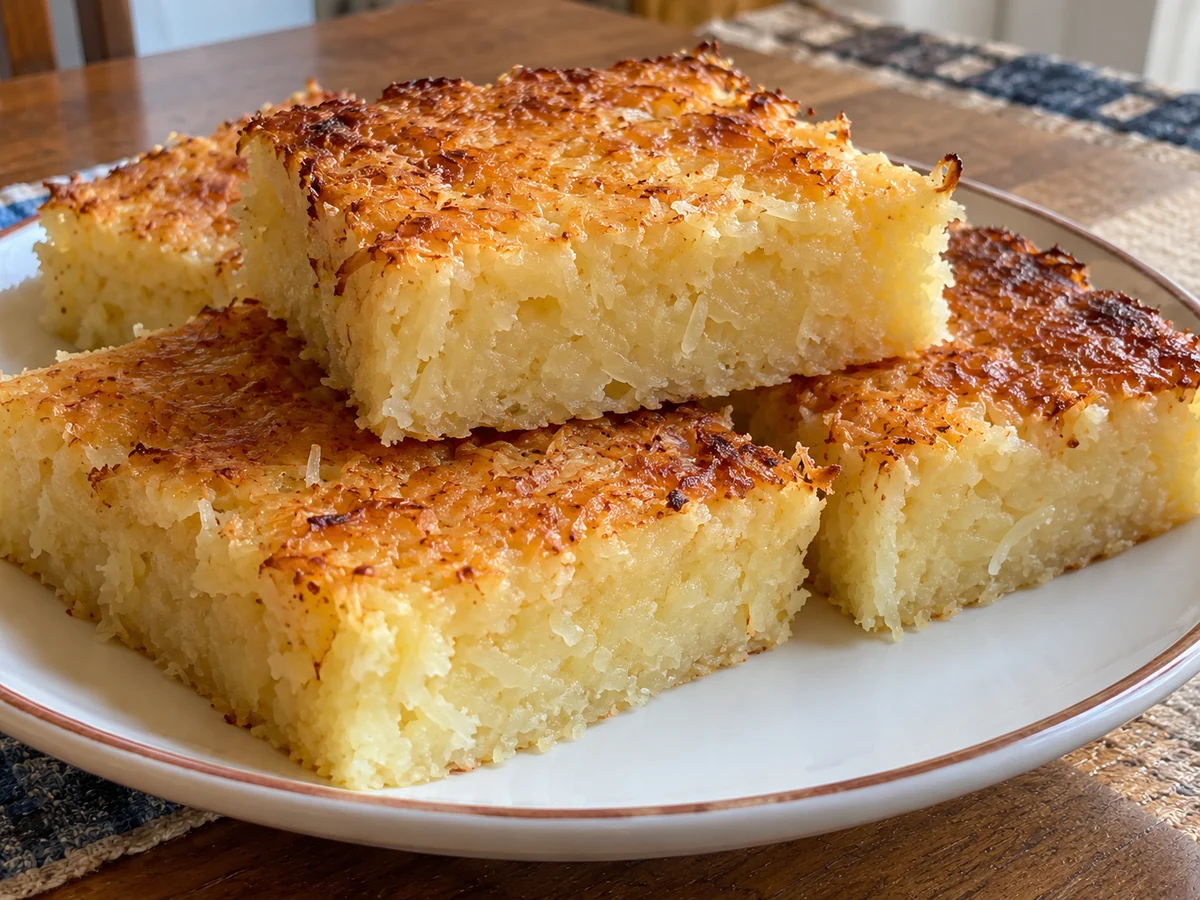
Ingredients
- 600 g firm plain cassava purée, commercially processed and fully cooked, labelled ready to eat, without added sugar, milk or fat
- 60 g food-grade grated coconut
- 3 eggs
- 100 g sugar
- 80 g butter, melted and cooled slightly
- 100 ml pasteurised milk
- 1 teaspoon vanilla extract
- 1 pinch salt
- 5 g butter for the tin
Preparation
Use only commercially processed, fully cooked food-grade cassava labelled ready to eat, mashed to a firm purée if necessary. Do not replace it with raw grated cassava, even if sold as sweet. This recipe does not provide treatment of raw or bitter roots.
Preheat to 170 °C. Butter a roughly 20 cm tin and line its base. If the already cooked cassava is frozen, thaw in the refrigerator according to its label, drain if required and mash firmly without adding water.
Beat eggs, sugar and salt until combined, without whipping a very airy foam. Add slightly cooled melted butter, milk and vanilla.
Fold in the already cooked cassava purée and coconut, mixing until evenly distributed without liquid pockets. Fill the prepared tin and level to an even depth.
Bake for 45–55 minutes until the egg mixture is completely set, without a raw wet centre. Cover the top lightly if it colours early. This structural baking does not replace cassava safety processing, which must already have been completed commercially.
Cool slightly in the tin, unmould carefully and let cool before cutting eight portions. Do not taste the raw batter.
Serve small slices. Cool leftovers promptly, cover and refrigerate, then use within 2 days.
Introduction
Weigh the prepared food product after any operations required by its label. Frozen already cooked cassava must thaw and drain as specified, under appropriate cold conditions. Adding unplanned thawing liquid changes the cake, while squeezing a product that should not be squeezed may dry it. Do not repair excess moisture by adding coconut or wheat flour without understanding the original preparation. Mix eggs just until uniform; a very airy foam cannot turn the heavy cassava mixture into a sponge. Let melted butter cool slightly so it distributes without cooking the eggs. The roughly 20 cm tin gives a suitable layer depth: too small leaves a slow-cooking centre beneath a browned surface. Cover the top lightly if it colours before the centre is ready, while continuing the required cooking. Cooling helps structure and neat slicing but does not replace the cooking check. Use a clean sharp knife and refrigerate cut leftovers in one layer.
This is specifically an adaptation with 600 g firm, plain, already cooked cassava purée. It is not a method for raw grated roots. The oven sets the eggs and cake structure; its temperature and appearance do not establish cyanogenic-compound safety. Only a commercially processed, fully cooked product labelled ready to eat is suitable.
Cultural context
Context and identity are documented here: https://www.latelierdekristel.com/2022/03/07/pudding-de-manioc/. The measured amounts and small-batch method are a domestic formulation, not an exclusive origin claim or a universal family recipe.
Tips
Prepare the ingredients and utensils first, then follow the sequence to control the final texture.
Taste a small portion at serving temperature before adding optional seasoning to the entire batch.
Follow the stated storage conditions; a clean container alone does not make food shelf stable.
Variations
Keep the base unchanged for the first attempt. Change one optional flavour in a later batch, rather than changing quantities and technique together.
Accompaniments
Serve a small portion with the other elements of the meal or snack already prepared. Choose a lightly seasoned accompaniment or an unsweetened drink, and offer optional garnishes separately.
Nutrition notes
Cassava supplies mainly starch. Eggs and milk add protein, milk provides calcium and eggs contribute B vitamins. Coconut and butter add fat. This sweet requires the cassava preparation precautions regardless of its possible mineral content.