Fried fish
Lightly floured fish steaks pan-fried with turmeric and garlic, served with lime.
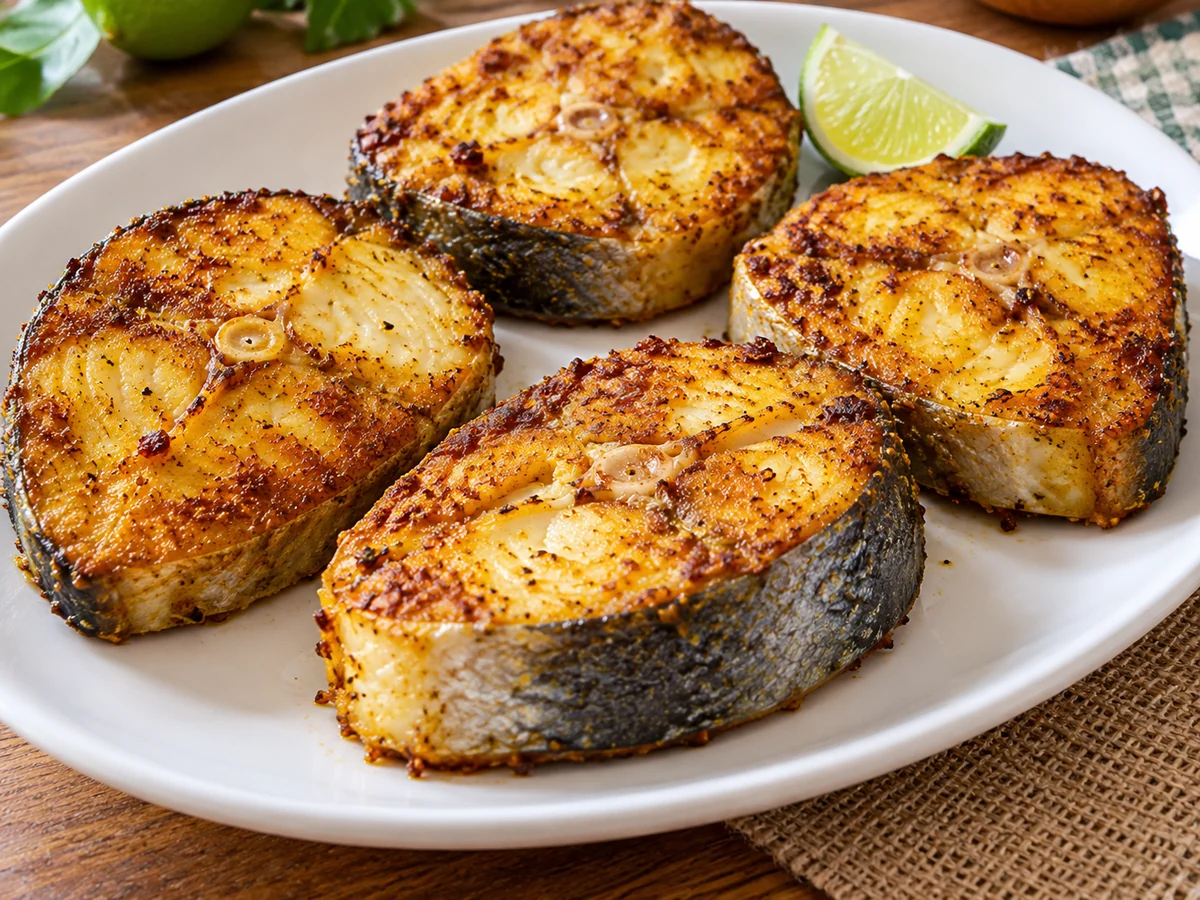
Ingredients
- 4 firm white-fish steaks of 180–200 g, about 2 cm thick
- 50 g wheat flour
- 2 grated garlic cloves
- 1/2 tsp turmeric
- 1/2 tsp salt
- 1/4 tsp pepper
- 100 ml neutral pan-frying oil, absorption varies
- 1 lime for serving
Preparation
Check steaks for accessible bones and pat all surfaces dry; keep fish cold until cooking.
Mix garlic, turmeric, salt and pepper with a spoonful of measured oil. Coat lightly and chill 10 min.
Flour both sides of the next steaks to be cooked, shaking off excess rather than coating everything early.
Heat a thin layer of the measured oil in a stable large pan without smoking. Add at most two steaks with space between.
Cook first side 4–5 min over moderate strong heat; wait for the crust to release before moving.
Turn carefully with a wide spatula and cook 4–5 min more, reducing heat if colour develops too quickly.
Check 63 °C in the thickest flesh without touching bone. Drain cooked steaks without sealing them under a lid.
Cook the next batch after removing burnt flour. Serve promptly with lime and clean utensils, separate from raw fish.
Introduction
This is an original domestic formulation for a Mauritian recipe collection. The named local source documents the culinary context or an example, rather than certifying these exact quantities. Prepare the ingredients and serving dishes before heating the pan. Follow the described texture and thickness as well as the approximate time, because different products and equipment do not behave identically. Optional chilli is kept separate when diners prefer different heat levels. A nearly transparent flour coating gives a fine crust, while a heavy wet layer may peel away. Fish thickness controls timing, and yellow turmeric colour alone does not prove doneness. Do not keep shifting the steaks before a crust forms. The flour that has touched raw fish is not returned to its original packet. Clean the pan of dark particles between batches, and never pour water into hot oil to cool it.
Cultural context
The local reference supports the dish or its culinary setting; it does not establish an exclusive origin or a single mandatory family recipe. The quantities here are an original home version, with the specific starting product and technique stated clearly. Reference: https://mauritiusnow.com/fr/blog/things-to-do/cuisine-mauricienne/
Tips
A nearly transparent flour coating gives a fine crust, while a heavy wet layer may peel away.
Fish thickness controls timing, and yellow turmeric colour alone does not prove doneness.
Do not keep shifting the steaks before a crust forms.
The flour that has touched raw fish is not returned to its original packet.
Variations
Rice flour can replace wheat flour for a different coating; check contamination if gluten avoidance is required.
Add chilli at service rather than into the flour.
Thick skinless fillets work but require especially gentle handling.
Accompaniments
Serve with the suggested simple sides rather than several rich sauces. Rice, vegetables and a small fresh condiment can form a complete plate; for a snack, keep portions modest. Offer lime and chilli separately so each diner adjusts the portion without wetting the whole dish. Prepare sides in advance and use clean serving utensils that have not touched raw seafood or batter.
Nutrition notes
Seafood supplies protein and can provide vitamin B12 and minerals such as iodine, selenium, zinc or copper, depending on the species. The actual product, edible portion and cooking method change the composition; no precise values are invented. Salt is adjusted after tasting, especially with precooked products or prepared stock. Announce fish, crustacean or mollusc allergens as applicable, and check flour, egg, mustard or declared additives in the ingredient list.