Roasted peanuts
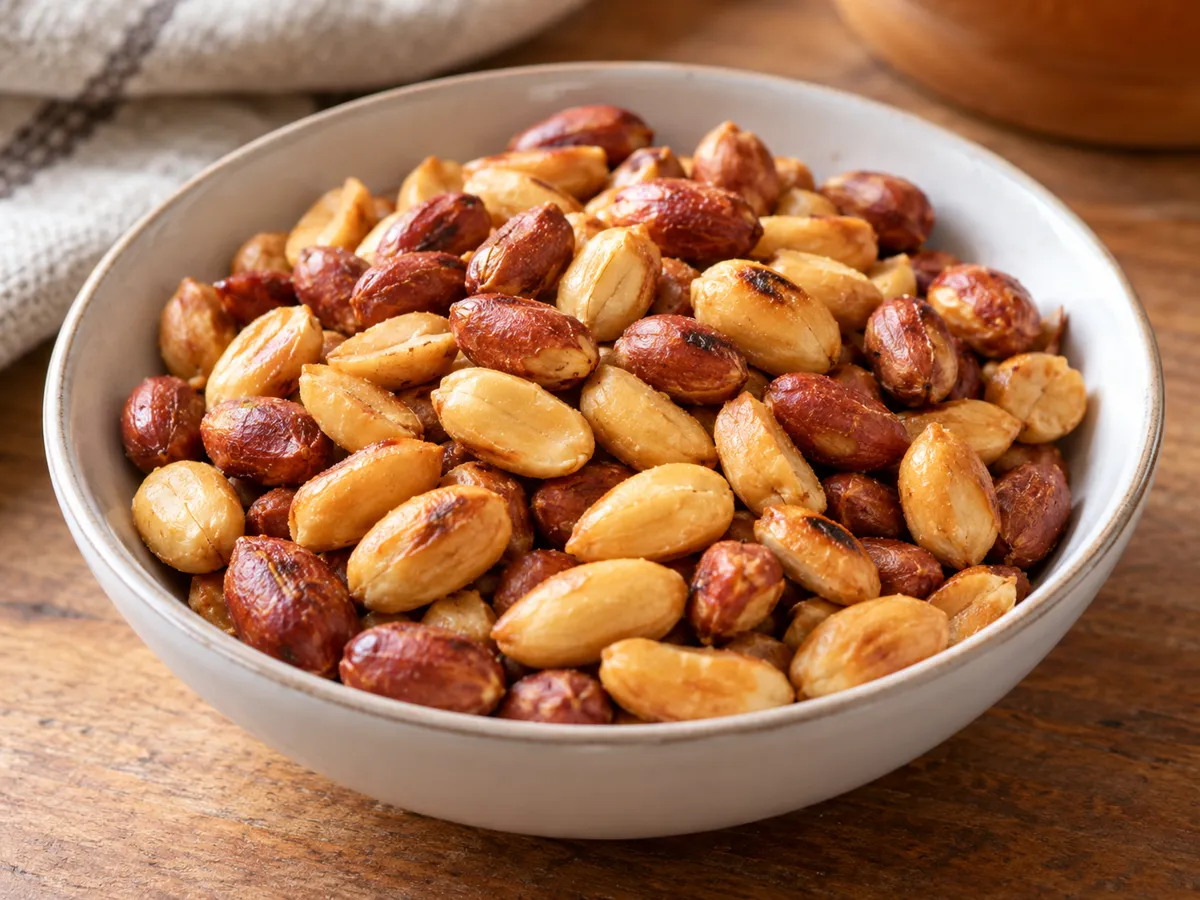
Shelled peanuts gently dry-roasted in the oven and cooled to develop their crunch.
Ingredients
- 500 g dry raw shelled food-grade peanuts, with or without thin skins
- 2 g fine salt, optional for serving
Preparation
Check the label for raw peanuts. Spread on a light tray, remove debris and visibly damaged nuts. Reject a damp, mouldy or abnormally smelling lot rather than relying on the oven to make it usable.
Preheat a conventional oven to 160°C. Choose a tray large enough for one layer. Use two trays or separate batches rather than piling up the nuts, which encourages uneven roasting.
Spread on the dry tray, optionally lined with oven-safe baking paper. Separate clumps. Add no oil, sugar or syrup; thin skins can remain on during roasting.
Roast on the middle shelf for approximately 25–35 minutes, checking earlier for small nuts. Stir after 7–8 minutes and again during cooking, moving nuts from the edges towards the centre. Avoid smoke or an acrid smell.
From around 20 minutes, remove a few nuts and cool them on a small plate. Split one to check for lightly golden flesh and taste only once no longer burning hot. This tests final crunch more accurately.
Remove when most nuts are evenly roasted; do not automatically wait for the maximum time. Transfer to a room-temperature tray to limit carry-over cooking. Burnt, black or bitter nuts cannot be repaired by mixing them with others.
Cool completely in a thin layer. To remove some skins, gently rub cooled nuts with clean hands or a clean dry cloth and separate the loosened fragments. Skin removal is optional; thin skin is not the outer shell.
Taste plain before adding optional salt. Dry salt adheres poorly to cooled nuts and can be offered separately. Put in a clean dry container only after full cooling, avoiding condensation, and follow storage guidance for the purchased product.
Introduction
Roasting develops aroma and colour; cooling reveals the final crunch. A hot peanut may still feel softer than it will after cooling, so do not roast until it is already completely brittle. Use dry, raw shelled food-grade peanuts, not fresh boiling peanuts or a product already roasted. Start with a sound lot from a reliable supplier; domestic roasting does not rescue questionable ingredients.
Taste a peanut after it cools to check the crunch before storing the batch.
Cultural context
MaliTourisme mentions roasted peanuts among street foods. This is a home oven method, not a claim to reproduce every vendor’s equipment or an exclusively Malian invention.
Context source: https://malitourisme.com/index.php/decouvrir/gastronomie
Tips
Roast in one layer.
Stir instead of raising the heat.
Taste a cooled nut.
Close the container only after full cooling.
Planning
Prepare a wide tray, spatula, tasting plate and second cooling tray. Watch aroma as well as colour, especially with skins. Cooling is part of the method, not merely storage.
Variations
A dry pan requires smaller batches, moderate heat and continuous stirring; oven timings do not apply. Already roasted peanuts do not need the same complete roasting cycle. Caramel or spice coatings are different preparations.
Accompaniments
Offer a shared bowl as a snack or appetiser. Chopped roasted peanuts can garnish another dish, but peanut sauce and djouka require their own methods; a change of serving alone is not a new recipe.
Nutrition notes
Peanuts provide fat and plant protein. No added oil does not mean fat-free. Peanut is a major allergen, and roasting does not remove that allergen. No numerical nutritional claims are supplied without calculation.