Grilled fish
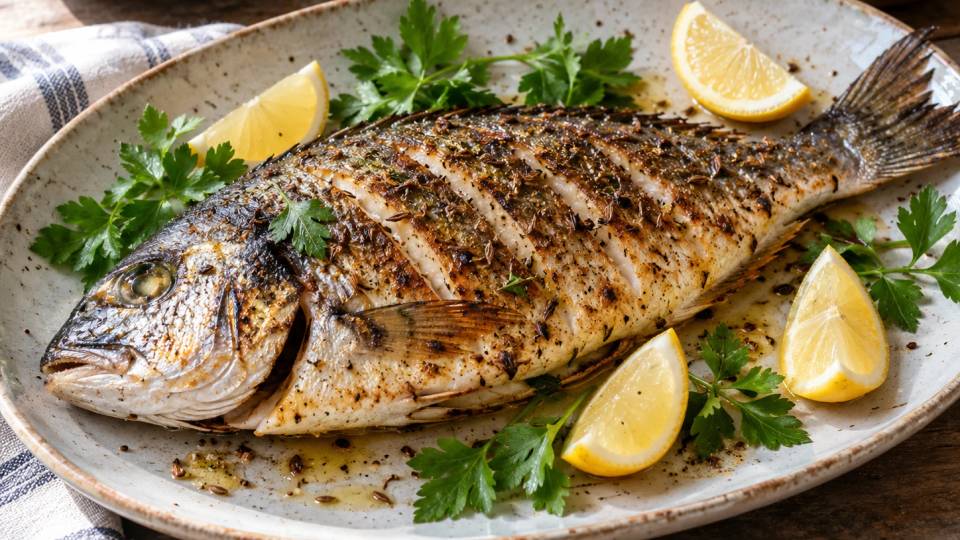
The grilled fish highlights the quality of the product and the precision of the fire.
Ingredients
- 2 sea bream or other whole fish suitable for grilling, about 700 g each, gutted and scaled
- 3 tablespoons olive oil
- 3 cloves of garlic, crushed
- 1 teaspoon ground cumin
- 1 teaspoon sweet paprika
- 1/2 teaspoon ground coriander
- 1/2 teaspoon black pepper
- 1 level teaspoon salt, to be distributed over the fish
- 1 lemon
- 20 g of parsley
- A little oil for the grill
Preparation
Ask for fish that are peeled and peeled, then check the cavity and remove any residue. Carefully wipe the outside and inside with clean paper towel. Make two or three shallow incisions on each side, without cutting to the center ridge. Keep the fish cool while you prepare the spices.
Mix the oil, garlic, cumin, paprika, ground coriander, pepper and some salt. Brush the sides and inside. Let stand in the refrigerator for fifteen to twenty minutes. Save the lemon for serving: it is not necessary to soak the flesh in its juice for a long time.
Prepare a clean grill over medium-high heat, with a less hot area for finishing if necessary. Lightly oil the grill or use a suitable double fish grill; a dirty surface will stick more and may tear the skin off on the first flip.
Place the fish on the side and let it cook without moving it continuously. For the size indicated, start checking after eight to ten minutes on the first side. The skin should be marked and peel off more easily. If it still sticks strongly, wait a little rather than pull.
Turn over with two wide spatulas or the double grill. Continue for about eight to ten minutes depending on the skin thickness and actual heat. If the skin darkens too quickly, move the fish to the less hot area. Coloring should not be a substitute for cooking from the center.
Check the thickest part near the ridge without pressing the probe against the bone. The flesh should be opaque and reach the cooking mark indicated in the technical notes. Lift one side slightly to observe the separation of the strips, without shredding the whole fish.
Place the fish on a plate carefully. Add the parsley and the slices of lemon. Let it rest very briefly while you bring the escorts. Do not pour a large amount of juice on the skin if you want to keep the surface grilled.
Serve by lifting the top fillets first, then removing the middle edge to access the second side. Warn guests of the possible presence of small edges. A clean spatula and a dish for edges make serving easier for the whole table.
Introduction
Grilled fish highlights the quality of the product and the precision of the fire. This version flavoured with cumin, garlic and paprika is a family coastal proposal for the Libyan section. The fish remains whole during cooking; its skin protects the flesh, and the incisions promote a more even cooking in the thick areas.
The recipe is suitable for two fish of comparable size. One big fish or six small fish don't require the same kind of behavior. Durations are therefore not guarantees independent of size. The goal is a marked skin and tender flesh, still in lamellae. A very strong hailstorm can blacken the outside before the centre is ready; a more moderate heat zone allows to finish without burning the spices.
Preparation notes
Choose and prepare the fish. Buy a product that is cold stored and suitable for the advertised method. A thin fillet will not last as long as a thick darn or whole fish. Ask the fishmongers to drain and peel whole fish and check the bones before serving. A fish that is suitable for grilling may not have the strength needed for long cooking in sauce; for a substitute, compare thickness and firmness rather than just the price per kilogram.
Sponge the surface before cooking to color. Outside water must first evaporate and can prevent a skin from browning regularly. A fragrant marinade should not mask a questionable product. Keep the fish in the refrigerator while preparing side dishes and take it out when needed. Lemon gradually transforms the surface of the flesh; a very long acidic marinade can change the texture even before the heat arrives.
Fish is less manipulable than meat in a stew. Once placed on a hot surface or in a sauce, allow the structure to settle before attempting to move it. Use a wide spatula and support the piece along its entire length. In a sauce, a slight movement of the container is often enough to spread the juices. Repeated mixing separates the slices and turns an entire portion into crumbs.
Check the thickest piece. An opaque flesh that easily peels off is a handy marker; a probe placed in the center provides additional verification. The typical fish safety mark is 63°C at the heart. Do not confuse the temperature of the pan, oil or sauce with the temperature of the center of the fish. When several portions are very different, remove the thinner ones as soon as they are ready rather than extending the entire baking time.
The service influences the perception of cooking. An already very hot sauce continues to transmit heat after the fire has stopped. So prepare the plates and side dishes before the last minute. If you cook in advance, it is often best to prepare only the sauce and cook the fish at mealtime. For leftovers, quickly separate thin portions and refrigerate. Gently reheating limits drying, but does not make a fish that has been poorly preserved before safe.
Cultural context
The Libyan coastal cuisine is made up of Mediterranean fish. The mixture presented is a family version advertised, without assigning this exact dosage to all coastal cities. This leaflet is for grilled fish and is not to be confused with fried fish or haraimi cooked in a sauce.
Variations
In the oven, place the fish on a lightly oiled baking sheet and adjust the time to their thickness. Advertise this method as baking rather than grilling. Filets can be used, but they will take less time and require even more delicate handling.
Accompaniments
A salad of cucumber and tomato, roasted potatoes, or a small portion of rice is fine. Choose only one starchy accompaniment and keep the lemon separate. A flat bread can be used to collect the juices from the dish without hiding the fish.