Libyan-style lasagne
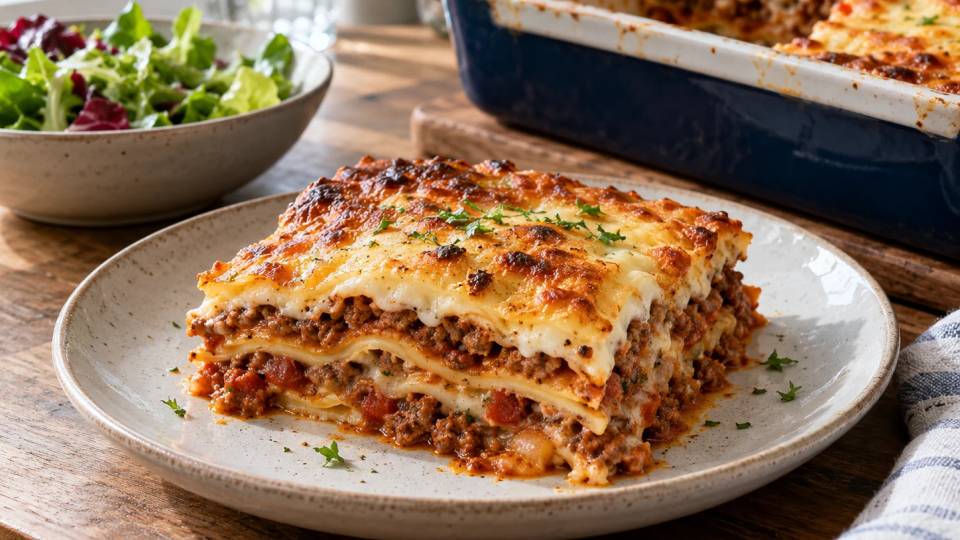
These Libyan-style lasagne are presented as a family adaptation: oven-baked pasta, a meat sauce flavoured with cumin and paprika, and a measured amount of béchamel.
Ingredients
- 250 g dried lasagne sheets suitable for oven cooking
- 500 g minced beef or minced lamb
- 800 g crushed tomatoes
- 1 onion of 150 g
- 3 cloves of garlic
- 30 g tomato paste
- 2 tablespoons olive oil
- 1 teaspoon sweet paprika
- 1/2 teaspoon cumin
- 1/4 teaspoon optional cinnamon
- 600 ml of milk
- 40 g of butter
- 40 g wheat flour
- Salt and pepper
- 150 ml of water to adjust the tomato sauce
Preparation
First, prepare the meat sauce. Melt the chopped onion in oil for six minutes, add the garlic and spices, then the meat. Crush it with a spatula and cook it all the way through. Add the concentrate and stir for one minute before incorporating the tomatoes.
Pour the 150 ml of water and simmer for twenty minutes over low heat. The sauce should remain soft to moisturize the dough sheets. Taste before adding salt, then set aside. A very dry sauce at the beginning would give lasagna corners still hard despite the coloration of the top.
Melt the butter in a saucepan without browning. Add the flour and stir for one minute. Pour in the milk gradually, whipping to limit lumps. Bring to a gentle simmer and cook for five to eight minutes until you get a smooth béchamel that covers the spoon.
Preheat the oven to 180°C on normal heat. Choose a dish about 20 by 30 cm (8 by 9 inches) in diameter. Spread a thin layer of tomato sauce on the bottom, then arrange the leaves without dry stacking them in several layers. Break only as much as necessary to cover the gaps.
Alternate leaves, meat sauce and a little bit of bechamel. Spread the filling evenly into the corners, which dry faster. Finish with a layer of dough completely covered with bechamel and some traces of tomato sauce. It is not necessary to add cheese in this version.
Cover the dish with a sheet suitable for the oven and cook for twenty-five minutes. Then remove the cover and continue for 15 to 20 minutes to lightly color the surface. The duration depends on the brand of the leaves; Also check the package before assembly.
Insert the tip of a knife into the centre: it should pass through the layers without meeting a hard pasta sheet. If the surface is already browned enough, cover it again and continue cooking gently. Do not turn the grill to its highest setting in an attempt to cook a centre that is still firm.
Remove the dish and let it sit for ten to fifteen minutes. This time stabilizes the layers and makes cutting easier. Serve six portions with a large spatula. To preserve leftovers, spread them in shallow containers rather than letting the whole dish simmer for a long time.
Introduction
These Libyan-style lasagna are advertised as a family adaptation: baked pasta, a meat sauce flavoured with cumin and paprika, and a measured béchamel. The title does not turn every detail into a national tradition; it describes a coherent proposal in a country where pasta is part of the domestic repertoire, with Mediterranean exchanges and influences.
The dish does not seek a thick cheese covering. The texture comes from the layers of dough hydrated by two sauces and rest after cooking. The meat sauce is prepared before assembly, which allows it to be tasted and adjusted in consistency. Too dry preparation can give firm leaves in the center; The excess liquid prevents the portions from holding. A good reference is a sauce that spreads easily, without looking like soup.
Preparation notes
Understand pasta cooking. Shape and thickness are as important as quantity. Thin spaghetti, penne and lasagne sheets do not require the same treatment. Read the package and use the recipe-specific instructions. Dry pasta designed to cook in plenty of water does not automatically replace very thin fresh pasta in a long cooking process. If you are changing formats, start checking earlier instead of waiting for a time that has become inappropriate.
Salt should be distributed between the elements. A sauce with canned tuna, broth or other already salted ingredients may require less added salt. Try a bite of dough and garnish rather than just the sauce. A very concentrated sauce sometimes seems too strong on its own, but becomes balanced when it coats the pasta; the reverse also exists. The chilli pepper is added with restraint and can remain available at the table.
The right bond between dough and sauce is built with moisture. For drained pasta, set aside some cooking water before emptying the pan. Its starch helps relax a sauce without making it immediately watery. Add it in scoops and gently mix. For an oven preparation, the sauce must be flexible enough to allow the leaves to moisten; a filling that is too dry does not become fluffy simply because of prolonged cooking.
A tomato sauce is best if it's worked on before the final phase. Melt the spices, cook the concentrate briefly, and let the tomatoes lose their raw flavor. Sugar does not always replace this cooking time. If the tomato is still too acidic, check first its maturity, the amount of concentrate and the reduction. A pinch of sugar can be a taste choice, but is not a must for every pot.
Serve pasta with consideration for its evolution. It continues to absorb sauce after the heat is turned off, and a long wait changes its texture. To receive, prepare the aromatic base in advance and finish the assembly near the meal. Baked dishes need a short rest to cut cleanly. Cool the leftovers without leaving them for half a day at room temperature. A heated portion may require a few spoons of water. It will not always be exactly as supple as it was when first served.
Cultural context
This version differs from stewed pasta in the pot by layering and baking. The presence of milk and flour in the béchamel must be announced: the dish contains gluten and dairy products, in addition to meat.
Variations
A well-drained vegetable and lentil sauce can replace meat in a vegetable adaptation, keeping enough liquid for pasta. A milk-free version requires another white sauce, the holding capacity of which should be checked separately. Do not present these substitutions as automatic equivalents.
Accompaniments
Serve a salad of leaves, cucumber, or tomato. Avoid multiplying starches next to the layers of dough. For a meal prepared in advance, sauces may be cooked the day before, quickly cooled and stored in the cold.