Roasted squash
Roasted pumpkin is offered as a family accompaniment with cumin and paprika.
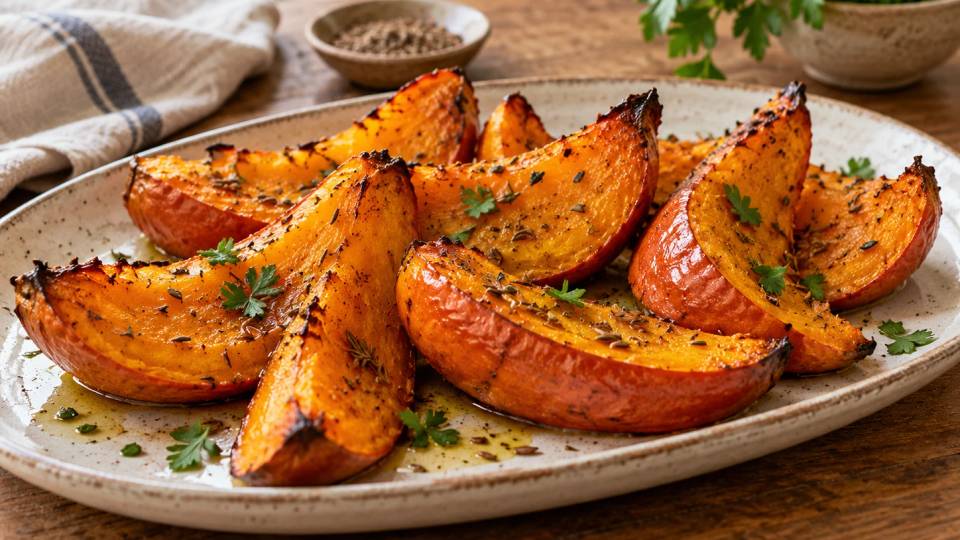
Ingredients
- 1.5 kg firm squash, weight before removing the seeds
- 3 tablespoons olive oil
- 1 teaspoon cumin
- 1 teaspoon sweet paprika
- 1/2 teaspoon ground coriander
- 1/2 teaspoon pepper
- 3/4 teaspoon fine salt
- 2 cloves of garlic, crushed
- 20 g of parsley
- 1/2 lemon optional
Preparation
Preheat the oven to 200 °C with conventional heat. Wash the squash before cutting and use a stable board and a suitable knife. Remove the seeds and stringy fibres. Peel varieties with a tough skin that is not meant to be eaten; squash varieties differ in this respect.
Cut into quarters of comparable thickness, about three centimeters in their thickest part. Mix oil, cumin, paprika, coriander, pepper and salt. Brush both sides without leaving all the oil at the bottom of the bowl. Even distribution gives a more homogeneous color than a concentrated final sprinkle.
Lay it on a plate in one layer and leave some space between the pieces. Bake for 20 minutes. Gently roll with a spatula and add the crushed garlic. Already tender pieces must be handled with more support to prevent them from breaking.
Continue for 15 to 20 minutes, depending on the variety. Stick the thickest piece in, the flesh must be melted. The edges may be browned, but shall not be charred. A very watery squash may require more time; A flour variety may break down earlier.
Remove the plate, remove any dark pieces of garlic and let stand for five minutes. Taste before adding salt. Sprinkle with fresh parsley. Optional lemon is added in small drops after cooking to bring freshness without covering the natural sweetness of the vegetable.
Present the quarters on a large enough plate, without stacking them. Serve warm with the meal. If the squid has a preserved skin but is not edible, mark it clearly so that each can strip off the flesh. A service knife makes it easier to share large quarters.
Introduction
Roasted squash is offered as a family side dish to cumin and paprika. This adaptation for the Libya section highlights a vegetable often associated with cereal dishes, but presents it here separately, with the edges colored by the oven. It is not to be confused with squash pieces cooked in couscous broth.
The variety has a strong influence on the texture. A dense flesh will keep the quarters in shape better, while a water-rich squash can give a softer surface. Choose comparable pieces and observe the center with a knife. Seeking extreme color to compensate for an aqueous variety can simply dry out the ends. The seasoning remains deliberately simple and does not require the systematic addition of honey or sugar.
Preparation notes
Give a specific place to the vegetables. The size of the pieces determines how regularly the food is cooked. Similar pieces end up together; The very different sizes of the parts make it necessary to choose between parts that are still firm and other defects. Also decide what you want to achieve: a filling that retains its shape, a melting texture, or a sauce that is bound by part of the vegetable. These objectives do not require the same fire or the same mixing.
The spices build a base before the water comes in. Onion needs to become soft; garlic, added later, burns faster. Dry spices release their flavor after brief contact with the fat, but should not blacken. If the recipe contains tomato paste, a short cooking removes some of its raw taste. This construction gives relief without having to continually increase the salt.
Adapt the liquid to the container. A covered cocotte retains more water than a wide hopper left open. Add the liquid gradually and watch the bottom. For a sauce that is too light, a controlled reduction is more useful than a large amount of flour added at random. If the preparation is too dry, a few tablespoons of hot water can be used to start cooking again. Don’t drown an already tender vegetable in the hope of getting it back to a lost hold.
The timing of the seasoning changes the outcome. Salt becomes concentrated when water evaporates. Lemon added at the end keeps a fresher impression and may require less quantity than juice that has been steamed for a long time. Fresh herbs add their fragrance without necessarily having to be cooked as much as roots or legumes. Taste a portion with its sauce to evaluate the whole, then correct one thing at a time.
Vegetable preparations benefit from being presented in a simple way. Spread the pieces and their sauce rather than hiding the vegetable under numerous toppings. The chili can be kept apart. To prepare in advance, keep fresh items, herbs and final seasonings separate when this protects their texture. After cooking, spread the leftovers in shallow containers and place them quickly in the cold. A salad served at room temperature is not meant to remain exposed all day.
Cultural context
This leaflet is an explicitly advertised adaptation. It does not claim a traditional regional name for simple roasted quarters. The method of baking and the proportion of spices are the markers of the described version.
Variations
A few grilled squash seeds may provide a contrast, but they are optional and should not replace control of cooking. For a more spicy version, add a small pinch of chili to the initial seasoning. Cinnamon would alter the profile to another variant.
Accompaniments
Pumpkin is served with fish, vegetable sauce, or grilled meat. A crispy salad balances the melted texture. Adjust the other starchy foods in the meal according to the fullness of the plate and the appetite, but do not force everyone to eat the same portion.