Whole-wheat bohobe
Whole-wheat bohobe for four people, with measured quantities and step-by-step preparation. Bohobe denotes the bread family.
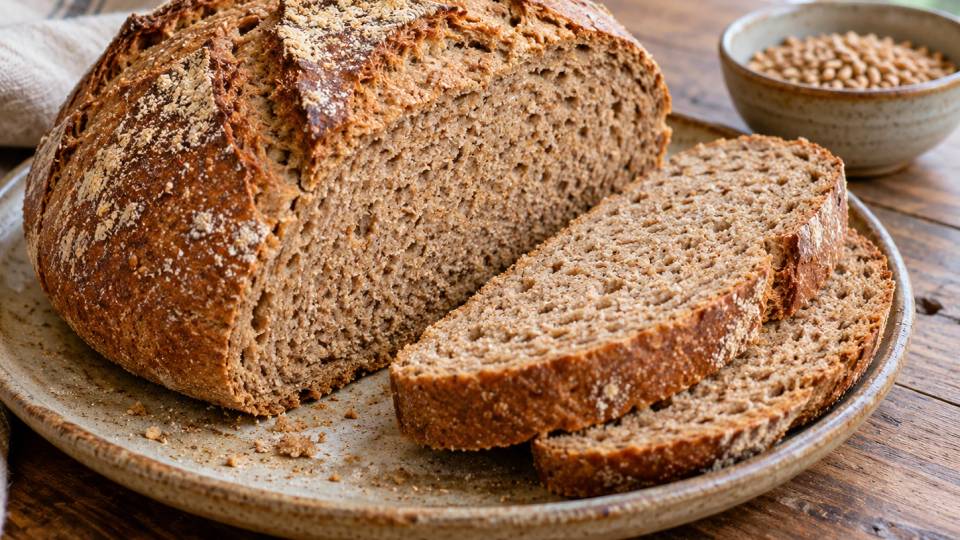
Ingredients
- 350 g whole-wheat flour
- 150 g white wheat flour
- 340 ml lukewarm water
- 7 g dried baker’s yeast
- 8 g salt
- 15 ml oil
Preparation
Mix both flours, yeast and salt. Add lukewarm water, then oil; stir until no dry flour remains.
Knead for 10 minutes until elastic, although still slightly sticky. Cover and rise for 1 hour 30 minutes until visibly expanded.
Gently fold the dough, shape a ball and place on baking paper. Cover and rise for another 45 minutes. Allow for both rises.
Preheat the oven to 220 °C with an oven-safe lidded casserole inside. Check the lid knob’s temperature limit.
Lower the loaf and paper into the hot pot; slash the top and cover. Bake for 30 minutes, then uncover and bake for 15 minutes at 200 °C.
Cool on a rack for at least 45 minutes before slicing. The crumb should be set, not sticky.
Introduction
Bohobe denotes the bread family. This whole-wheat loaf baked in a covered casserole is a contemporary variation; a domestic oven is not presented as one unique historical method.
Cooling helps set the crumb and must be included in the time before eating. The method below gives texture and cooking cues so the preparation can be adapted to the available ingredients and equipment. The proportions are those of a domestic version written for this collection; they have not been tested in a kitchen.
The result to look for
Wholemeal and white flours form a yeast loaf with two rises. Bake in a suitable covered pot, then uncover as directed and allow the separate cooling time before slicing.
Reading the dough and planning rises
Judge dough by touch as well as time. Flour absorbs water gradually, and two similarly named flours can feel slightly different. Start with the stated proportions and mix until dry patches disappear before deciding something is missing. Young dough can look uneven without being unsuccessful. Kneading and resting then change its structure. Avoid rapidly adding lots of flour to remove every trace of stickiness: this may make the bread needlessly dense and change the intended balance.
Cover dough during rising to limit drying and choose somewhere without excessive heat. Lukewarm water must not be scalding. The stated time depends on room conditions; observe expansion and appearance instead of seeking a universal minute. After dividing or shaping, handle without unnecessarily tearing the surface. Equal-sized portions cook more evenly. If several batches are needed, protect waiting dough pieces and set out equipment before starting the first batch.
Respect this recipe’s specific method: a pan, an oven and a closed vessel produce different surfaces. Fast exterior browning does not guarantee a cooked centre. Adjust heat to let the crumb form without burning the crust or faces. When a very hot pot is required, check that the lid, handles and baking paper are suitable. Resting or cooling after cooking helps set the crumb; slicing too soon can give the impression of sticky dough. Filled breads need a cohesive filling that stays in place rather than immediately wetting the crumb. Accompaniments and composite flours are variations to describe precisely, not grounds for treating every change as a new independent traditional bread.
Tips
Cooling helps set the crumb and must be included in the time before eating.
Planning
Active preparation: 25 min. Indicative cooking: 45 min. Also allow for 2 hours 15 minutes of rising and 45 minutes of cooling. The total time includes these planned periods; extend cooking if the tenderness cues have not been reached.
Serving
Serve as directed in the final step; suggested accompaniments are not included in the quantities unless explicitly stated.
Storage
Use clean utensils. Cool leftovers without leaving them at room temperature for long, then refrigerate in a closed container. Reheat only the portion needed.