Lituma 🌿 (Kivu Mashed Plantain Paste)
Green or semi-ripe plantains mashed in a mortar until a soft, homogeneous paste is obtained, shaped into balls or small loaves. An iconic specialty of Eastern DR Congo — North and South Kivu, Maniema — where it replaces cassava fufu as an essential side dish. Delicately sweet flavor, dense and melting texture.
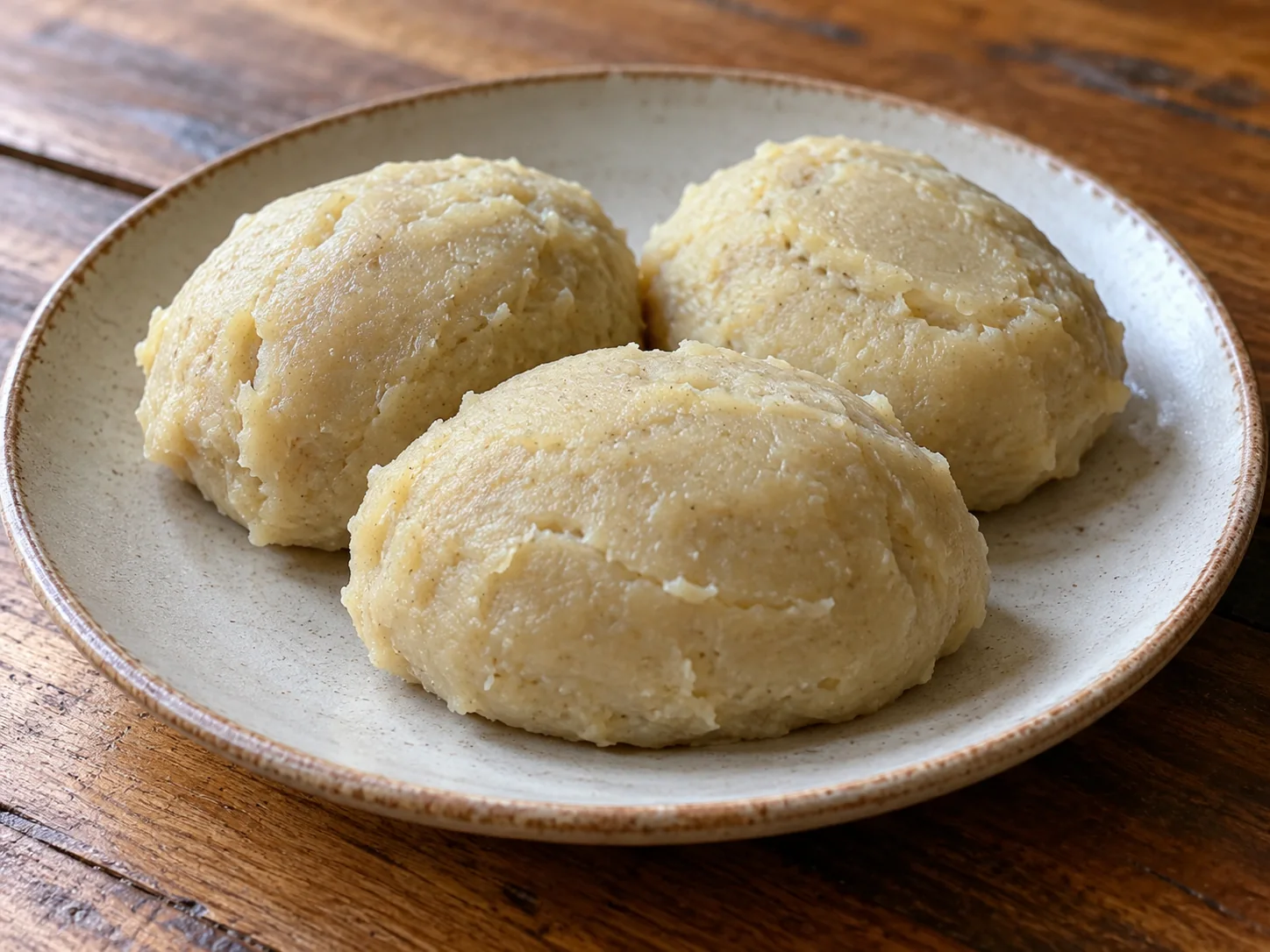
Ingredients
- 1.5 kg green or slightly yellowing plantains (about 4 to 5 medium-sized plantains)
- 1 teaspoon salt (adjust to taste)
- Lightly salted water for cooking
- Flavor option: 1 knob of shea butter or 1 tablespoon red palm oil to incorporate during pounding (optional)
- Aromatic option: a few fresh African basil leaves (efirin / ocimum gratissimum) to incorporate into the pestle (regional version)
Preparation
🍌 Choose and prepare plantains: Select plantains that are very green or whose skin is just beginning to yellow — they will yield a firm, slightly sweet lituma. Overly ripe plantains result in a paste that is too sweet and difficult to work in the mortar.
✂️ Peel: Score the skin lengthwise with a knife (do not peel by hand like a dessert banana — the skin sticks). Gently pull off the skin. Cut each plantain into 3 or 4 pieces.
🫕 Cook: Bring a large quantity of lightly salted water to a boil. Immerse the plantain pieces. Simmer gently for 20 to 25 minutes until the flesh is tender and a skewer penetrates without resistance. The flesh should be cooked through but not falling apart.
🪣 Drain thoroughly: Pour the cooked plantains into a colander and let drain for 2 minutes. The drier the plantains, the firmer and easier to pound the lituma will be.
🪨 Pound in a mortar (traditional method): Transfer the plantain pieces to a large wooden mortar (kinu). Pound vigorously with a heavy pestle, turning the paste with a wet spatula after each series of blows. Continue for 12 to 15 minutes until a perfectly smooth, lump-free, soft, and homogeneous paste is obtained. If the paste is too sticky, lightly moisten your hands with water.
⚡ Modern method (food processor): For a faster result, pulse the cooked and drained plantains in a powerful food processor until a smooth paste is obtained. Note: the result will be slightly airier than the mortar method. Finish by hand with a spatula to work the texture.
🧈 Incorporate oil (optional): If using palm oil or shea butter, incorporate it gradually during the final pounding, kneading well. This gives the lituma an appetizing sheen and a richer flavor.
🟢 Shape: With lightly moistened hands, form egg-sized balls (individual portion) or a large elongated loaf to cut at the table. Some families shape flat patties.
🌡️ Serve immediately: Lituma is served hot, accompanied by a generous sauce. It hardens as it cools — so it is important to prepare it at the last minute or keep it warm.
Introduction
Lituma is the culinary soul of Eastern Congo. 🏔️ In the green lands of North Kivu, South Kivu, and Maniema, bordered by the great African lakes (Lake Kivu, Lake Tanganyika, Lake Edward), plantain is not just a leading agricultural crop — it is a pillar of identity, social life, and food. Where the rest of the DR Congo turns to cassava and corn as staple starches, Eastern Congo has made plantain the foundation of its daily cuisine.
Lituma differs from cassava fufu in several essential characteristics. Where fufu is neutral and almost translucent, lituma has its own flavor: slightly sweet when plantains begin to ripen, very starchy and dense when they are very green. Its texture is more compact, seemingly lumpier at first glance but perfectly smooth on the palate when properly worked in the mortar. Its color ranges from ivory cream white for green plantains to pale golden for semi-ripe plantains.
In the Bashi, Hunde, Nande, Shi, Fuliiru, and many other communities of Eastern Congo, lituma is omnipresent: it accompanies bean sauces (madesu), stewed meats, Lake Kivu fish, sautéed vegetables, or rich peanut sauces. It is served during daily meals, wedding ceremonies, funerals, and community celebrations.
The act of pounding itself is full of meaning. In families, it is often a shared task: one person puts their full weight on the pestle while another turns the paste by hand, rhythmically. This collective work, punctuated by the blows of the mortar, is a harbinger of the meal — children playing outside know that soon they will be called to the table.
In the urban areas of Goma, Bukavu, or Uvira, lituma is available in popular restaurants and markets, often sold in large balls wrapped in banana leaves, ready to take away. It is thus both home cooking and popular street food, adapted to all lifestyles in Eastern Congo.
Cultural context
🌺 The place of plantain in Eastern Congolese cultures goes far beyond food. In several societies in the Great Lakes region, the banana tree is associated with fertility, prosperity, and community life. Family banana plantations are inherited and carefully maintained, as they represent a permanent resource: a mature banana tree continuously produces bunches for years, offering relative food security against climatic hazards.
In Shi culture (people of the South Kivu highlands), preparing lituma for a festive meal means that the family has gathered its resources to host well. The quantity of lituma prepared is often proportional to the consideration given to guests — a large pot of lituma accompanied by a generous sauce is a clear sign of respect and hospitality.
Lituma is also at the heart of women's informal economy in Eastern cities. Vendors travel through neighborhoods with basins carried on their heads, offering hot lituma balls accompanied by a ladle of bean or fish sauce. This small trade, often the sole income for single-parent families, structures the daily lives of thousands of people.
Important for a fair representation: Eastern DR Congo is a region of extraordinary cultural, linguistic, and gastronomic richness, which has also been marked by decades of armed conflict. Approaching the cuisine of this region means recognizing the resilience and creativity of the populations who have kept their culinary practices alive despite often difficult conditions. Lituma is also a symbol of this cultural continuity.
Lituma varies by community and altitude: in high mountain areas (Virunga volcanoes, Minembwe highlands), plantains are smaller and denser; in lake areas, they are larger and sweeter. These differences influence the final texture of the paste.
Tips
🍌 Choose plantains of similar size for even cooking — smaller ones cook faster.
💧 Keep slightly warm cooking water handy — a few drops on the pestle prevent the paste from sticking.
💪 Alternate pounding with rotating movements — this distributes the work better and prevents lumps.
🌡️ Keep the lituma warm by covering it with a banana leaf or a clean cloth during serving.
👐 To test for the right texture, the paste should detach cleanly from the pestle and mortar without sticking, and form into a ball without cracking.
⏰ Prepare the lituma last, just before serving — it quickly loses its heat and suppleness.
🧂 Season moderately during cooking — the accompanying sauce usually provides enough salt.
🎋 Wrap the balls in banana leaves if you need to transport them or keep them warm.
📏 For equal portions, weigh each ball (about 150–180 g per adult portion).
♻️ Cooked and unpounded plantains can be refrigerated for 24 hours and pounded at the time of serving.
Planning
🌿 Choose green or barely yellow plantains and cook them before pounding. Use a clean, stable mortar large enough for the batch. Pound gradually, lightly moistening the pestle to reduce sticking; with a mixer, work slowly without incorporating too much air. Wash hands before shaping the dough.
Serving
🍽️ Serve lituma hot, as individual balls or portions to share, with a fish, meat or vegetable sauce. A clean food-safe leaf can be used underneath. Offer lemon, chilli or herbs separately to suit the chosen sauce.
Storage
❄️ Divide leftovers among small containers and refrigerate within 2 hours at no more than 4 °C. Eat within 48 hours. Reheat only the portion needed, once, until hot throughout. Freezing may change the texture; thaw in the refrigerator.
Variations
🔄 Regional variations: • Lituma ya makemba ya mbivu (semi-ripe plantain): Sweeter, more golden, appreciated as a minor dish or snack. • Lituma ya mbuma (with sweet banana incorporated): Some families mix 70% green plantain + 30% ripe banana to soften the paste. • Lituma with African basil (efirin): A few crushed leaves incorporated during pounding give a very characteristic herbaceous aroma in certain areas of Kivu. • Grilled lituma: Lituma patties shaped and placed on a lightly oiled hot plate — a golden crust forms, creating a pleasant texture contrast. • Steamed sausage-shaped lituma: Paste wrapped in banana leaves and steamed for 20 minutes — a firmer version, similar to chikwangue, transportable. • Version with mixed tubers: In some communities, plantain is mixed with taro or yam, pounded together for a different texture and richer taste.
Accompaniments
🥣 Sauces and side dishes: • Madesu ya nyanya (red beans with tomato) 🫘: The most classic pairing in Eastern Congo. The protein from the beans and carbohydrates from the lituma form a complete and very nutritious meal. • Peanut sauce (nguba): Creamy, rich, fragrant — it perfectly coats the lituma. • Fried or grilled Lake Kivu fish: Tilapia, Mukeke (Haplochromis), lake sardine — fresh, iodized taste that contrasts with the sweetness of the plantain. • Mfumbwa (sautéed wild vegetables, African spinach): A very nutritious vegetarian version. • Goat meat in spicy sauce: For festive meals in the Kivu highlands. • Chicken with tomatoes and onions: Simple but flavorful sauce, very common in urban families.
🥤 Drinks: • Uji (light fermented corn porridge): Typically consumed with meals in some areas. • Passion fruit juice (maracuja): Widely cultivated around Lake Kivu — magnificent fruity acidity. • Brewed black tea (very popular in high-altitude areas of Kivu). • Fresh water flavored with lime and ginger.
Nutrition notes
🍃 Estimated nutritional values per serving (uncertified, based on typical ingredients):
Lituma is an excellent source of complex carbohydrates, ideal for providing sustained energy over several hours. Green plantain has a moderate glycemic index, lower than that of very ripe plantains, making it an interesting energy food for active people and physical laborers who form a significant portion of the traditional consumers of this dish.
Green plantain is naturally rich in resistant starch, a type of prebiotic fiber that nourishes beneficial bacteria in the gut microbiome. Water cooking preserves a significant portion of this resistant starch — unlike frying which reduces its effect. This aspect is particularly interesting for digestive health.
Lituma also provides potassium (an essential mineral for blood pressure regulation), vitamin B6 (involved in amino acid metabolism and neurological health), and vitamin C (an antioxidant and immunostimulant). These contributions are more significant in green plantain lituma than in preparations made with very ripe plantains.
For a balanced meal, combine lituma with a source of protein (madesu beans, fish, meat) and green vegetables. The complementarity of vegetable proteins from beans and complex carbohydrates from lituma is one of the most judicious combinations in Eastern Congolese cuisine — a nutritional alliance inherited from centuries of empirical culinary experience.
Conclusion
Good lituma holds together while remaining pliable under the fingers or spoon. Fully cooking the plantain and then pounding it evenly creates that texture. Serve with a generous sauce, allowing its mild flavour to remain clear rather than overwhelming it with seasoning.
Enjoy your meal
Mboté na bile! Enjoy your meal! 🇨🇩