Nigerian White Rice and Stew
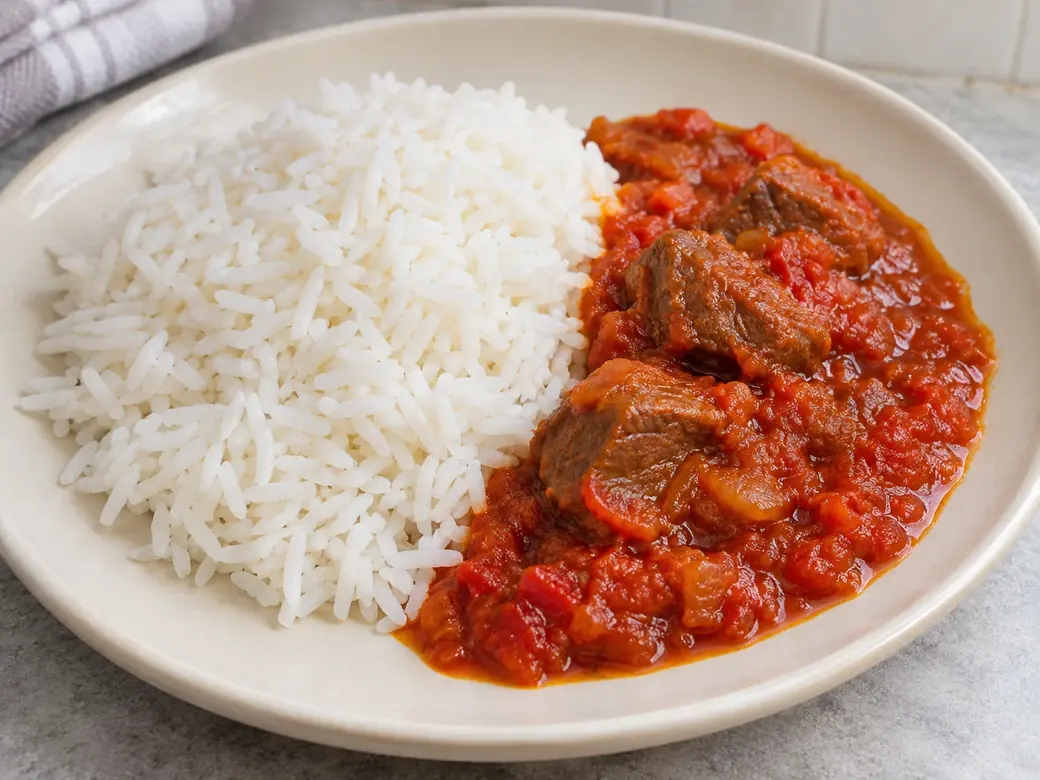
Nigerian white rice served with its stew 🍲, a creamy sauce of tomatoes, bell peppers, and chili simmered in oil, served with your choice of chicken, beef, or fish.
Ingredients
- 600 g long-grain or parboiled rice, rinsed
- 6 ripe tomatoes
- 2 red bell peppers (tatashe), deseeded
- 1 to 3 chili peppers (rodo / Scotch bonnet), to taste
- 2 onions (1 for the sauce, 1 sliced)
- 120 ml vegetable oil
- 3 tablespoons tomato paste
- 2 cloves garlic
- 1 piece ginger (2 cm)
- 1 bay leaf
- 1 teaspoon thyme
- 1 teaspoon curry
- Optional: 700 g chicken pieces, 600 g beef, or 600 g fish (tilapia, mackerel)
- 1 to 2 bouillon cubes (optional) and salt to taste
- Water for cooking rice
Preparation
🍚 Cook the white rice in salted water (or steam) until tender and grains are separate; drain and keep warm.
🍗 Season the chosen protein (chicken, beef, or fish) with salt, onion, a little curry, and thyme, then pre-cook it in a little water; set aside the meat and its juice. (Fish is briefly cooked separately.)
🍅 Blend tomatoes, bell peppers, chili peppers, 1 onion, garlic, and ginger into a smooth puree; reduce for 15 minutes to remove water.
🧅 In a pot, heat the oil and sauté the sliced onion until golden.
🥫 Add the tomato paste, and cook for 3 to 4 minutes.
🌶️ Pour in the reduced puree, bay leaf, thyme, curry, and a little of the meat cooking juice; simmer for 20 to 25 minutes over low heat until the oil rises and the sauce thickens.
🍖 Incorporate the pre-cooked protein into the stew and simmer for 10 minutes to infuse flavors; adjust salt.
🍽️ Serve the hot white rice topped with stew and garnished with the protein.
Introduction
🍲 "White rice and stew" — white rice and tomato sauce — is one of Nigeria's most common and beloved meals. Simple in appearance, it relies on a successful contrast: plain, fluffy, and neutral white rice that serves as a backdrop for a rich, flavorful red stew. This stew (often called "ata dindin" in Yoruba, meaning fried chili) is a staple sauce found in countless Nigerian homes, adapted according to available proteins: chicken, beef, fish, or even eggs. It is the quintessential everyday meal, economical, filling, and adaptable. 🍚
🍅 The heart of the dish is the stew. It is prepared from a base of ripe tomatoes, sweet red bell peppers (tatashe), and hot chili peppers (rodo), blended and then simmered in oil until the oil rises to the surface — a sign that the sauce is perfectly cooked. Tomato paste enhances the color and depth; onion, garlic, ginger, thyme, bay leaf, and curry provide aromatic complexity. Long, slow cooking is essential: it transforms a simple tomato puree into a creamy, glossy, and flavorful sauce. 🌶️
🍗 The protein is chosen according to taste and budget. Chicken, pre-cooked and then simmered in the stew, is a classic; beef adds body and chewiness; fish (tilapia, mackerel) offers a lighter and more fragrant version. You can also prepare an egg stew with hard-boiled eggs, which is economical and quick. In all cases, the protein is first seasoned and pre-cooked, then it finishes cooking in the stew to absorb its flavors — a technique that guarantees tender and tasty meat. 🍖
🍚 The white rice, meanwhile, is simply cooked in salted water or steamed until the grains are tender and separate. Its neutrality is an asset: it balances the richness and spiciness of the stew and absorbs the sauce wonderfully. This dish illustrates a truth of Nigerian cuisine: simplicity, well-executed, is a source of great pleasure. Unlike jollof, where the rice cooks in the sauce, here the rice and stew are prepared separately and then combined on the plate. 🍽️
🌍 White rice and stew is found in all regions of Nigeria, from big cities to villages, and across all ethnic groups. It embodies authentic and comforting Nigerian home cooking. Preparing it at home means tasting everyday Nigerian life, generous and warm. ✨
Cultural context
🏡 White rice and stew is a pillar of Nigerian home cooking. It is served for lunch and dinner, weekdays and weekends, and feeds families and students economically. The stew is often prepared in large quantities and can be stored for several days, making it a valuable base for weeknight meals. 🍲
🗣️ Tomato stew goes by various names depending on the region and language — "ata dindin" (fried chili) among the Yoruba, for example. Each household has its own recipe, more or less spicy, more or less rich in oil. We should avoid attributing a single and absolute origin to this type of sauce, which is widespread in West Africa in multiple forms. What matters is the family transmission of the know-how: the patience of reduction, the right amount of chili, the choice of protein.
Tips
🍲 Simmer the stew until the oil rises: this is the key to its flavor.
🍗 Pre-cook the meat before simmering it in the sauce.
🐟 Add fish at the end of cooking so it doesn't fall apart.
🍚 Do not overcook white rice: separate grains are better than mush.
🧂 Salt to taste: bouillon cubes are already salty.
Variations
🗺️ Chicken stew: the most classic. Beef stew: more substantial. Fish stew: lighter and more fragrant. Egg stew: economical and quick. Assorted stew: several meats. You can also enrich the stew with dried shrimp or smoked fish for more depth. The level of spiciness can be adjusted according to guests.
Accompaniments
🥗 Side dishes and drinks: fried plantains (dodo), sautéed greens (efo riro), coleslaw, salad, hard-boiled eggs, moimoi. Drinks: Chapman, zobo (bissap), ginger juice, pineapple juice, or fresh water. A fresh juice tempers the spiciness of the stew. 🍹 🇳🇬 Enjoy your meal — Kà ci daɗi! / Rie nke ọma! / Ẹ jẹun dídùn! Author: Alioune (recettesafricaines.com)
Nutrition notes
💚 Estimated nutritional values per serving (approx. 350 g, rice + stew, with some protein): approx. 450 kcal, 20 g protein, 58 g carbohydrates, 15 g fat, 4 g fiber, and 1.3 g salt. These values vary depending on the protein and amount of oil. 🍲 White rice provides carbohydrate energy. The stew, rich in tomatoes, bell peppers, and chili peppers, provides lycopene, vitamin C, beta-carotene (provitamin A), and antioxidants; garlic, onion, and ginger support digestion. Proteins (chicken, beef, fish) provide iron, zinc, and essential amino acids; fish adds heart-healthy omega-3 fatty acids. For a lighter version, reduce the oil in the stew, choose skinless fish or chicken, and increase the portion of green vegetables. Be mindful of the salt in bouillon cubes: prefer measured seasoning. Dominant vitamins are C, A, and B-group; minerals include iron, potassium, magnesium, and zinc.
Conclusion
Serve after checking the centre is fully cooked and the texture is homogeneous.
Enjoy your meal
Enjoy your meal!