Spring rolls
Contemporary Ghanaian party vegetable rolls with thin wheat wrappers. This internationally shared food is presented as a domestic adaptation, not an exclusive origin.
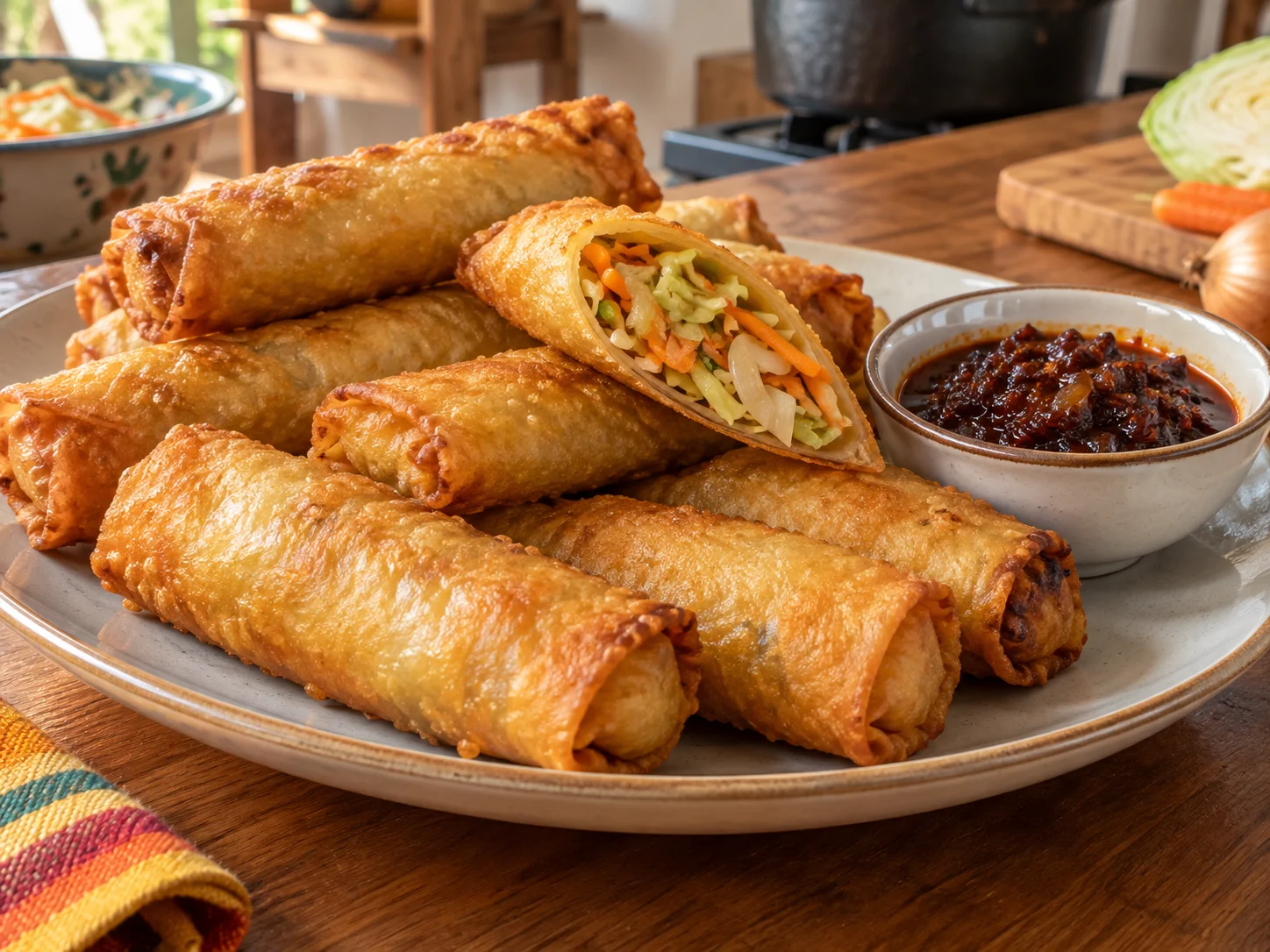
Ingredients
- 12 ready-to-fill wheat spring-roll wrappers, about 20 cm square
- 250 g finely shredded white cabbage
- 100 g grated carrot
- 100 g diced green pepper
- 100 g sliced onion
- 6 g chopped garlic and 10 g grated ginger
- 15 ml oil for filling
- 3 g salt
- 20 g flour and 30 ml water for sealing
- 1 litre frying oil, not entirely consumed
Preparation
Heat the 15 ml oil. Soften onion 4 minutes, add garlic and ginger for 30 seconds, then cabbage, carrot, pepper and salt.
Cook 8 to 10 minutes, stirring, until tender without free liquid. Spread in a clean dish and cool before rolling.
Mix 20 g flour with 30 ml water to make thick glue. Keep wrappers supple under a clean slightly damp cloth per packaging, without soaking.
Place wrapper as a diamond. Add one twelfth of cool filling near the lower point, fold point and sides, then roll without squeezing. Seal final tip; make 12 rolls.
Heat bath to 170 °C in a pan at most one-third full. Fry small batches 3 to 5 minutes, turning until pastry is golden and fully cooked.
Drain on a rack and cool briefly. Serve 2 per person with separate sauce. Refrigerate leftovers within 2 hours and eat next day after thorough reheating.
Introduction
Contemporary Ghanaian party vegetable rolls with thin wheat wrappers. This internationally shared food is presented as a domestic adaptation, not an exclusive origin.
Cultural context
KenteTV presents Ghanaian-style spring rolls as a meeting of Ghanaian and Asian flavours. This vegetable version uses ready-made wheat wrappers and claims no exclusive origin.
Tips
Use clean equipment and measure the stated ingredients. Observe texture and check the finished preparation before serving.
Keep the wheat wrapper supple, not wet like rice paper. Follow its manufacturer's instructions, take out only what is needed and cover the rest. Dry sheets crack when folded; soaked ones stick and tear. Flour-water glue is for the closing tip, not the whole sheet. Keep the edge free of oil and filling.
Roll just firmly enough to hold the filling. Excess pressure pushes vegetables sideways and can tear the wrapper. Fold sides in before the last turn to close ends and prevent oil leakage. The long shape requires a different fold from triangular samosas, even when both snacks share a buffet.
Use a thermometer if possible. Cool oil softens the wrapper before it sets; excessively hot oil colours the outside too fast. Make a small test batch, let one roll cool slightly and check the dough near the centre and folds. Overlapping layers must be cooked, without a white floury band. Adapt time to the actual wrapper.
Lower and turn rolls with dry utensils. Fill the pot no more than one third and watch continuously. Remove loose crumbs between batches to prevent excessive browning. Never put water into the oil. The litre of oil is for the frying process, not consumption per person. Nutrition estimates depend on actual absorption.
Drain on a rack in one layer rather than piling in a bowl. The inside stays hot after the outside seems manageable; let it cool before biting. For transport, cool promptly and keep chilled, then oven-reheat until hot at the centre. Microwave reheating softens the wrapper. Avoid repeated reheating and never combine pieces left out a long time with refrigerated stock.
Serving
Serve promptly with separate accompaniments and identify ingredient allergens.
Storage
Keep covered at 4 °C or below. Follow the shorter storage limit in the instructions; do not leave over 2 hours at room temperature.
Variations
Substitutions change the texture, cooking method and nutritional estimate; identify them clearly.
Nutrition notes
Estimated values per stated portion; accompaniments and optional garnishes are separate. Actual yield and ingredients may vary.