Manioc frit
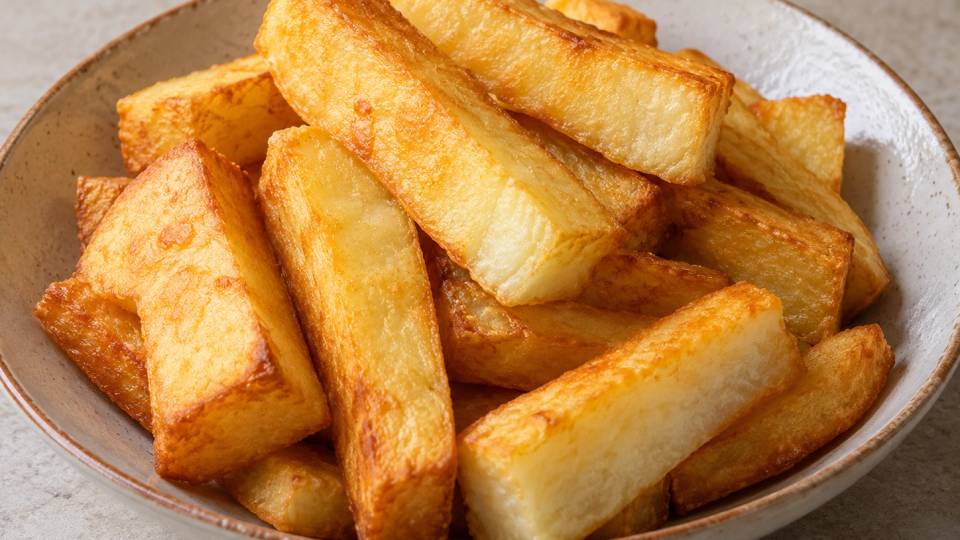
Properly processed, precooked food-grade cassava sticks, drained and fried until golden outside and tender inside.
Ingredients
- 800 g commercially processed fully precooked food-grade cassava, following manufacturer instructions
- 2000 ml water
- 1000 ml frying oil for deep frying
- 3 g salt
Preparation
Reheat already precooked cassava in water about 5 minutes or per packaging. Cut into thick sticks and remove hard fibres. Do not use unknown raw roots here.
Drain carefully, then dry the surface to avoid splattering.
Heat the frying oil bath to 170 °C in a suitable container, filling it no more than one-thirdway. Fry the pieces in small batches for 4 to 6 minutes until golden brown.
Drain on a rack, sprinkle with salt, and serve. The volume of the bath is not the amount of oil consumed.
Introduction
This recipe starts exclusively with commercial food-grade cassava that has already been properly processed and fully precooked. Do not substitute an unknown raw or bitter root. The 800 g refers to the edible prepared product, without peel or a tough central fibre. Follow the manufacturer’s instructions if further heating or boiling is required, using the listed water. This recipe does not teach raw cassava processing. Cut even sticks, drain thoroughly and let their surface dry before frying. The aim is a golden outside and a tender, fluffy centre. Prepare a draining rack before heating the oil and work in small batches. The litre of oil is a frying bath, not the amount eaten. Salt after draining and serve promptly before steam softens the crust. The yield is four generous side portions. Shito, meko and protein accompaniments are separate and excluded from the base nutrition estimate. Reserve broken small pieces for another use because they brown faster.
Cultural context
A domestic fried-cassava adaptation for the Ghana chapter, using only commercially prepared, fully precooked food-grade cassava and manufacturer instructions. This is not a method for processing unknown or bitter raw roots. Serve Ghanaian pepper sauces separately.
Tips
Precision is key for this recipe. Weigh all edible ingredients before starting the preparation. This includes peeled cassava and salt. A reliable kitchen scale will help you achieve consistent results and master the flavors. The amount of water for pre-cooking is also important to ensure uniform cooking of the cassava, while the amount of oil for frying guarantees a sufficient bath for even and crispy cooking. Do not underestimate the impact of these measurements on the final result.
For cutting the cassava, aim for thick and regular sticks. Thickness is crucial so that the cassava remains tender inside after frying, without becoming dry. Regularity ensures uniform cooking of all pieces, preventing some from being overcooked or undercooked. Use a sharp knife and work on a stable surface. If the sticks are too thin, they risk burning quickly or becoming too hard. Sticks that are too thick will take longer to cook and may not brown evenly.
Pre-cooking the cassava in boiling water is a fundamental step. The goal is to make it fully cooked but firm enough to hold its shape. Monitor cooking carefully: the cassava should be tender at heart, but should not fall apart. Test doneness with the tip of a knife. If it sinks in easily without resistance, the cassava is ready. Insufficient cooking will make the cassava hard, while overcooking will make it mushy and difficult to fry without breaking.
After cooking, draining and drying the cassava are essential. Thorough draining removes excess water, which is crucial to avoid dangerous splattering during frying. Use a slotted spoon to remove the sticks from the water and place them on a rack. Then, gently dry them with absorbent paper. A well-dried surface promotes faster and crispier frying, and significantly reduces the risk of hot oil splashes, thus ensuring your safety in the kitchen.
Controlling the oil temperature is paramount for successful frying. Heat the oil bath to 170 °C. A kitchen thermometer is highly recommended for this step. Oil that is too cold will make the cassava greasy and soft, as it will absorb too much oil before browning. Oil that is too hot will burn the outside of the cassava before the inside has time to brown properly. Maintain a stable temperature throughout frying to achieve a crispy texture and a beautiful golden color.
Never overload the frying container. Fry the cassava sticks in small batches. This helps maintain a stable oil temperature and ensures uniform cooking of each piece. If you put too much cassava at once, the oil temperature will drop sharply, resulting in less efficient frying and less crispy, greasier sticks. Patience is key to achieving the best result. Leave enough space between each piece for optimal heat circulation.
The choice of frying container is important. Use a deep fryer or a pot with high, thick sides. Never fill the container more than one-thirdway with oil. This leaves enough space for oil expansion and to prevent dangerous overflows when you add the cassava. A stable container suitable for frying is an essential safety measure to prevent accidents in the kitchen and ensure calm cooking.
The frying time, between 4 and 6 minutes per batch, is an indication. Monitor the browning of the sticks. They should be well golden and crispy. The exact time may vary slightly depending on the thickness of your sticks and the power of your heat source. Do not hesitate to adjust the time slightly if necessary, relying on visual appearance. The goal is to obtain a beautiful, uniform golden color over the entire surface of the cassava, a sign of perfect frying.
After frying, drain the cassava sticks on a rack rather than on absorbent paper. A rack allows air to circulate all around the sticks, which helps maintain their crispness and drain excess oil. Absorbent paper can sometimes retain moisture and soften the surface. Once drained, immediately sprinkle salt on the still hot sticks. The heat allows the salt to adhere and melt slightly, thus uniformly infusing the cassava with flavor.
Variations
The possibilities for variations for fried cassava are numerous, allowing the dish to be adapted to personal tastes or available ingredients. A common substitution could be the use of sweet potato instead of cassava. Sweet potato, being sweeter, will offer a different flavor and a slightly softer texture after frying. It is important to note that this substitution will modify potential allergens, the necessary quantities (sweet potato having a different density) and, consequently, the nutritional calculation. Another variation consists of adding spices to the cassava before frying. A mixture of paprika, garlic powder, or mild chili can enhance the taste and bring an additional aromatic dimension. For a touch of originality, one can also consider lightly breading the cassava sticks with a thin layer of rice or corn flour before frying, which will accentuate the crispiness. Each modification requires a careful re-evaluation of the ingredients to ensure the absence of unwanted allergens and to adjust cooking times if necessary. These variations remain separate from the main recipe to maintain the clarity and precision of the basic version.
Accompaniments
Fried cassava, with its crispy texture and mild taste, pairs wonderfully with a variety of accompaniments, enriching the culinary experience. For a complete meal, it can be served with a spicy tomato sauce, seasoned with onions, garlic, and chili, which will bring a touch of liveliness. A rich and creamy peanut-based sauce is also an excellent choice, offering a contrast of flavors and textures. For those who prefer proteins, fried cassava ideally accompanies fried or grilled fish, braised chicken, or scrambled eggs. A fresh salad of seasonal vegetables, seasoned with a light vinaigrette, can bring a note of freshness and balance the dish. Accompaniments are offered separately from the basic recipe. It is crucial to check the labels of the products used for these accompaniments and to ensure the absence of allergens. Allergens: No major allergens identified in the basic ingredients of fried cassava. However, it is imperative to check the labels of all added products for accompaniments and to consider the risks of cross-contamination, especially for sauces based on nuts, soy, or dairy products.
Nutrition notes
Estimate per portion based on 200 g peeled raw cassava, an assumed 10 g oil absorbed and 0.75 g salt. The litre of frying oil is not consumed. Actual absorption and yield vary; vitamins and minerals are not measured.