Hausa koko
Already fermented millet porridge with ginger and clove; a domestic pasteurised-milk variation.
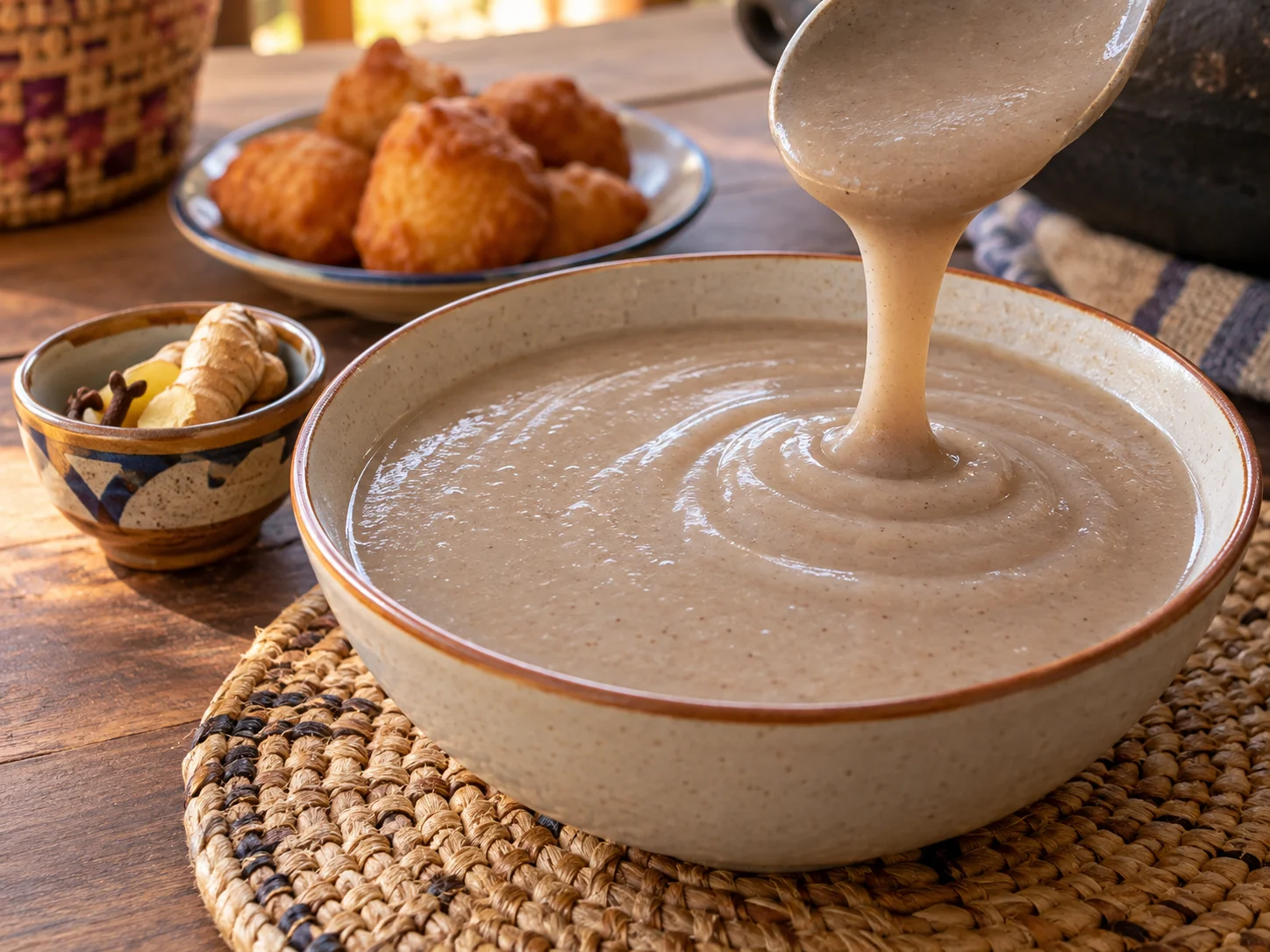
Ingredients
- 200 g fine food-grade already fermented millet flour for koko
- 1000 ml drinking water: 300 ml slurry and 700 ml infusion
- 400 ml pasteurised semi-skimmed milk
- 40 g sugar
- 10 g sliced fresh ginger
- 2 whole cloves
Preparation
Simmer 700 ml water with ginger and cloves 10 minutes. Strain, discard spices and restore liquid to 700 ml with drinking water.
Mix flour with remaining 300 ml cold water without lumps. Add milk to the infusion and bring gently to a simmer.
Stir the cold slurry and whisk it into hot liquid. Cook gently about 25 minutes or longer per manufacturer, scraping the bottom.
Add sugar and divide into 4 bowls. It should be fluid and flour fully cooked. Cool to a comfortable temperature.
Introduction
This household Hausa koko variation uses food-grade already fermented millet flour, ginger-clove infusion and pasteurised milk. Fermentation belongs to the purchased flour; no further home fermentation is required. Disperse flour cold, then stir into hot liquid and cook thoroughly. Other versions use water without milk. Four bowls are the reference portions.
Cultural context
Hausa koko is a Ghanaian fermented-millet porridge, often spiced and paired with koose. Use food-grade already fermented millet flour from a reliable supplier, not an improvised home fermentation. This base has ginger and clove and added pasteurised milk as an announced household variation; ordinary unfermented flour makes a different porridge.
Tips
⚖️ Weigh dry ingredients and measure liquids. Packed flour and loosely filled cups differ. Scale all ingredients together and use a vessel suitable for the smaller or larger amount.
🥣 Add liquid gradually when making a smooth batter or slurry. Press small lumps against the bowl and scrape the sides. Do not automatically pour in extra water to hide lumps.
🔥 Follow the specific pan, frying-pan or grain-cooking method. Control heat and watch the bottom. Burnt flavour cannot be corrected with sugar or milk.
🥄 Cool a small sample to assess texture. Check for uncooked flour or hard grains where tenderness is intended. Warm mixtures can seem thinner than rested ones, so adjust with serving temperature in mind.
🍬 The stated sugar defines this version. Distribute evenly and avoid adding several sweeteners together without revising the formula. Offer optional toppings separately.
🍽️ Stir gently before portioning when appropriate. Use similar-sized bowls or follow the stated number of individual pieces. Extra fruit, sauces and drinks are excluded unless listed.
Variations
🔄 Different flours change absorption, structure and cooking. Equal weight does not guarantee identical texture. Follow the formula first, record the product and adjustments, then change one element. Dairy-free or wheat-free adaptations also require checking all ingredients and labels.
Accompaniments
🥭 Serve at the stated temperature. Optional fruit gives contrast but is not essential; cut just before plating. For more portions, adjust vessel size or work in batches. Larger amounts heat and cool differently, so do not multiply time mechanically.
Nutrition notes
Theoretical estimate per equal portion from ingredients before cooking: FAO/INFOODS Western Africa 2019, supplemented by USDA SR Legacy 2018. All added oil is counted; cooking, fat and vitamin losses are not corrected. Vitamin amounts describe uncooked ingredients, not measured served food. Vegetable oil is represented by unfortified peanut oil; standard varieties, brands and cuts are documented in the calculation. Measured salt uses the stated maximum unless otherwise noted. Optional accompaniments excluded. Missing values remain undetermined, never assumed zero.