Sesame Halva
These small sesame halva bites are a homemade adaptation, inspired by oriental flavors. They combine the richness of tahini with the sweetness of honey and the texture of powdered milk, offering a simple and quick-to-prepare treat.
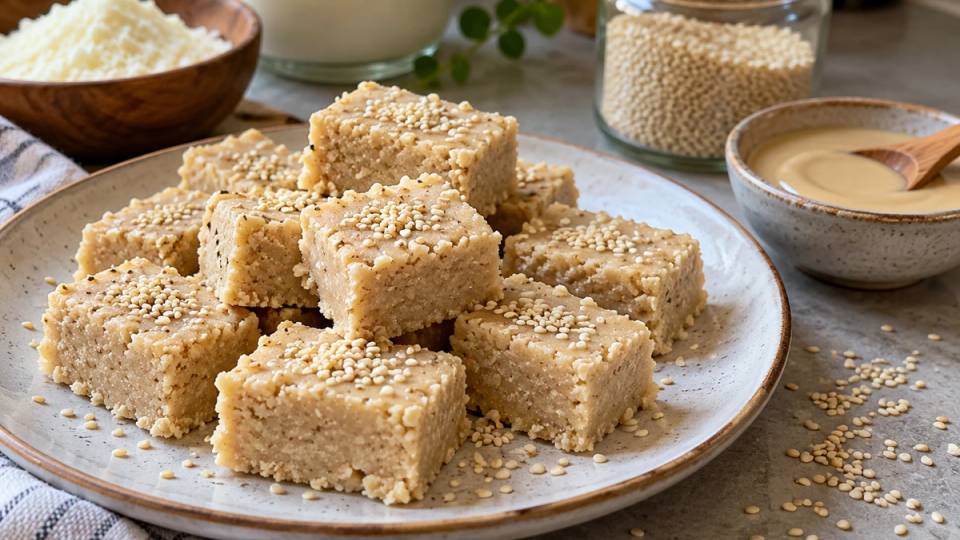
Ingredients
- 150 g tahini (sesame paste)
- 75 g liquid honey
- 50 g whole milk powder
- 1/2 teaspoon ground cinnamon (optional)
- A few toasted sesame seeds for decoration (optional)
Preparation
In a large bowl, pour the tahini. Make sure it is well mixed and homogeneous before use, as the oil tends to separate when resting. 🥣
Add the liquid honey to the tahini. Carefully mix the two ingredients with a spatula or wooden spoon until a smooth and uniform paste is obtained. The mixture may seem a bit thick at first. 🍯
Gradually incorporate the milk powder. Add it in several batches, mixing well after each addition to avoid lumps. The paste will thicken and become firmer. ✨
If using cinnamon, add it at this stage and mix until well distributed in the paste. Cinnamon is optional but adds a warm note. 🍂
Once all ingredients are well combined and the paste is homogeneous, it should be firm enough to handle. If it is too sticky, you can add a small amount of extra milk powder.
Line a small square or rectangular dish (about 15x15 cm) with parchment paper, leaving the edges overhanging to facilitate unmolding. This will prevent the halva from sticking. 🍽️
Spread the halva paste evenly in the prepared dish. Use the back of a spoon or your slightly moistened hands to firmly press and smooth the surface. The layer should be about 1 to 1.5 cm thick. 👍
Sprinkle some toasted sesame seeds on top if desired, then press them lightly so they adhere to the paste. This adds an aesthetic touch and a crunchy texture. 🌰
Place the dish in the refrigerator for at least 2 hours. This resting time is crucial for the halva to harden and achieve a firm consistency, thus facilitating cutting. ❄️
Once the halva is well chilled and hardened, remove it from the refrigerator. Use the edges of the parchment paper to easily unmold it from the dish. 🔪
Cut the halva into small bites or squares of the desired size. A sharp knife will facilitate clean cutting. Serve fresh. 😋
Store any remaining halva bites in an airtight container in the refrigerator. They keep well for about 3 days, but are best consumed fresh.
Introduction
Halva, in its many incarnations, is a confectionery whose roots extend across the Middle East, Central Asia, the Balkans, and parts of Africa. While this specific recipe is a domestic adaptation and does not claim to be a canonical Eritrean formula, it is inspired by the sesame sweets found in the Red Sea region. Eritrea, with its strategic position along historical trade routes, has been a crossroads of cultural and culinary exchanges. Ingredients like sesame and honey are pillars of local cuisine, used in a variety of sweet and savory dishes.
Sesame, in particular, is cultivated and prized for its oil and seeds. It is often processed into tahini, a creamy paste that serves as the base for many preparations. Honey, meanwhile, is a source of natural sweetness and is used to sweeten drinks, desserts, or even accompany certain savory dishes. The idea behind this adaptation is to capture the essence of these familiar flavors in an accessible and easy-to-make at home, no-bake form. It is a way to pay homage to the culinary traditions of the region while offering a simplified and modern version.
This recipe is particularly appreciated for its simplicity and the few ingredients required. It requires no cooking, making it ideal for quick preparation or when you want to avoid turning on the oven. The result is a dense, slightly grainy confectionery, with a pronounced sesame taste softened by honey. Cinnamon, although optional, adds a spicy note that harmoniously complements the other flavors. It is a treat that can be served at the end of a meal with coffee, or as a small energizing snack. It also lends itself well to festive occasions, offering an alternative to more elaborate desserts.
Cultural context
This sesame halva recipe is a domestic adaptation, inspired by the flavors and ingredients found in the Red Sea region, particularly in Eritrea. It is important to note that this is not a canonical traditional Eritrean recipe, but rather a modern interpretation that uses familiar culinary elements. In Eritrea, sesame is a common ingredient, used in various forms, including tahini. Honey is also a valued natural source of sweetness. Sesame-based sweets are present in the region's cuisine, often consumed during celebrations or as an accompaniment to coffee. This adaptation seeks to evoke these flavors in a simple, no-bake preparation, paying homage to local ingredients without claiming strict historical authenticity. It is part of an approach to discovering and appreciating Eritrean flavors through a contemporary lens.
Tips
Use good quality tahini, preferably creamy and not bitter, as it forms the main base of the halva's taste. Well-mixed tahini is essential.
If your honey is too thick, you can warm it very slightly in a double boiler to make it more liquid and easier to incorporate into the tahini.
For a smoother texture, make sure to mix the milk powder gradually to avoid lump formation. A sieve can help incorporate it more finely.
If the paste is too sticky to handle, add a small amount of extra milk powder, one teaspoon at a time, until the desired consistency is achieved.
For clean cuts, use a thin-bladed knife and run it under hot water between each cut to prevent the halva from sticking.
You can vary the thickness of the bites according to your preferences; thinner pieces will harden faster.
For an elegant presentation, you can use small cookie cutters to create original shapes before refrigerating the halva.
Make sure the halva is well chilled before cutting it, this ensures better hold and a pleasant texture.
Variations
This sesame halva recipe is very adaptable. For a different flavor touch, you could incorporate a pinch of ground cardamom instead of cinnamon, which would bring a more floral and slightly peppery note, much appreciated in some oriental cuisines. Another option would be to add crushed pistachios or toasted almonds to the paste before pressing it into the dish, for a crunchy texture and nutty taste. If you want a more chocolatey version, a tablespoon of unsweetened cocoa powder can be mixed with the milk powder, creating a two-tone or entirely chocolatey halva. For those who prefer less intense sweetness, the amount of honey can be slightly reduced, although this may affect the final consistency. Finally, for a festive presentation, you can dip part of the bites in melted dark chocolate after they have hardened, then let them cool again to create a crunchy shell.
Accompaniments
These sesame halva bites pair wonderfully with traditional Eritrean coffee, often served strong and without milk, to balance the sweetness of the dessert. Coffee, with its rich aromas and slight bitterness, cleanses the palate and highlights the sesame and honey flavors. For a more refreshing drink, a light mint tea or a fresh ginger infusion would be excellent choices, offering a pleasant contrast without masking the halva's flavors. As an accompaniment, a few fresh dates or dried fruits like figs can complete the sweet platter, adding a different texture and natural sweetness. For a more gourmet touch, a small scoop of vanilla or almond milk ice cream can be served alongside, offering a contrast in temperature and texture.
Nutrition notes
This sesame halva, although indulgent, offers interesting nutritional benefits thanks to its main ingredients. Tahini, made from ground sesame seeds, is an excellent source of unsaturated fats, known for their role in maintaining good cardiovascular health. It also provides plant-based proteins, contributing to satiety and muscle mass maintenance. Sesame seeds are rich in essential minerals like calcium, magnesium, iron, and zinc, important for bone health, nerve function, and the immune system. Honey, as a natural sweetener, contains antioxidants and bioactive compounds. Milk powder adds high-quality protein and calcium, beneficial for bone density. Cinnamon, if used, is known for its antioxidant properties. It is a snack that can provide sustained energy thanks to its blend of complex carbohydrates, healthy fats, and proteins.