Flaxseed Bread
This flaxseed bread is a baking adaptation inspired by the traditional use of flax in Eritrea. It offers a soft texture and a rustic flavor, perfect for accompanying various Eritrean dishes.
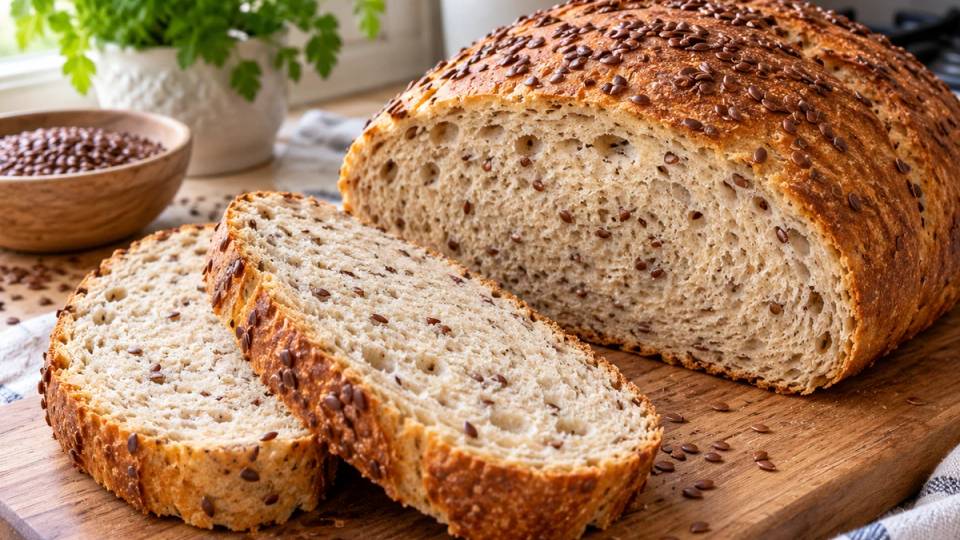
Ingredients
- 450 g (15.9 oz) wheat flour (type T65 or T55)
- 35 g (1.2 oz) whole flaxseeds
- 300 ml (10.1 fl oz) lukewarm water (approx. 35-40°C / 95-104°F)
- 8 g (0.3 oz) fine salt
- 6 g (0.2 oz) active dry baker's yeast
- A little oil for the proofing bowl
Preparation
In a large bowl, mix the dry yeast with the lukewarm water and one teaspoon of flour taken from the 450 g. Let it rest for 5 to 10 minutes until the yeast activates and forms a slight foam on the surface. 🫧
Add the remaining flour and salt to the bowl with the yeast mixture. Incorporate the whole flaxseeds. Mix by hand or with a wooden spoon until a coarse dough is obtained. 🥣
Knead the dough on a lightly floured work surface for about 8 to 10 minutes. The dough should become soft, elastic, and less sticky. If it is too sticky, add a little flour, but sparingly. 💪
Form the dough into a ball, then place it in a large, lightly oiled bowl. Cover the bowl with a clean cloth and let it rise in a warm place for 1 hour to 1 hour 30 minutes, or until the dough doubles in volume. ⏳
Gently degas the dough by pressing it gently with your fists. Shape it into a loaf (round, oval, or bâtard) and place it on a baking sheet lined with parchment paper. 🥖
Cover the bread again with a cloth and let it rise for a second proofing of about 30 to 45 minutes, or until it has slightly puffed up. Meanwhile, preheat your oven to 220°C (425°F). 🔥
Just before baking, you can make a few light incisions on top of the bread with a razor blade or a very sharp knife to allow the bread to develop harmoniously. 🔪
Bake the bread in the preheated oven. To create steam, you can place a small container of hot water in the bottom of the oven during the first 10 minutes of baking. 💧
Bake for 30 to 35 minutes, or until the bread is golden brown and sounds hollow when you tap the bottom. The crust should be crispy. 🔔
Once baked, remove the bread from the oven and let it cool completely on a wire rack before slicing and serving. This allows the crumb to stabilize and prevents it from being gummy. 🌬️
This bread is ideal for accompanying Eritrean dishes or for enjoying on its own with a drizzle of olive oil. 🍽️
Introduction
Flax, or 'telba' in Tigrinya, holds a significant place in Eritrean culinary culture, although often in forms different from a leavened bread. Traditionally, flaxseeds are valued for their oil, used in cooking and sometimes for cosmetic or medicinal purposes. They are also found ground to thicken sauces, enrich porridges, or prepare refreshing drinks, notably 'telba mai' or 'telba shai', a beverage made from roasted and ground flaxseeds, sometimes sweetened and spiced. The integration of flax into the Eritrean diet is ancient, testifying to a deep knowledge of its nutritional properties and versatility. This flaxseed bread is a contemporary exploration and a baking adaptation, seeking to combine the nutritional richness and characteristic flavor of flax with the universal tradition of bread. It is not a traditional Eritrean bread recipe per se, but rather an interpretation that pays homage to the importance of flax in the country's gastronomy. The idea is to create an accompaniment that can harmoniously integrate with the robust and spicy flavors of Eritrean dishes, offering an alternative or complement to flatbreads like injera. The preparation of this bread is part of an effort to enhance local ingredients and their culinary potential, by offering a new way to appreciate them. This bread can be served with stews, vegetables, or sauces, bringing a unique texture and flavor to the table. It is designed to be simple to make at home, allowing everyone to discover or rediscover flax in a different and flavorful form.
Cultural context
The use of flax in Eritrea is well-documented, but primarily in forms other than leavened bread as we know it in the West. Flaxseeds are valued for their oil, extracted and used in daily cooking, especially for sauces and vegetarian dishes, particularly important during fasting periods observed by the Tewahedo Orthodox Church. They are also processed into a refreshing drink, 'telba mai', and sometimes incorporated into cakes or porridges. This 'Flaxseed Bread' is a modern baking adaptation, inspired by this richness of uses. It does not represent a traditional Eritrean bread, but rather a creation that integrates an important local ingredient in a new form. It is distinct from traditional breads like injera or kitcha, which have their own preparation methods and cultural contexts. This recipe seeks to honor the 'flax' ingredient by offering it a new culinary expression, while respecting the spirit of simplicity and flavor that characterizes Eritrean cuisine.
Tips
For a crispier crust, spray a little water on the oven walls at the beginning of baking or place a baking tray with hot water at the bottom of the oven.
If you don't have active dry yeast, you can use 12g of fresh yeast, also dissolved in lukewarm water.
To check the correct water temperature for the yeast, it should be lukewarm to the touch, not hot (approx. 35-40°C / 95-104°F).
Proofing time may vary depending on the ambient temperature. A warm, draft-free place is ideal.
For a more pronounced flavor, you can lightly toast the flaxseeds in a dry pan before incorporating them into the dough.
If you want a denser crumb, you can slightly reduce the amount of water or add a tablespoon of flour.
The bread keeps well at room temperature in a cloth bag or bread box for 2-3 days. It can also be frozen sliced.
Variations
To vary the pleasures, this flaxseed bread can be enriched in different ways. You could incorporate other seeds, such as sesame seeds or nigella seeds (habesha kemun), which are also used in Eritrean cuisine, to add aromatic notes and different textures. A small amount of teff flour (about 50g replacing part of the wheat flour) could be added to impart a more rustic flavor and a slight touch of Eritrean authenticity, although this may alter the texture and require water adjustment. For a more gourmet version, the addition of caramelized onions or fresh herbs like chopped parsley or cilantro could bring an extra dimension. A touch of honey or agave syrup in the dough can slightly sweeten the bread and promote better crust coloration. Finally, for those who prefer a more airy crumb, a slightly higher hydration (a few extra milliliters of water) can be attempted, keeping in mind that the dough will be more difficult to handle.
Accompaniments
This flaxseed bread is an excellent accompaniment to many Eritrean dishes. It pairs particularly well with rich and spicy wots (stews), such as Doro Wat (chicken) or Shiro Wat (chickpeas), whose flavorful sauces it can absorb. It is also delicious with vegetable dishes like Alicha Birsen (lentils) or Tsebhi Hamli (spinach). For a simple tasting, it can be served with a drizzle of Eritrean olive oil or a Berbere chili paste. As for drinks, a traditional black tea (chai) or Eritrean coffee (buna) after the meal are appropriate choices. To accompany the meal, fresh water or a light local beer, if available, will pleasantly complement the flavors of the bread and dishes.
Nutrition notes
Flaxseeds are recognized for their richness in dietary fiber, which contributes to good digestion and can help maintain a feeling of fullness. They are also an excellent source of omega-3 fatty acids, essential for the proper functioning of the body. These fatty acids are important for cardiovascular health. Bread, as a source of complex carbohydrates, provides sustained energy. The integration of flaxseeds also increases the intake of plant proteins and various minerals such as magnesium and phosphorus. The consumption of this bread can thus be part of a balanced diet, providing varied nutrients. It is important to note that the benefits are linked to regular and balanced consumption, as part of a diversified diet.