Hanza
Hanza is a soft and slightly sweet Eritrean bun, delicately flavored with cinnamon. Ideal for accompanying tea or coffee, it offers a tender texture and a comforting taste.
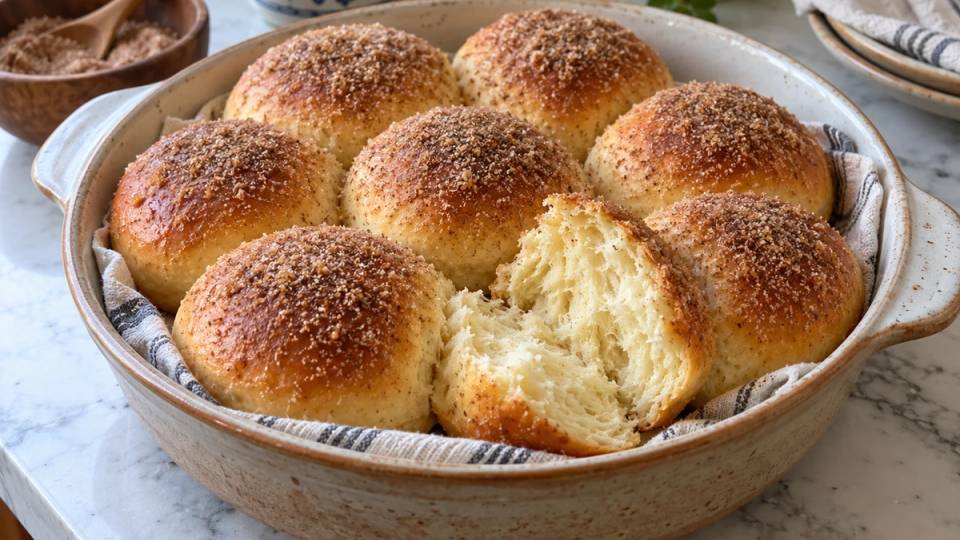
Ingredients
- 300 g all-purpose wheat flour
- 120 ml lukewarm whole milk
- 50 g unsalted butter, melted
- 30 g powdered sugar
- 7 g active dry baker's yeast (about 2 teaspoons)
- 1/2 teaspoon fine salt
- 1 teaspoon ground cinnamon
- 1 beaten egg (for glazing, optional)
Preparation
In a large bowl, mix the flour, sugar, cinnamon, and salt. 🥣
In another bowl, combine the lukewarm milk and yeast. Let stand for 5 minutes until the yeast is activated and foamy. 🥛
Pour the milk-yeast mixture and melted butter into the bowl of dry ingredients. Mix first with a spatula, then knead the dough on a lightly floured surface for about 8 to 10 minutes, until smooth and elastic. ✨
Form the dough into a ball, place it in a lightly oiled bowl, cover with a clean cloth, and let rise in a warm place for 1 to 1.5 hours, or until doubled in volume. ⏳
Gently deflate the dough and divide it into 8 equal portions. Shape each portion into a small ball. 👐
Arrange the dough balls on a baking sheet lined with parchment paper, spacing them slightly. Cover again with a cloth and let rise a second time for 30 to 45 minutes. ⬆️
Preheat your oven to 180°C (Thermostat 6 / 350°F). If desired, gently brush the buns with beaten egg for a shiny glaze. 🥚
Bake for 15 to 20 minutes, or until the Hanza are golden brown and well risen. ♨️
Let cool slightly on a wire rack before serving. 🌬️
Introduction
Hanza, though less universally known than other Eritrean specialties, represents a sweet and comforting facet of local pastry. These soft buns, often described as tender and fragrant, find their place in Eritrean homes, especially during shared moments around a hot drink. Their apparent simplicity hides a richness of flavors, where cinnamon plays a prominent role, evoking the warm aromas of spices often used in the cuisine of the Horn of Africa. The preparation of Hanza is part of a tradition of home baking, where kneading and rising the dough are gestures passed down, guaranteeing the airy texture and characteristic softness of these breads. It is not an ostentatious festive dish, but rather a daily or occasional treat that brings a touch of comfort and conviviality. The Eritrean press has sometimes echoed these “very tender buns covered with sweet spices,” highlighting their local appreciation. This recipe is a homemade adaptation, designed to faithfully reproduce the texture and flavors of Hanza as described, using accessible ingredients and classic baking techniques. It aims to capture the essence of this Eritrean pastry, emphasizing sweetness, softness, and the subtle scent of cinnamon. The preparation is a rewarding process that allows one to discover another dimension of Eritrean culinary richness, beyond the more well-known savory dishes. It is an invitation to explore the sweet and spicy flavors that punctuate meals and breaks in Eritrea.
Cultural context
Hanza is part of the Eritrean culinary landscape as an appreciated sweet, although its presence is less documented than that of emblematic dishes like Shiro or Injera. It is often mentioned in the local press as a “very tender bun covered with sweet spices,” suggesting its role as a comforting pastry. Unlike some ritual preparations, Hanza does not seem to be associated with specific ceremonies or complex shaping traditions. It is rather a domestic pastry, whose consumption is linked to moments of conviviality, such as tea or coffee breaks. The use of cinnamon is characteristic of the sweet and spicy flavors found in various Eritrean preparations. This recipe is a homemade adaptation, developed to capture the essence of Hanza as described, using common baking techniques. It does not claim to reproduce a specific ancestral tradition, but rather to offer a faithful interpretation of this soft and fragrant bun, based on available descriptions and typical pastry ingredients. It is important to note that Eritrean cuisine, like many regional cuisines, evolves and adapts, and Hanza is an example of an appreciated sweet in this context.
Tips
For optimal rising, ensure your milk is lukewarm (about 37-40°C / 98-104°F), but not hot, to avoid killing the yeast. 🔥
Kneading is crucial to develop gluten and achieve a soft texture. Don't hesitate to knead long enough. 💪
If you don't have cinnamon, a sweet spice blend like cardamom or nutmeg can be used, but it will alter the aromatic profile. 🌿
For a softer crust, cover the Hanza with a clean cloth as soon as they come out of the oven while they cool. 🧺
Hanza are best on the day they are made. To store them, place them in an airtight container at room temperature. 📦
To reheat Hanza the next day, warm them for a few minutes in a gentle oven or toaster to restore their softness. 🔄
You can add a pinch of orange or lemon zest to the dough for a subtle citrus note. 🍋
Variations
While the basic Hanza recipe focuses on cinnamon, several adaptations can be considered to vary the pleasures. For a richer version, chopped dried fruits like dates or raisins can be incorporated into the dough during kneading, adding extra texture and sweetness. Another option is to replace part of the sugar with honey, which will give the buns a deeper flavor and a more intense golden color. For chocolate lovers, dark or milk chocolate chips can be added to the dough, creating an interesting fusion between cinnamon and cocoa. In terms of spices, although cinnamon is characteristic, a pinch of ground cardamom or ginger powder can be added to complexify the aromatic profile. Finally, for a different finish, a light glaze made from icing sugar and lemon juice or orange blossom water can be poured over the cooled Hanza, adding a touch of shine and a tangy or floral flavor. These variations allow Hanza to be adapted to individual preferences while retaining its essence as a soft and comforting bun.
Accompaniments
Hanza, with its subtle sweetness and cinnamon fragrance, pairs ideally with a variety of drinks and accompaniments. Traditionally, it is excellent with a cup of strong and aromatic Eritrean coffee, often served during the coffee ceremony, or with a lightly sweetened black tea. For a fresher drink, a glass of fresh milk or a plant-based milk like almond milk can pleasantly complement its soft texture. In terms of accompaniments, Hanza is delicious on its own, but it can be served with a small touch of local honey or a red fruit jam for extra sweetness. Plain yogurt or a light fresh cheese can also offer an interesting contrast to the sweet side of the bread. For a more complete experience, it can be offered at the end of a light meal or as an afternoon snack, providing a gourmet break without being too heavy. Its simplicity makes it an excellent base for complementary flavors without masking them.
Nutrition notes
Hanza, as a small bun, provides a source of energy thanks to the complex carbohydrates in the flour. The presence of milk and butter contributes to the intake of proteins and lipids, essential for the proper functioning of the body. Cinnamon, beyond its pleasant aroma, is recognized for its aromatic compounds. Baker's yeast, for its part, is a source of B vitamins, important for energy metabolism. This dessert, consumed in moderation, can be part of a balanced diet, offering a moment of gustatory pleasure. It is not a food for therapeutic purposes, but a sweet treat that, by its basic ingredients, contributes to the intake of necessary macronutrients. Whole wheat flour could be used to increase fiber intake, but this would alter the traditional texture. Fats and sugars are present for taste and texture, and their consumption should be adjusted to individual needs.