Halawa
A simplified, deliciously melt-in-your-mouth homemade version of Egyptian halawa tahinia, easy to make without cooking.
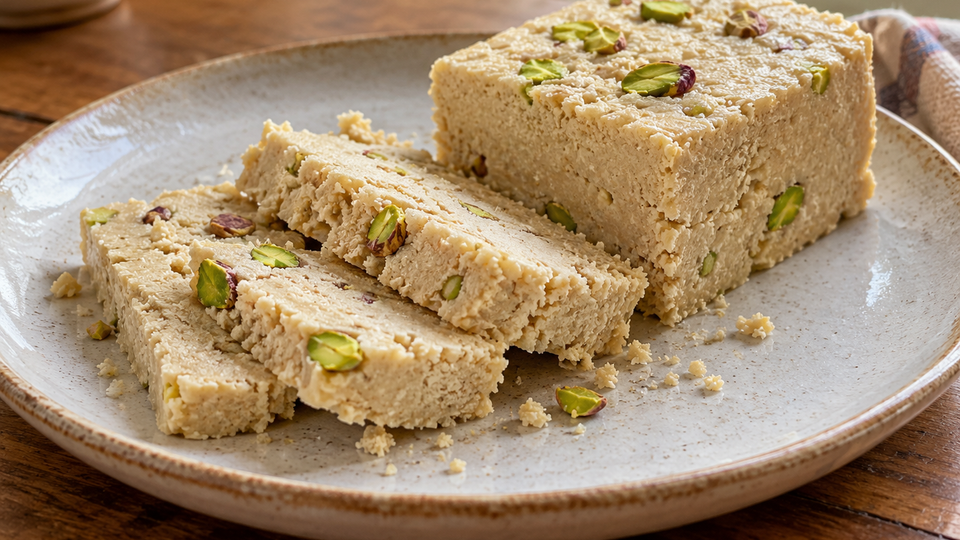
Ingredients
- 250 g Tahini (sesame paste)
- 160 g Powdered sugar
- 150 g Full-fat milk powder
- 40 g Shelled unsalted pistachios
Preparation
Preparation of dry ingredients: In a large bowl, carefully mix the sifted powdered sugar and milk powder. Ensure that both powders are perfectly combined and there are no lumps. Use a spatula or a dry whisk for this step. If using pistachios, add them to the powders and mix well. 🥣 (5 minutes)
Gradual incorporation of tahini: Pour the homogenized tahini gradually over the powder mixture. Start with half of the tahini and mix with a wooden spoon or a sturdy spatula. The mixture will first form a thick, granular paste. 🥄 (3 minutes)
Kneading and homogenization: Continue to add the rest of the tahini little by little, kneading the mixture by hand or with the spatula. The goal is to obtain a homogeneous mass, soft but firm, which holds together well and can be pressed. The texture should be that of a dense modeling clay. 👐 (7-10 minutes)
Mold preparation: Line a small mold (about 15x10 cm or a small loaf pan) with parchment paper, leaving the edges overhanging to facilitate unmolding. Make sure the mold is clean and dry. 📏 (2 minutes)
Compacting the halawa: Transfer the halawa mass into the lined mold. Press the paste firmly and evenly over the entire surface of the mold using the back of a spoon or your hands. The goal is to compact the halawa as much as possible so that it is dense and without air pockets. There should be no visible free oil. 🏋️♀️ (5 minutes)
Refrigeration: Cover the mold with plastic wrap and place it in the refrigerator for a minimum of 4 hours. This resting time is crucial for the halawa to harden and for the flavors to develop. 🧊 (4 hours (minimum))
Unmolding and cutting: Once firm, remove the halawa from the refrigerator. Use the edges of the parchment paper to gently unmold it. Place it on a cutting board and cut it into 12 small equal portions using a sharp knife. 🔪 (3 minutes)
Introduction
Halawa, this iconic confectionery from the Middle East and North Africa, evokes childhood memories and comforting flavors. Our homemade adaptation of Egyptian halawa tahinia invites you on a culinary journey where the sweetness of sesame marries the richness of powdered milk and the subtle crunch of pistachios. Far from complex artisanal methods involving cooked syrups, this simplified recipe prioritizes ease and speed, while offering a crumbly and melt-in-your-mouth texture. It's an ideal treat to accompany tea or coffee, or simply for a sweet break. Its preparation is child's play, requiring only a few ingredients and a little patience for chilling. Get ready to succumb to its irresistible charm and share this delight with your loved ones. 😋
Cultural context
Halawa is a highly appreciated confectionery in many cultures of the Middle East, North Africa, and the Balkans. Its name, derived from the Arabic 'halwa', means 'sweetness'. In Egypt, 'halawa tahinia' is particularly popular, often consumed for breakfast or as a snack. It is valued for its energy richness and unique sesame flavor. This homemade version, although different from artisanal production which uses sugar syrups cooked at high temperatures to obtain a characteristic fibrous texture, captures the essence of halawa with its sweetness and melt-in-your-mouth texture. It demonstrates culinary ingenuity in adapting classics for more accessible home preparation. Halawa is often associated with moments of sharing and conviviality, present on tables during celebrations and family gatherings. It is a symbol of generosity and hospitality. 💖
Tips
Quality of Tahini Use good quality tahini, 100% sesame, without additives. Well-homogenized tahini (mixed before use) is essential for a smooth texture and easy incorporation. If your tahini is too thick, you can warm it very slightly in a bain-marie to thin it, but be careful not to cook it.
Sift Powdered Sugar Don't skip the step of sifting the powdered sugar. This prevents lumps and ensures a finer, melt-in-your-mouth final texture for your halawa. A fine-mesh sieve is ideal for this.
Manual Kneading Hand kneading is often the most effective for this recipe. It allows you to feel the texture of the dough well and ensure that all ingredients are perfectly incorporated and compacted. Don't hesitate to put some elbow grease into it! 💪
Compact Firmly The secret to halawa that holds together well lies in very firm pressing into the mold. The more you compact it, the denser the halawa will be and the less crumbly it will be when cut. Use the back of a spoon or a potato masher for even pressure.
Pistachios or Other Nuts If you use pistachios, coarsely chop them so they provide crunch without being too hard. You can also experiment with other nuts like slivered almonds or crushed cashews, respecting the indicated quantity.
Dry Utensils Make sure all your utensils and your bowl are perfectly dry. The slightest trace of moisture can alter the texture of the halawa and make the mixture difficult to work with.
Planning
For this recipe, the choice of products is paramount. Opt for quality tahini, well homogenized, for an optimal final texture. Full-fat milk powder will provide superior flavor richness. Utensils must be perfectly dry to avoid any alteration of the texture. Kneading is a key step: you must work the dough until it is well compacted and homogeneous. Don't be afraid to press the halawa firmly into the mold; this will ensure it holds its shape. Chilling is non-negotiable for the halawa to harden correctly and for the flavors to develop fully. A sharp knife will facilitate cutting into neat portions. 🔪
Serving
Serve the halawa cold, cut into small portions. It can be enjoyed alone, with fresh bread, or accompanied by tea or coffee. For an elegant presentation, you can arrange the pieces on a serving platter and garnish them with a few extra crushed pistachios or a pinch of cinnamon. ☕
Storage
🧊 Divide perishable leftovers into small containers and refrigerate promptly at 4°C or below; do not wait for complete cooling on the worktop. Preferably eat them the next day. Follow commercial ingredient labels too. Reheat only the portions needed until steaming hot throughout.
Variations
While this recipe is a simplified version of halawa tahinia, you can adapt it to your taste. For an extra touch of flavor, incorporate a teaspoon of vanilla extract or orange blossom water into the tahini before adding it to the powders. You can also vary the nuts: slivered almonds, crushed cashews, or even toasted sesame seeds for an intense crunch. For a more festive presentation, sprinkle the surface of the unmolded halawa with a little cocoa powder or cinnamon before cutting it. These additions should remain optional and not alter the basic structure of the recipe.
Accompaniments
Halawa is traditionally enjoyed with fresh flatbread, such as pita bread or Egyptian baladi bread, for a nourishing breakfast or snack. It also pairs wonderfully with a cup of strong black tea, a robust Arabic coffee, or a glass of fresh milk. For a more gourmet experience, serve it with fresh cut fruits, such as dates, figs, or melon slices, which bring a touch of freshness and lightness. A simple and refreshing drink to accompany it could be a fresh mint infusion: steep a few mint leaves in hot water, strain, let cool, and serve chilled, possibly with a thin slice of lemon. 🍋
Nutrition notes
📊 Figures are rounded estimates per serving, excluding optional bread, sauces and toppings. Products, actual serving size, retained syrup and absorbed oil affect them. Vitamin and mineral descriptions are qualitative, with no measured amounts or health promises.